

























































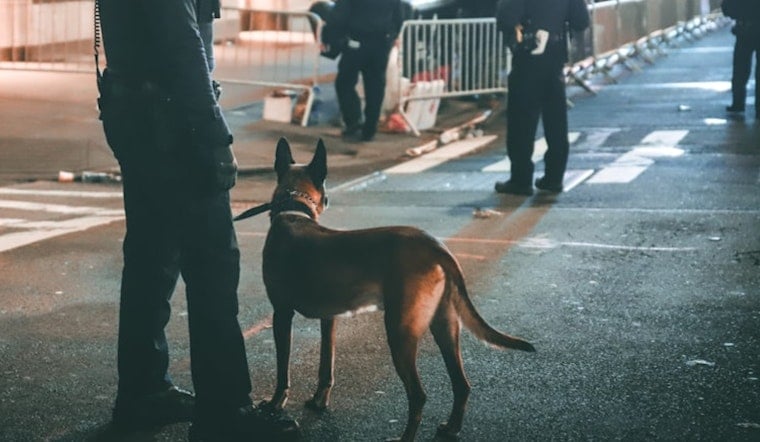
A golden retriever named Scooby has become an unlikely but crucial weapon in Greenville County's fight against child exploitation, trained to sniff out hidden cellphones, flash drives, and microSD cards that human investigators often miss. Scooby works electronic detection for the Greenville County Sheriff's Office, searching for the chemical signature of circuit boards rather than drugs or explosives, and this summer he logged his 100th evidence find.
Scooby is trained to detect triphenylphosphine oxide, or TPPO, a chemical coating applied to electronic components to prevent overheating, according to FOX Carolina News. That scent allows him to locate micro SD cards, flash drives, and hidden ghost cellphones that investigators executing search warrants might otherwise overlook. He works alongside handler Alicia Turner, an investigator with the sheriff's office's Internet Crimes Against Children division.
Scooby reached his milestone 100th find in July, according to the Greenville County Sheriff's Office, which noted he was donated to the department by the nonprofit Defenders for Children and sponsored by local manufacturer International Plastics. He succeeded a previous electronic detection dog named Queue in the role.
Why a Dog's Nose Beats a Human Search
The station's report describes how Turner said Scooby searches for the TPPO odor in exchange for a food reward, receiving a snack as reinforcement each time he successfully locates a device. Miniaturized storage media, such as microSD cards the size of a fingernail, can hold up to 300,000 files and are frequently hidden in obscure locations like light fixtures, power cords, or sealed containers, according to Gunner Kennels. That kind of concealment is exactly why scent-detection dogs have become vital tools; visual searches by human investigators routinely struggle to find hardware that small.
Data from the nonprofit Defenders for Children indicates electronic storage detection dogs uncover an average of two or more hidden electronic devices missed by human investigators during every search warrant execution, as reported by CTV News. The organization has placed 27 ESD dogs with law enforcement agencies nationwide, resulting in more than 3,200 hidden devices located. Gentle breeds like Labradors and golden retrievers are typically selected for this work because only about one in 50 candidate dogs qualifies, and their non-threatening demeanor lets them double as comfort dogs for victimized children during searches.
A Growing Caseload for Greenville's ICAC Unit
Per Turner, Greenville County's Internet Crimes Against Children division is one of the largest ICAC units in the Southeast, and it receives about 40 cyber tips a month. Those tips originate from tech platforms including Google and Facebook, which detect potential child exploitation material using automated hashing and AI algorithms. The National Center for Missing and Exploited Children then routes those flagged cyber tips to local law enforcement for follow-up.
The volume of such leads has surged nationally. The organization's CyberTipline received 21.3 million reports in 2025, with online enticement reports jumping 158% year-over-year following expanded federal reporting mandates, according to the National Center for Missing and Exploited Children. Separately, CyberTipline reports involving generative artificial intelligence used to create or manipulate child sexual abuse material rose to more than 1.5 million files in 2025, up from under 7,000 reports in early 2024, per the Department of Homeland Security.
A federal law change has also given investigators more runway to act on those tips. The REPORT Act, enacted in May 2024, extended the legal data retention requirement for electronic communication service providers from 90 days to one year, according to Thorn. Previously, 90-day retention windows often expired before local officers could locate suspects and secure search warrants, giving task forces like Greenville County's significantly more time to process leads.
State Support and a Warning to Parents
Greenville County's ICAC unit does not operate alone. The South Carolina Internet Crimes Against Children Task Force is centralized within the South Carolina Attorney General's Office, coordinating statewide investigations, digital forensics, and prosecutions with local affiliate agencies including the Greenville County Sheriff's Office, per the South Carolina Attorney General's Office.
Turner said the sheriff cares about children in Greenville County, and she offered parents several concrete precautions. She cautioned parents against giving young children unrestricted cellphone access and said smartphones should never be handed over without strict boundaries. Turner warned that children's apps with chat functions can expose kids to offenders and pedophiles, and she urged parents to watch for ghost apps disguised as calculators. She also recommended parents implement random passcode checks on children's devices and use National Center for Missing and Exploited Children resources for guidance on age-appropriate digital safety conversations.
The use of dogs to sniff out hidden storage devices dates back more than a decade. Electronic storage detection dogs were first developed in 2012 by the Connecticut State Police after a forensic chemist isolated TPPO as a detectable marker, adapting techniques from the state's 1986 arson-dog program, according to Taste of the Wild. One of the earliest high-profile demonstrations came in 2015, when a Labrador retriever named Bear found a hidden flash drive containing child sexual abuse material in the home of former Subway spokesman Jared Fogle, evidence prosecutors cited as essential to securing his conviction.
Greenville's program joins a small but growing number of similar efforts around the country, including an ESD K-9 named ASCII that Hoodline previously covered helping a Boulder sheriff's office and ICAC task force with digital evidence retrieval. For Greenville County, Scooby's 100 finds represent tangible proof that a dog's nose can still outperform a human eye when it comes to the smallest, best-hidden pieces of digital evidence.





