

























































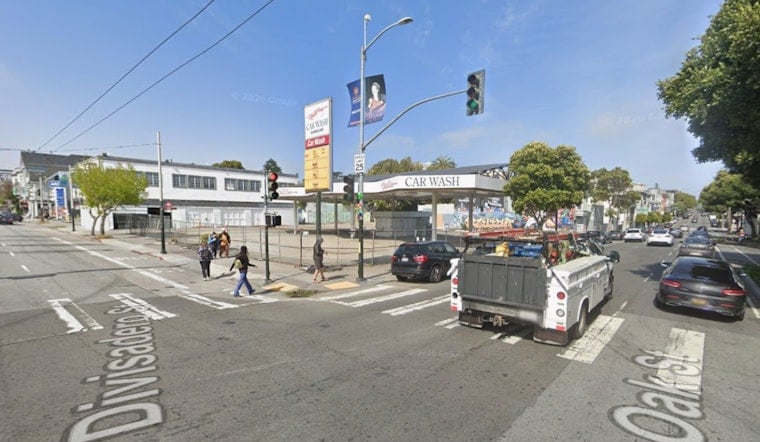
The long-vacant corner of Divisadero and Oak streets, once home to San Francisco's first automated car wash, is finally set to see bulldozers this fall. San Francisco Public Works has issued street and sidewalk closure permits for the site with an October 19 start date, signaling that ground-level work is imminent after years of false starts.
South Carolina-based Greystar, the largest multi-family housing developer in the country, has stepped in to take over development responsibility from 4Terra Investments and provide the institutional financing needed to push the long-delayed project across the finish line, according to SFist. As reported by San Francisco YIMBY, Greystar's new funding is expected to help expedite the remaining work on a project that has been delayed several times over the years. 4Terra had already completed much of the design and permitting phase before handing the reins to Greystar.
A Familiar Corner Finally Gets Its Redesign
The site itself spans 0.93 acres across five merged assessor lots at the northeast corner of Divisadero and Oak, per the San Francisco Planning Department, though San Francisco YIMBY describes the parcel along Divisadero between Oak and Fell as covering 0.79 acres. The lot sits two blocks from the Panhandle, which connects to Golden Gate Park, and runs along the Wiggle bicycle route, according to San Francisco YIMBY's report. For decades, it was known for Touchless Car Wash, which closed in 2019 after operating since 1958 under owners Roy and Patricia Shimek, as detailed by The Real Deal.
Plans call for full demolition of the current site to make way for an eight-story, 85-foot building designed by BDE Architecture, San Francisco YIMBY reports. The project will yield around 194,280 square feet, with 109,800 square feet allocated for housing, 1,850 square feet for retail, and 8,480 square feet for a 24-car garage. The design includes an articulated facade clad with stone veneer, stucco, and wood-look siding, along with bay windows, balconies, and blue accents, and a five-story annex surrounded by landscaping.
From 131 Base Units to 203 Homes
The unit count has shifted repeatedly throughout the project's history. San Francisco YIMBY notes the plan was most recently revised from 184 to 203 units, which will include 121 one-bedroom apartments and 82 two-bedroom apartments, along with four ground-floor units facing Divisadero Street. The ground floor is also slated to include a lobby, fitness center, lounge, parking, and retail space, while residents will have access to a podium-top central courtyard and rooftop terrace, plus parking for 24 cars and 144 bicycles.
That final unit count reflects a series of state and local interventions that reshaped what could be built on the parcel. Developers secured ministerial approval for the complex in late 2024 under California Assembly Bill 2011 and used the State Density Bonus Law to expand well beyond the parcel's base zoning limit of 131 units, according to San Francisco YIMBY's earlier reporting. Twenty of the units will be set aside as below-market-rate housing for households earning 55% of the Area Median Income, with estimated monthly rents around $1,400 for one-bedroom units and $1,545 for two-bedroom units, per The San Francisco Standard.
A Decade of Political and Financial Gridlock
The corner has been a flashpoint in San Francisco's housing debate for years. Texas-based Genesis Real Estate Group originally won approval for a 186-unit project on the site in 2019 after holding more than 1,000 community outreach meetings, but abandoned the development in 2022 as construction costs soared and the market weakened, SFist reports. Hoodline covered several of those early milestones, including a 2017 open house and a 2019 community meeting that preceded the project's initial approval.
After Genesis walked away, the nonprofit Tenderloin Neighborhood Development Corporation went into contract in late 2022 to purchase the site for 100% affordable housing, but that deal collapsed in early 2023 when city funding failed to materialize, according to The Real Deal. The stalled lot then became a central issue in the 2024 District 5 Supervisor race, with political group GrowSF funding a billboard over the property and candidate Bilal Mahmood campaigning on breaking the permitting gridlock, SFist notes.
New Rules Aimed at Speeding Up Stalled Projects
Mahmood later championed code-locking legislation known as the SHADE Act, which allows stalled projects like 400 Divisadero to build under the codes in place at the time of their original application rather than adjusting to code changes every three years. That change is estimated to save the project between 5% and 7% in construction costs, according to SFist's reporting. Combined with the state density bonus tools used to expand the unit count, the legislation removed several of the regulatory and financial hurdles that had stalled the project for years.
With Greystar's backing now in place and site closures scheduled to begin on October 19, the corner that has sat vacant since the car wash closed appears finally headed toward construction. San Francisco YIMBY first reported on the site's development plans back in January 2022, underscoring just how long the project has wound through design revisions, funding collapses, and changes in ownership before reaching this point.





