

























































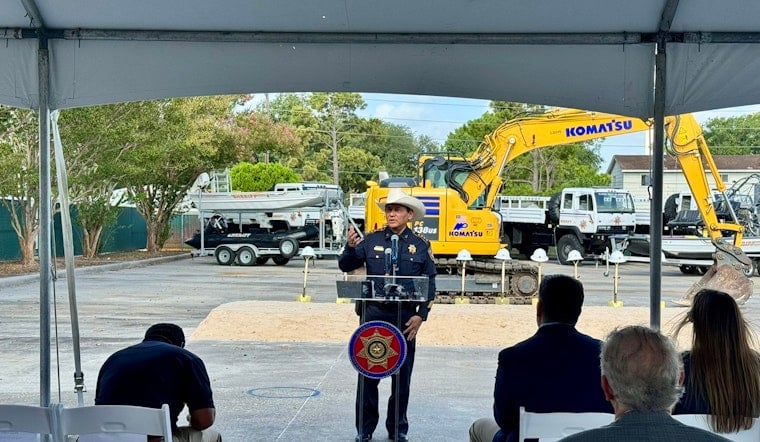
Harris County officials broke ground Friday on a dedicated swiftwater rescue training facility near TC Jester Boulevard, a project meant to end the county's longtime reliance on shipping deputies to Central Texas for flood rescue instruction. The site sits at 1731 Hugh Road in northern Harris County, and once complete it is expected to train up to 1,600 emergency personnel a year, according to Community Impact.
The groundbreaking was announced in a livestreamed post from HCSOTexas, which described the effort as involving the Harris County Sheriff's Office, the Harris County Engineering Department and other partners, and called it the first facility of its kind in the region. The Harris County Sheriff's Office is the largest sheriff's office in Texas, based in Houston, and is currently led by Sheriff Ed Gonzalez, per the same post.
The project traces back to funding approved in April 2023, when the Harris County Commissioners Court unanimously authorized $7 million to design and build the facility, according to Community Impact. That money came out of the broader $100 million public safety bond that Harris County voters approved in November 2022.
What the Hugh Road Facility Will Include
The finished complex is designed to span 9,500 square feet, with 7,200 square feet dedicated to swiftwater training and another 2,500 square feet set aside for classrooms, equipment storage and locker rooms, the outlet reports. That dedicated training space represents a dramatic scale-up from what the county could offer before: Harris County previously sent only about 100 first responders per year to Central Texas for swiftwater instruction, since no comparable local option existed.
When commissioners first approved the project in 2023, county officials noted it would become only the second purpose-built swiftwater rescue training center of its kind in the country, with the other located in Georgetown, Texas, per Community Impact's reporting. County officials at the time said they hoped to eventually host agencies from across the nation once construction wrapped.
Years of Stalled Local Alternatives
Harris County's push for local training infrastructure follows years of setbacks elsewhere in the region. A separate $30 million disaster training facility proposed by Houston Community College at its Northeast campus stalled after construction costs escalated, according to the Houston Landing. That left local fire and law enforcement agencies dependent on distant facilities or improvising with local reservoirs like Lake Houston for water practice.
Neighboring Fort Bend County has pursued its own answer to the same problem. Emergency service leaders there broke ground on STORM Ranch, a separate $104 million, 27-acre flood rescue training complex in Mission Bend that will feature flooded urban simulation environments, as reported by Click2Houston. The project is operated by Harris Fort Bend ESD 100, and its emergence alongside the Hugh Road facility points to a broader regional movement to turn Greater Houston into a hub for flood response training.
Why Local Officials Say the Need Is Urgent
The case for local training capacity is grounded in Harris County's flood history. During Hurricane Harvey in 2017, emergency personnel conducted more than 17,000 high-water rescues across the county as catastrophic flooding displaced over 30,000 residents, according to a report submitted to GovInfo. Harvey remains the wettest tropical cyclone on record in the United States.
Two years later, during Tropical Storm Imelda in September 2019, the Harris County Sheriff's Office fielded nearly 1,000 weather-related calls for service and carried out 407 high-water rescues, per FloodList. Imelda dumped more than 40 inches of rain in parts of the region during that event.
These emergencies are not confined to major named storms. Harris County deputies performed multiple high-water rescues during localized thunderstorms in Mission Bend last August, after heavy rainfall stranded occupied vehicles, the Houston Chronicle reported. Local officials have noted that as little as 12 inches of moving water is enough to sweep a car off the road, underscoring why swiftwater response remains a year-round hazard rather than a once-in-a-generation concern.





