

























































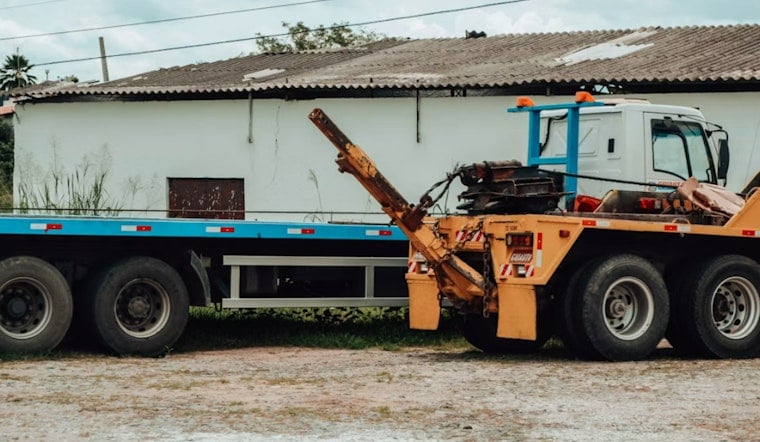
A Hawaii tow company charged $33,000 to remove a pickup truck that hit a guardrail and flipped over, one of several eye-popping examples state lawmakers reviewed this week as they consider tightening the rules governing the towing industry. The figure emerged during a towing-industry briefing at the state Capitol, where officials described a pattern of fees that regularly outpace what state law allows.
House Transportation Committee chair Darius Kila and House Committee on Consumer Protection and Commerce chair Scot Matayoshi held the briefing, according to Honolulu Star-Advertiser reporter Andrew Gomes. Kila described towing-industry abuse as plaguing Hawaii communities, and he said he hoped the session would set the stage for legislative action when lawmakers reconvene in January 2027. Matayoshi separately urged the state Office of Consumer Protection to explore pursuing tow companies in small-claims court, a venue that would cover disputes involving up to $5,000.
Complaints Keep Piling Up at Consumer Protection
The Office of Consumer Protection has fielded a steady stream of towing complaints in recent years, ranking towing among the top four complaint subjects it received in each of the past three fiscal years, according to the office's executive director, Mana Moriarty. The office received 64 towing complaints in fiscal year 2024, when towing ranked second behind 96 data-security and privacy complaints. That number climbed to 108 in fiscal year 2025, when towing ranked first, ahead of 91 vehicle-rental complaints, before dropping to 90 in fiscal year 2026, when it ranked fourth behind refunds, vehicle rentals, and travel or vacation businesses.
Towing-industry complaints made up between 43% and 60% of the complaints the office pursued across fiscal years 2024 through 2026, per the same briefing, and the office pursued 256 recent towing complaints in total. Yet the office recovered only $7,901 through refunds or disgorgement across 18 of those cases. Many cases were closed without a finding of a violation, and the office has pursued contested enforcement actions in state court because it lacks administrative hearing authority of its own.
Fees That Blow Past State Caps
Complaints reviewed by lawmakers involved companies including VIP, PM Autoworks, All Island Towing, and All Island Wreckers. Field investigator Michael Nuss described tow companies charging fees for extra equipment, fees to open a tow-yard gate, and fees for difficult hookups that investigators found were not actually difficult. Some companies charged waiting fees of up to $900 per 15 minutes, added $300 charges for hazardous-materials cleanup, and billed as much as $500 per day for vehicle storage.
Those figures dwarf the statutory caps under Hawaii Revised Statutes § 290-11, which limits standard non-consensual towing charges to $75 (or $85 with a dolly) plus $7.50 per mile, and caps storage fees at $25 per day for the first week and $20 per day after that, according to First Insurance Company of Hawaii. Scot Matayoshi said some towing companies simply were not following state laws. County towing contracts have also conflicted with state law, adding another layer of confusion for vehicle owners trying to figure out what they legally owe.
A Law Meant to Curb Cash Demands
Lawmakers already tried to address one slice of the problem in 2024 with Act 60, which amended HRS § 290-11 to require that owners of unattended vehicles towed from public or private property be allowed to pay by credit card, debit card, or cash, and which prohibited tow operators from directing vehicle owners to use an on-site ATM instead of accepting card payments. The law also limited the surcharge for overturned vehicles to $35. Investigators told lawmakers that tow companies did not add the state general excise tax on top of towing charges and did not require vehicle owners to pay cash, though the broader pattern of unregulated add-on fees has persisted regardless.
If lawmakers act again in the session beginning in January 2027, it would mark at least the third action in three years addressing towing-industry complaints, following Act 60 and a House-Senate resolution that directed the state Department of Land and Natural Resources to improve parking-management practices at state small boat harbors.
Harbor Towing and a Push for PUC Oversight
Harbor parking has become its own flashpoint. Harbor parking signage was criticized as deficient, and harbor parking practices were criticized for prioritizing towing over ticketing at facilities managed by the state. At Oahu's Ala Wai Small Boat Harbor, Hawaii's largest boat harbor with 900 parking spaces, more than 2,500 vehicles were towed in 2024 alone amid community complaints about confusing signage and automated plate-scanning enforcement, according to Civil Beat. State rules allow contracted vendors to immediately remove vehicles from harbor stalls once posted time limits are exceeded, without issuing a citation first.
Kila and Matayoshi both said they are interested in having the Hawaii Public Utilities Commission take over regulation of the towing industry, giving the agency licensing and license-revocation authority it does not currently hold over tow operators. The PUC already regulates tour-bus and limousine operators under Hawaii Revised Statutes Chapter 271, enforcing safety rules, collecting fees, and issuing or revoking operating certificates. PUC chair Jon Itomura said he is open to the commission taking on towing oversight, noting the agency can pursue fines for violations through administrative hearings and can revoke licenses to operate — tools the Office of Consumer Protection currently lacks.
A National Pattern of Bill-Inflation
Hawaii's predatory-towing problem echoes a national trend. A 2026 report from the National Insurance Crime Bureau found that predatory towing operators nationwide inflate crash-scene bills to as much as $10,000 or $16,000 per tow by tacking on vague administrative, gate, transfer, and hazmat cleanup fees, with special agent Scott Slagle among those tracking the issue in Hawaii. States including Florida, Colorado, Mississippi, and Virginia have enacted towing reform laws between 2024 and 2026 that mandate written price estimates, fee caps, and permit-revocation authority for operators who don't comply.
The stakes extend beyond individual drivers stuck with shocking bills. In testimony to state lawmakers in January 2025, the Hawaii Insurers Council warned that excessive, unchecked towing charges paid out by insurance carriers directly drive up motor vehicle insurance premiums across the state, since insurers ultimately pass those costs on to policyholders. Standard local towing rates in Hawaii average between $125 and $250 for jobs up to 10 miles, making bills in the thousands or tens of thousands of dollars far outside the norm.



