

























































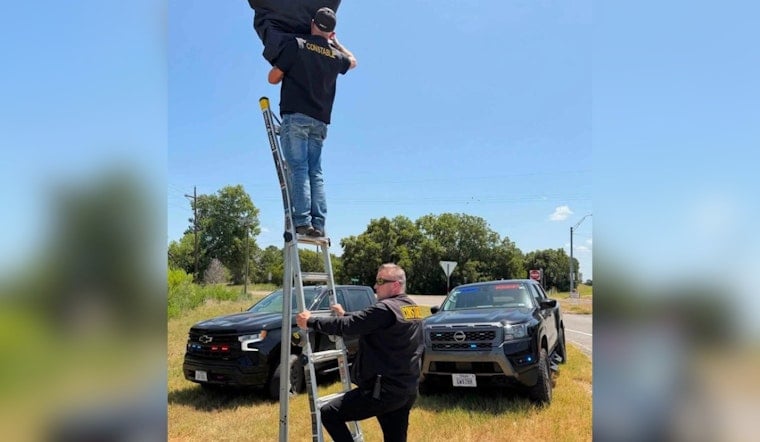
Hood County Precinct 2 Constable John Shirley spent last Saturday and Sunday physically covering and unplugging the county's Flock Safety license plate cameras, carrying out an order from county commissioners after months of citizen complaints about warrantless tracking. Shirley made clear the move was as much a statement as a shutdown, declaring that permanent, warrantless surveillance does not belong in a free society.
The physical teardown capped a decision that began April 14, when the Hood County Commissioners Court voted 4-0 to cancel its contract with Flock Safety and demand a $126,000 refund from the company, according to Hood County News. Shirley's on-the-ground action, first detailed by CBS News Texas, turned that months-old vote into a visible, physical end to the county-run camera network. FOX 4 News Dallas-Fort Worth also confirmed that Hood County has now shut down its county-controlled Flock cameras.
A Jurisdictional Patchwork Remains
The county's cancellation only reaches cameras owned and operated by Hood County government. The same Hood County News report notes that the City of Granbury, the county seat, still runs about 26 of its own Flock Safety cameras independently along major corridors like U.S. 377, under a separate municipal contract. That means drivers passing through Granbury remain just as monitored as before, even as the surrounding county goes dark.
The split outcome reflects friction that had been building for more than a year. Hood County News reported in September 2025 that commissioners were already fighting with the vendor over a $132,000 contract dispute, after discovering that 24 grant-funded Flock cameras had been paid for but only one had actually been installed, due to delays in permitting from the Texas Department of Transportation.
Emergency Communications Director Pushed Back
Not everyone in Hood County law enforcement wanted the cameras gone. Emergency Communications Director Shawn McGuire testified to commissioners in April that his own monthly audits, which he said took two to three hours each month to conduct, had found zero cases of search abuse within the county's system. Per Hood County News, McGuire pointed to one case in which Flock data helped track a suspect and prevent a child assault on Interstate 20 as evidence of the platform's public safety value.
That local defense stood in contrast to what was happening at the national level. Flock Safety CEO Garrett Langley publicly apologized last Thursday for cases of system misuse across the country and announced corporate reforms, including cutting default data retention from 30 days down to seven and requiring mandatory case-number logging for every search, according to CBS Texas. The overhaul followed an investigation that documented 46 cases nationwide in which police officers were accused of using Flock cameras to stalk women or monitor personal targets.
Part Of A Statewide Retreat
Hood County is not acting alone. An August report from The Texas Tribune estimated that more than 10,000 Flock cameras operate across Texas, with data shared among roughly 200 local agencies. That same reporting noted that neighboring Burnet County removed its fixed Flock cameras in early August after public backlash and physical vandalism, following vandals cutting camera power lines there, as per Hoodline.
Legislative pressure is building on two fronts. U.S. Representative Keith Self, a Texas Republican, introduced federal legislation in July requiring federal agencies to obtain a judicial warrant before accessing automated license plate reader databases, the Tribune reported. At the state level, HB 961, introduced during the 89th legislative session, would require Texas law enforcement agencies to obtain a warrant or court order before using automatic license plate readers and would restrict data use strictly to violent crime investigations, according to BillTrack50.
What Misuse Could Mean Legally
Texas law already carries specific penalties for officers who go beyond authorized use of surveillance systems like Flock. Under Texas Penal Code § 33.02, knowingly accessing a computer network or law enforcement surveillance system without authorization constitutes Breach of Computer Security, a charge that ranges from a Class B misdemeanor up to a felony, with penalties enhanced for public servants. Hoodline has previously reported on Harris County deputies losing camera access amid a similar misuse review tied to that same statute.
Hood County's move adds to a growing list of Texas communities rethinking automated surveillance, joining Burnet County's camera removal and mirroring pushback seen elsewhere, including Salida police walking away from Flock contracts over data-sharing fears and Sumpter Township pulling the plug amid its own budget pressures. For now, Hood County's decision leaves a clear line on the map: county roads without cameras, and Granbury's 26 units still watching U.S. 377.



