

























































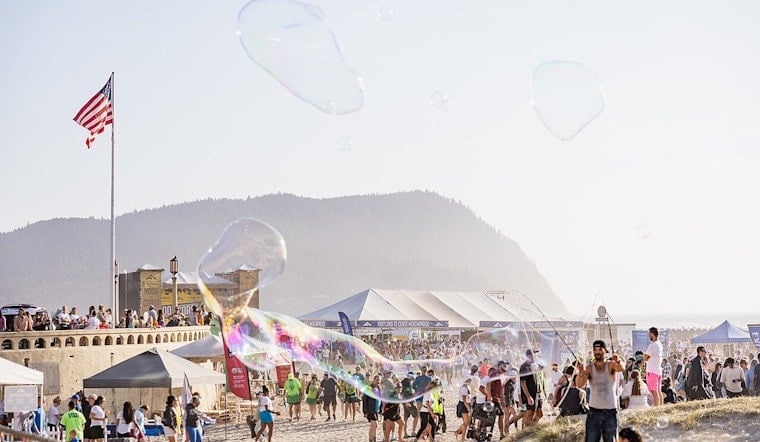
Runners lined up in the dark outside Timberline Lodge early Friday morning, kicking off the 44th running of Hood to Coast, the 199-mile relay that sends thousands of racers from the slopes of Mount Hood down to the beach in Seaside. The event, nicknamed the Mother of All Relays, has sold out for the 37th consecutive year, drawing teams from all 50 U.S. states and 40 countries around the world.
Each team fields 12 members who split the course into three legs apiece, handing off through exchange points as they wind toward the coast, according to KATU. Runners are expected to reach Seaside on Saturday, where the city will host a large party for finishers capping off the weekend. The relay format traces back to a much smaller gathering: the first Hood to Coast ran on August 7, 1982, when Oregon Road Runners Club president Bob Foote organized 80 runners across eight 10-person teams for a 165-mile race from Mount Hood to Pacific City, according to the Oregon Encyclopedia.
How the Route Grew to Nearly 200 Miles
The race did not always end in Seaside. In 1989, organizers permanently moved the finish line there from Pacific City after the smaller town could no longer handle the crowds, a shift that stretched the course to its current 199 miles and expanded team rosters from 10 to 12 runners, per the same encyclopedia entry. The move also gave organizers larger parking areas and safer transition zones spread across Clatsop County.
A year later, in 1990, organizers introduced a companion event, the Portland to Coast Walk relay, after walking teams from Nike and other local groups asked for a course option that did not require running. That walking relay now starts at Portland's Tilikum Crossing and follows a similar path to the Seaside finish, per Hood to Coast's own history page. Portland to Coast caps its field at 400 teams and shares the same beachside finish as its running counterpart.
A Lottery for 20,000 Spots Draws 60,000 Hopefuls
Demand for entry has grown so intense that organizers now run a single-day lottery 11 months before race day, with roughly 60,000 applicants competing for about 20,000 available spots spread across 1,000 to 1,200 teams, according to Courthouse News. Applicants who miss out one year reportedly receive preferential status in future lotteries. The event's operator, Foote Sports Productions, has since built Hood to Coast into an international brand, licensing official franchise relays in China, Taiwan, and the Netherlands, the outlet reports.
At the elite end of the field, the fastest team in race history remains Nike's Mambu Baddu squad, which ran the full 199-mile course in 15 hours, 44 minutes, and 55 seconds back in 1995, an average pace of 4:51 per mile, according to Tempo Journal. International teams, including Japan's Toyo University, have reportedly tried and failed to break that mark.
Safety Rules for a 34-Hour Race on Open Highways
Because the relay unfolds on open public highways over 28 to 34 continuous hours, race regulations require every 12-person team to run two support vans and mandate that runners wear reflective vests, headlamps, and flashing LED lights during night legs, per the same Tempo Journal report. Supporting that operation takes a coordinated force of roughly 2,500 to 3,500 volunteers stationed at 36 exchange points, first aid stations, and traffic crossings spanning four Oregon counties, the Oregon Encyclopedia notes. State and county law enforcement enforce standard traffic rules at the open highway exchanges, while emergency responders in Columbia and Clatsop counties staff extra shifts for the weekend.
Fundraising and Friction in Seaside
The relay carries a significant charitable footprint each year, raising about $1.6 million annually for various causes, per KATU. This year, race organizers and Providence Health & Services announced that fundraising teams brought in more than $1 million for the Providence Cancer Institute during the 2026 event alone, a single-year record that pushed total giving to the institute past $10.5 million since it became the relay's primary charity partner in 2013, according to the Seaside Signal.
Not everyone in Seaside welcomes race weekend without reservation. Local merchants have historically reported dips in traditional tourist shopping when race traffic floods the coastal town, prompting the Seaside Chamber of Commerce to distribute $25,000 to $30,000 in $5 wooden Coast Coins each August so participants spend money at downtown shops and restaurants, the Seaside Signal reports. Participating businesses redeem the tokens directly with the Chamber for full cash value, a workaround meant to keep race-weekend dollars flowing into local storefronts even as regular tourists steer clear of the congestion.





