

























































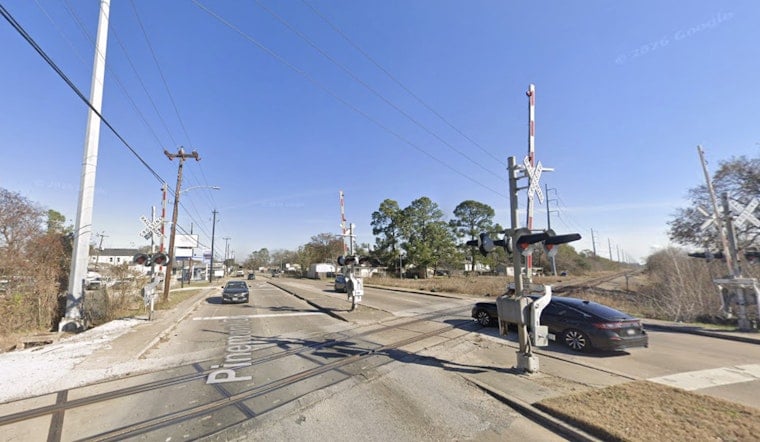
A Houston man spent nearly two hours manually holding up a 40-pound railroad crossing arm on Pinemont Drive so trapped drivers could get through, after the gates froze down for hours with no train anywhere in sight. Ben Smith, who stands 6 feet 4 inches tall, posted video of the ordeal on TikTok, and it has since racked up more than 2.2 million views.
The malfunction happened at DOT crossing #597082J, a crossing on Pinemont Drive near Antoine Drive in northwest Houston, according to FOX 26 Houston. The outlet reports the crossing malfunctions at least twice a month for hours at a time without a train present, and the resulting backup snarled traffic along Pinemont Drive for the length of Smith's stand at the gate. Drivers who benefited from his effort ended up tipping him a combined $86, the station reports.
Daniel Rodriguez, who owns D.O.D. One Stop Tire Shop next to the tracks on Pinemont Drive, told the station that people holding up crossing arms could be injured if a train were to come. Smith has said he plans to come back and help again if the Pinemont gates freeze down once more, per the same report.
Why No One Can Ticket the Railroad
The frustrating part for drivers and business owners alike is that nobody, at any level of government, can currently penalize a railroad simply for a crossing that stays blocked for hours. Local municipalities and state governments cannot enforce time limits on railroad blockages because federal law preempts their authority, since the Interstate Commerce Commission Termination Act and the Federal Railroad Safety Act place railroads under federal jurisdiction.
Texas once had a statute allowing fines for trains blocking crossings for more than 10 minutes, but the Texas Attorney General confirmed in 2004 that the law was preempted and unenforceable — a position later reinforced by the U.S. Court of Appeals for the Fifth Circuit's Friberg ruling, according to FindLaw. A 2005 Texas Attorney General opinion further confirmed that Texas Transportation Code § 471.007's criminal penalties on railroads were unenforceable under federal preemption, per the Office of the Attorney General of Texas.
BNSF Railway, which is not identified in FOX 26's reporting as the operator at Pinemont, has separately warned drivers against interfering with railroad crossing equipment and explained that crossing systems default to a fail-safe condition with gates down whenever equipment issues, environmental glitches, or maintenance testing occur. The railroad says it invests $145 million annually in grade-crossing safety programs nationwide.
A National Hotspot for Complaints
The Federal Railroad Administration has identified Houston's East End as a national hotspot for blocked-train complaints, FOX 26 reports, and the problem stretches well beyond Pinemont Drive. Houston has more than 700 railroad grade crossings citywide, with a heavy concentration in industrial eastside neighborhoods including the East End, Fifth Ward, and Denver Harbor, according to the Houston Chronicle.
Just weeks before the Pinemont incident, an East End crossing signal on Milby Street malfunctioned continuously for over six hours with lowered arms and active alarms and no train present, forcing drivers there to manually raise the gates too, as Hoodline reported in a story on East End gate failures. Federal Railroad Administration data shows the public submitted more than 30,000 blocked crossing reports nationwide in 2022, yet federal regulators remain legally restricted from issuing civil penalties to rail carriers solely for blockages, per Transport Topics.
Nationally, the stakes go beyond traffic delays. Emergency response vehicles in the Houston area were forced to detour around blocked train tracks more than 3,200 times between 2019 and 2023, a local fire chief reported during 2023 congressional inquiries, according to ProPublica.
A Bill Stuck in Committee, Grants Moving Slowly
FOX 26 reports it contacted U.S. Rep. Sylvia Garcia's office about federal oversight of the Pinemont crossing. Garcia introduced the Don't Block Our Communities Act, known as H.R. 1347, which would give the Federal Railroad Administration authority to issue civil fines to repeat violators, but the bill has stalled in committee. Garcia reintroduced the measure in December 2025, proposing a 10-minute federal cap on blocked crossings, according to a release from the Office of Representative Sylvia Garcia.
With enforcement off the table, Houston relies on federal infrastructure grants to physically eliminate dangerous crossings rather than police them. The city received a $37 million FRA Railroad Crossing Elimination Grant Program award for its West Belt Improvement Project, which will build four underpasses and eliminate seven at-grade crossings, but FOX 26 notes the project will take years to complete. That grant echoes state-level efforts too: Texas allocated $40 million in March to eliminate four crossings at Houston's Griggs-Long-Mykawa intersection, a project Hoodline covered in earlier reporting on the state funding, which also noted the December 2024 death of 15-year-old Milby High School student Sergio Rodriguez, who was struck and killed by a Union Pacific train near his campus.
Tracking Blockages in Real Time
In the meantime, the City of Houston has launched a Train Watch Dashboard that lets drivers view crossing statuses in real time and identify alternate routes around blocked crossings. The dashboard also provides links to report blocked crossings directly to the Federal Railroad Administration or through Houston's 311 system, giving frustrated commuters at least a way to document the problem even if no one can fine the railroad for causing it.





