

























































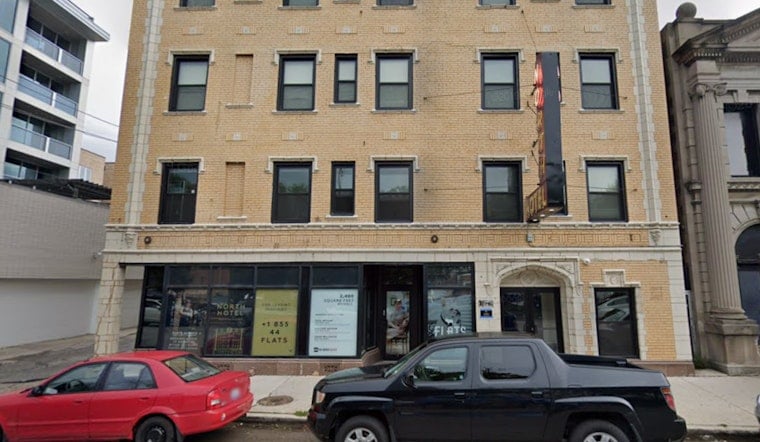
Construction officially began this week on a Humboldt Park youth shelter that will eventually offer 40 private rooms with their own bathrooms and mini kitchens, converting a former single-room occupancy hotel into what organizers hope becomes a model for the rest of Chicago. Twelve young adults are already living on the building's completed first floor at 1622 N. California Ave., and the rest of the construction is slated to begin later this month, with the full project wrapping by mid-2027.
Mayor Brandon Johnson joined 26th Ward Alderperson Jessie Fuentes, Department of Housing Commissioner Lissette Castañeda, Department of Family and Support Services Commissioner Angela Green, and leaders from La Casa Norte for an official groundbreaking ceremony Wednesday, according to the City of Chicago. As Block Club Chicago reports, Johnson addressed shelter residents directly during the ceremony, saying young people there deserve safety, future planning, stability and opportunity.
The nonprofit La Casa Norte owns and manages the site, which will serve youth experiencing homelessness between the ages of 18 and 24 using a non-congregate model that gives every occupant a private room rather than a shared dormitory. The building at 1622 N. California Ave. was previously a single-room occupancy hotel for low-income individuals before undergoing a full gut rehabilitation in 2015 that turned it into a 39-unit market-rate studio apartment building with two ground-floor storefronts, according to Interra Realty.
A Resident's Path From Crisis to a Locked Door of Her Own
Among the first residents is Rosalind Wharry, a 22-year-old originally from Chicago's South Side who is now attending college while living on the shelter's finished first floor. Wharry told Block Club Chicago that family issues led her into homelessness and that La Casa Norte provided shelter until she could secure housing of her own. She said having a private room made her feel safe and comfortable, a description that speaks directly to the case made by researchers who study non-congregate shelter design.
Multi-agency evaluation reports presented to housing authorities have found that non-congregate shelters lead to higher client retention, more transitions to permanent housing, reduced interpersonal conflict, and fewer emergency calls compared with traditional congregate shelters, according to the Illinois Housing Development Authority. Three young people have already transitioned from the North Hotel into stable housing, per the same Block Club Chicago report.
Funding Stitched Together From City, State and Federal Sources
The roughly $6 million project is being funded through a mix of city and private funds, per Block Club Chicago's reporting. The City of Chicago contributed $4.09 million through the Chicago Neighborhood Recovery Program, the Illinois Department of Commerce and Economic Opportunity provided $2 million, and the U.S. Department of Housing and Urban Development added $500,000. La Casa Norte officials say the project was proposed in early 2024 and received city approval that summer, with the state funding secured through the federal Community Development Block Grant-Coronavirus Urban Shelter Construction Program.
City assistance also helped La Casa Norte purchase the North Hotel building outright. The project fits into a much larger citywide push: in July 2025, Chicago allocated $40 million in capital grants — split between $20 million in HOME-ARP federal funds and $20 million in local bond funding — to modernize seven shelters and add more than 350 non-congregate beds across the city, according to the City of Chicago's shelter infrastructure initiative.
What the Finished Building Will Look Like
Once complete, the North Hotel shelter will include 40 rooms for youth ages 18 to 24, each with its own bathroom and mini kitchen area, plus free communal laundry on every floor. The ground floor will house a communal kitchen and community space along with two ADA-accessible rooms and a drop-in center offering case management, housing resources, therapy, career support and job help, according to Block Club Chicago's reporting on the completed first-floor conversion.
The scale of need behind the project is significant. More than 15,000 young people are experiencing homelessness in Chicago, and Chicago Public Schools data from the 2022-2023 school year documented 576 homeless students within the 26th Ward alone, including 20 unaccompanied homeless youth, according to a report from La Casa Norte.
An Organization Built on Personal Experience
La Casa Norte was founded in 2002 as a two-person operation in a West Side storefront to serve homeless youth and families; it has since grown into an organization with 91 employees that assists roughly 22,000 Chicagoans annually. CEO José M. Muñoz, who took leadership of the nonprofit in February 2020, personally experienced housing insecurity and doubled-up homelessness while growing up on Chicago's South Side, according to City Bureau.
The North Hotel builds on La Casa Norte's earlier Humboldt Park developments, including the 16-bed Solid Ground supportive housing site for young men and the $18.5 million Pierce House mixed-use supportive housing facility that opened in 2018. The nonprofit says it hopes to eventually bring this non-congregate youth shelter model to communities across Chicago.
The project also sits within a decade-old city policy fight over preserving low-cost housing stock. Chicago's Single-Room Occupancy Preservation Ordinance, enacted by the City Council in December 2014, requires SRO building owners to give 180 days' notice and negotiate with affordable housing buyers before converting or selling low-cost properties — a rule adopted after thousands of SRO units were lost to market-rate redevelopment, per the Chicago Department of Housing. For residents like Wharry, the shelter is meant to be a bridge rather than an endpoint, helping young people move from crisis to stability as the rest of the building's rooms come online over the next year.





