

























































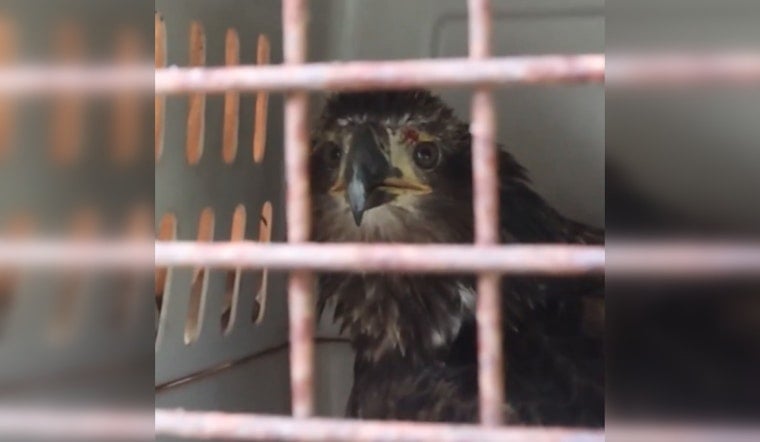
A young bald eagle with a badly injured wing got a second chance at life this year after a Manatee County animal welfare officer answered a call, kicking off a monthslong rescue effort that ended with the bird soaring back into the wild. The eagle's recovery leaned on a rare partnership between county field responders and the region's only dedicated wildlife rehabilitation center.
Manatee County Animal Welfare Officer Jay Dixon responded to the initial call and later returned to Wildlife, Inc. Education & Rehabilitation Center to help release the eagle, according to a post from Manatee County Government. After Dixon's initial response, the young eagle was transferred to the Bradenton Beach center, where Dr. Scott Rose and the rehabilitation team guided the bird through recovery and repaired its injured wing. Dixon and Animal Welfare Officer Supervisor Steve Bell later released the rehabilitated eagle back into the wild, completing a full-circle effort between the county's field responders and the nonprofit's medical staff.
From rescue to release. 🦅
— Manatee County Government (@ManateeGov) August 28, 2026
Earlier this year, Manatee County Animal Welfare Officer Jay Dixon responded to a call involving a young bald eagle with a badly injured wing.
The eagle was transferred to Wildlife,Inc. Education & Rehabilitation Center where Dr. Scott Rose and the… pic.twitter.com/j95xtzWBjG
A County-Wide Safety Net for Injured Wildlife
Manatee County Animal Welfare officers work to protect animals throughout the county and coordinate specialized medical care and rehabilitation for wildlife that field officers alone cannot treat. That division has been building out its public presence lately: the county announced in June that it is opening a new Animal Welfare Resource Center to supplement its existing shelters in Palmetto, Cat Town, and the Bishop Animal Shelter, according to Manatee County Government. The county also launched a behind-the-scenes video series called P.A.W.S. in April, which has documented Officer Dixon's field work, including his rescue of two bald eagles with wing injuries within a single week.
Once an injured raptor reaches Wildlife, Inc., the facility becomes the only option in the area equipped to handle it. The center is the sole wildlife rehabilitation facility in Manatee County for birds, mammals, and reptiles, serving more than 422,000 residents across 893 square miles and fielding over 4,000 calls a year, according to The Giving Partner. It operates as a nonprofit relying on volunteers and private donations, providing the kind of specialized veterinary surgery and flight recovery care that county shelters aren't set up to deliver.
Rebuilding After Hurricane Helene's Storm Surge
This rescue also lands against the backdrop of the center's own recovery. Hurricane Helene sent three feet of storm surge into Wildlife, Inc.'s Bradenton Beach headquarters in September 2024, destroying medical supplies, food freezers, and vehicles, according to the Anna Maria Islander. Volunteers managed to evacuate the animals before the surge hit, but the organization still faced a yearlong rebuild of its enclosures before it could return to full operation in time to treat raptors like this eagle.
Rehabilitating a bird of prey is not cheap. Birds of prey rank among the most expensive wildlife species to rehabilitate, with Wildlife, Inc. spending roughly $1,500 every two weeks just on frozen rodent orders needed for raptor nutrition, per Sarasota Magazine. That cost sits on top of the specialized veterinary care and trained volunteer labor required for wing surgery and flight conditioning.
Why Florida's Eagles Draw So Much Attention
Florida is an outsized player in the bald eagle's story nationally. The state supports the largest breeding population of bald eagles in the country outside of Alaska, with more than 1,500 active nesting territories documented statewide, according to the Florida Fish and Wildlife Conservation Commission. The state's official eagle nesting season runs each year from October 1 through May 15, and juvenile eagles like this one keep their brown-and-white mottled plumage for four to five years, often wandering hundreds of miles before growing the white head and tail feathers that mark full maturity.
That population density comes with strict legal guardrails. Under the federal Bald and Golden Eagle Protection Act of 1940, taking, capturing, or disturbing a bald eagle without a federal permit is illegal, carrying penalties of up to a $100,000 fine and a year in prison for a first offense, per the U.S. Fish and Wildlife Service. Florida aligned its own rules with those federal standards back in June 2017, when the state updated Rule 68A-16.002 while eliminating redundant state permit requirements, according to the Florida Fish and Wildlife Conservation Commission.
Wing injuries aren't the only threat facing Florida's eagles. Lead poisoning from ingested fishing sinkers or ammunition fragments remains a leading cause of death among the state's raptors, with rehabilitators noting that just two tiny lead fragments can prove fatal within 24 hours, according to the American Eagle Foundation. Hoodline previously reported on a Weeki Wachee eagle's 49-day recovery earlier this year, underscoring how often Florida's raptor rehabilitators are called into action. For this Manatee County eagle, though, the outcome was the one every wildlife officer and volunteer hopes for: a return to the sky.





