

























































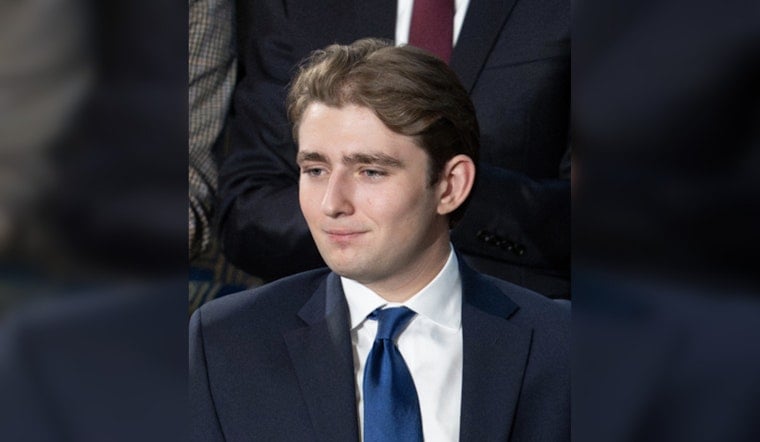
Iranian state television's Channel 3 aired a three-minute segment this week titled “Where to kill Barron Trump?” using computer-generated graphics to depict the 20-year-old's New York University dorm surroundings, his escort vehicles, and nearby Secret Service security posts, alongside a purported $10 million bounty on his life.
The broadcast, reported by India Today, mapped security routines around the president's son with dramatized graphics rather than confirmed surveillance. Barron Trump attends NYU, and the video specifically showed images of dorms on campus, according to reporting cited by KFOX. The $10 million bounty figure was attributed to the New York Post in that same report.
The U.S. Secret Service confirmed it is aware of and actively investigating the video, emphasizing that law enforcement examines all potential threats against its protectees, per The Week. That protective intelligence review is ongoing, and no additional detail on its scope has been made public.
Part of a Months-Long Propaganda Campaign
The threat against Barron Trump follows a July video released by the IRGC-affiliated Tasnim News Agency titled “Where to Kill Melania?!”, which detailed First Lady Melania Trump's routines near Manhattan luxury retailers, as noted by The Economic Times. That earlier segment ended with a direct warning: “This is just the beginning. Barron Trump, wait for us.”
Physical messaging inside Iran has echoed the digital threats. In July, billboards appeared across Tehran, including at Palestine Square, displaying images of President Trump, Melania Trump, and their children Ivanka and Barron with the word “KILLED” superimposed over their faces above coffins draped in American flags, according to the Irish Star.
A Documented History of Plots on U.S. Soil
Iranian retaliation is regarded within the Islamic Republic as a matter of certainty, and U.S. prosecutors have previously secured convictions tied to real assassination attempts. In March, a federal jury in Brooklyn convicted Pakistani national Asif Merchant, a trained IRGC operative, on terrorism and murder-for-hire charges after he attempted to recruit undercover FBI agents to assassinate American political figures, including Donald Trump, according to the Department of Justice.
That case builds on a pattern. Federal prosecutors previously charged IRGC operative Shahram Poursafi in 2022 over an alleged $300,000 murder-for-hire plot targeting former National Security Advisor John Bolton in retaliation for the 2020 drone strike that killed Quds Force commander Qasem Soleimani, per The National Herald. Domestic threats have also surfaced closer to home: in April, a Chicago man named Michael Kovco was charged in federal court with transmitting interstate threats after sending messages to the White House website threatening to murder Barron Trump and shoot investigating Secret Service agents, CBS News reported.
Treasury's 'Economic D-Day' Meets Iranian Pushback
The broadcast landed the same week U.S. Treasury Secretary Scott Bessent detailed what he called an “economic D-Day” in an op-ed, targeting secondary foreign entities that purchase or transport Iranian crude oil in an effort to achieve total financial isolation of the regime. Bessent described the plan as the single greatest financial offensive ever marshaled against an adversary and said the United States is entering the endgame against Iran, according to the Financial Times.
Global energy transport through the Strait of Hormuz has dropped from a pre-war average of 20 million barrels per day to between 4 million and 6 million barrels per day amid the six-month-old conflict, the outlet reported, underscoring the scale of disruption to Persian Gulf shipping that has accompanied the fighting.
Iranian Deputy Foreign Minister Kazem Gharibabadi publicly dismissed the announcement, arguing on social media that launching what he characterized as the largest financial invasion in history contradicted U.S. claims of having already destroyed 100% of Iran's military factories and nuclear capabilities, as reported by The Washington Post. Trump has said he buried Iran's nuclear program and destroyed nearly 100 percent of the country's military factories, while also increasing pressure on the regime; the Islamic Republic has framed its survival through what it describes as extortion used as security guarantees.
Hoodline previously reported on Israel's warning on an alleged Iran plot targeting President Trump during earlier Gulf escalations. Barron Trump, the son of the president, attended the State of the Union address at the U.S. Capitol in February, around the same time the U.S. Supreme Court struck down the administration's tariff strategy and the United States built up military forces in the Persian Gulf.





.jpg)