

























































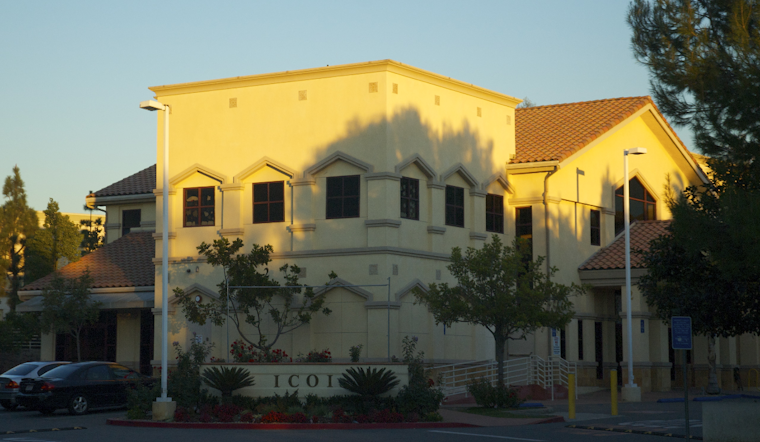
Bomb emojis and the word “dynamite” showed up in the comments after a viral Facebook post falsely accused the Islamic Center of Irvine of seizing three buildings behind its mosque to build a “parallel society.” The Irvine Police Department has since stepped up its presence around the center, and mosque leaders say they are taking new steps to protect their congregation.
The threats trace back to an August 11 post from Amy “Mek” Mekelburg, founder of the RAIR Foundation USA, who questioned why an Islamic “village” was being allowed to rise in Irvine and accused the center of seizing three additional buildings behind its mosque, according to the Los Angeles Times. The post was reposted by a far-right podcaster the same day and garnered nearly 250,000 views, drawing the online threats that followed. Amr Shabaik, legal director for the Council on American-Islamic Relations in Greater Los Angeles, said the Islamic Center of Irvine contacted authorities, filed a police report, and notified its community about the threats.
Among the comments the mosque flagged: a Facebook commenter posted an emoji of a bomb with a lit fuse, and another user wrote simply, “dynamite.” The Irvine Police Department said it was not aware of credible threats at the time but is monitoring the situation closely and has increased its presence at the center as a precaution.
What Mekelburg's Post Got Wrong About the “Village”
The buildings behind the mosque are part of what the center calls its “village,” a concept that member Amin Rafiq said was born in 2023. According to the same Times report, the Islamic Center of Irvine village is described as a modern community hub providing wellness, education, and personal-growth services rooted in Islamic principles and open to all. Its offerings include gym equipment, babysitting, STEM classes for youth, sessions on mastering the Quran, and a private hair salon.
Supporters of the mosque raised enough money in 2023 to acquire the buildings, with community members pulling together more than $1 million in a single night during Ramadan. A fundraising effort allowed the organization to operate four buildings by the following year. The Islamic Center of Irvine was first established in 2004.
A Familiar Playbook From RAIR Foundation
This is not the first time Mekelburg's organization has targeted a Southern California mosque with viral claims. In April, RAIR Foundation launched a similar campaign criticizing expansion plans at the Islamic Society of Orange County, which led to anti-Muslim rhetoric and violent online threats and prompted that Garden Grove institution to heighten its own security on April 17. The Southern Poverty Law Center classifies RAIR Foundation USA as an anti-Muslim hate group and reports that Mekelburg built the organization to convert her online influence into real-world activism.
The pattern extends beyond Orange County. In May 2025, RAIR Foundation circulated videos falsely claiming a 402-acre “Sharia enclave” was under construction in Josephine, Texas, according to WLIW. That campaign triggered state inquiries before attorneys for the mosque involved confirmed no construction had actually taken place.
A Community Already Scarred By Federal Surveillance
For members of the Islamic Center of Irvine, the online threats reopen wounds from a federal surveillance scandal nearly two decades old. Shabaik said the effects of that operation are still felt today. Starting in 2006, the FBI recruited paid informant Craig Monteihl, who posed as a Muslim convert named Farouk al-Aziz, to gather intelligence inside the mosque by wearing wiretaps and planting recording devices, according to the Harvard Law Review. Congregants reported Monteihl to authorities in 2007 after he began pushing for “violent jihad,” ending his role as what became known as Operation Flex.
Three mosque members later sued the FBI over alleged constitutional-rights violations, a case that reached the U.S. Supreme Court. The justices ruled unanimously in 2022 in Federal Bureau of Investigation v. Fazaga that a section of the Foreign Intelligence Surveillance Act does not override the government's state secrets privilege, sending the case back to lower courts to determine whether secrecy claims could block the congregants' civil rights claims. CAIR-LA and the American Civil Liberties Union continue to work on that lawsuit.
Elected Officials Denounce the Threats
Rep. Dave Min denounced the online threats against the Islamic Center of Irvine, calling the mosque a pillar in Orange County and saying hate has no place in Irvine, Orange County, or anywhere else. CAIR-LA wants law enforcement to investigate the threats, and Shabaik said the center is taking measures to protect its community in the meantime.
The Irvine incident lands amid a documented rise in anti-Muslim hostility nationwide. CAIR reported logging a record 8,683 complaints of anti-Muslim discrimination across the country in 2025, including 555 direct hate incidents and 33 incidents targeting Islamic institutions specifically. Closer to home, the Orange County Human Relations Commission counted 119 hate crime events across the county in 2024, though community advocacy groups have criticized that report for relying solely on law enforcement data while leaving out non-criminal hate incidents.
Heightened Security Follows a Deadly Attack
The threats also arrive against the backdrop of a real act of violence at a Southern California mosque earlier this year. On May 18, a shooting at the Islamic Center of San Diego left three men dead, including a security guard who exchanged gunfire with two attackers before they died by suicide, according to KESQ. The guard's actions kept the gunmen from reaching an area where 140 children were gathered at the time.
In the wake of that attack, California announced $80 million in state awards to 343 non-profit organizations through the state's Nonprofit Security Grant Program, funding that was subsequently made permanent at $80 million a year in the state budget. The program, created in 2015 and expanded after prior incidents at places of worship, gives mosques and other non-profits a path to fund physical security upgrades. Orange County has also built out its own response infrastructure, with the Board of Supervisors approving $1 million in 2022 for a “Hate Hurts Us All” campaign and expanded 2-1-1 hotline services for residents to report bias-motivated incidents.
Under California law, the threats reported by the Islamic Center of Irvine could carry criminal exposure for whoever posted them. Penal Code Section 422 makes it a crime to issue willful threats of death or great bodily injury through electronic communication that cause reasonable, sustained fear, while Section 422.6 specifically criminalizes using force or threats of force to interfere with someone's constitutional rights based on religion. Hate crime prosecutions under that latter statute require proof that bias was a substantial motivating factor in the conduct.




