

























































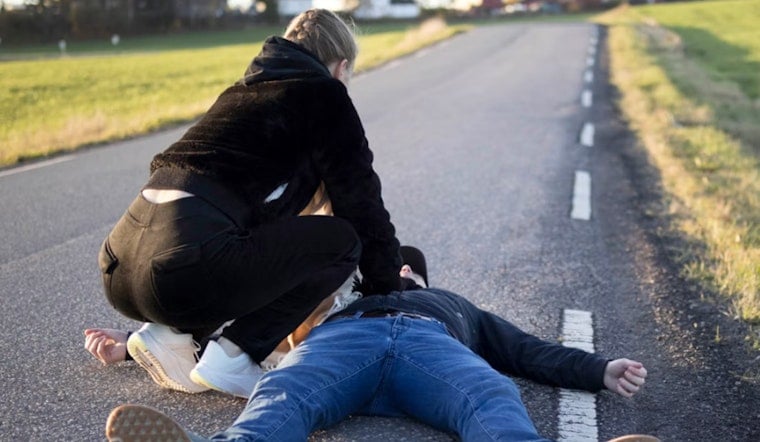
Lance Schellpeper had just stopped to pet a stranger's rescue dog on Jacksonville Beach on August 12 when his heart attack sent him crumpling onto the sand. The dog's owner, a vascular surgery physician assistant named Jennifer Carde, didn't hesitate — she began chest compressions within seconds and kept going for about four to five minutes until paramedics arrived.
Schellpeper had been fishing at Jacksonville Beach that day when he paused to greet Carde's dog, Evie, according to News4JAX. Moments later he collapsed. Carde asked a nearby bystander to hold Evie's leash so she could drop to the sand and start CPR almost immediately, the outlet reports. She also called 911 as she worked to keep blood flowing to his brain and organs.
Every Second Counted on the Sand
The timing mattered more than most people realize. Research presented at the American Heart Association's Resuscitation Science Symposium found that bystander CPR delivered within the first two minutes of a collapse offers the best odds of survival and of preserving brain function, with survival odds dropping roughly 10% for every additional minute that passes without help, according to the American Heart Association. Nationally, roughly 350,000 out-of-hospital cardiac arrests happen each year in the U.S., and only about 10.5% of those patients survive to hospital discharge, per the same association's CPR statistics.
Location worked in Schellpeper's favor, too. Cardiac arrests that happen in public places carry a survival-to-discharge rate of 21.1%, compared with just 8.9% for arrests that occur inside private homes, according to national data cited by the Red Cross. More than 70% of cardiac arrests happen in residential settings where a trained bystander may not be nearby, the same source notes. A beach full of strangers, in this case, turned out to be exactly the right place to go down.
A Heart Attack Becomes a Sudden Collapse
Schellpeper was diagnosed with a heart attack, which doctors distinguish from cardiac arrest even though the two are often confused. A heart attack is a circulation problem caused by a blocked artery, while sudden cardiac arrest is an electrical malfunction that stops the heart from beating — though a heart attack frequently triggers that sudden collapse, according to the American Heart Association's explanation of the difference between the two conditions. That is what happened on the sand: the heart attack caused Schellpeper's heart to stop, and it was Carde's compressions that kept his blood moving until first responders arrived while she was still performing CPR.
Schellpeper underwent a quadruple bypass afterward. Doctors told him that Carde's immediate CPR was what helped him survive, he said, according to the News4JAX report. Carde, for her part, was quick to spread the credit around rather than take it herself — she pointed to the bystander who held Evie's leash, the first responders, and the hospital teams who treated Schellpeper afterward.
An Unlikely Friendship Forms
The two have stayed in touch since the collapse and live about a mile apart, and they plan to remain part of each other's lives going forward. Schellpeper said the beach had been a place where life felt simple, and he has already returned to going there once or twice a week. He said the heart attack changed how he views his health and his life more broadly.
The collapse also nudged Schellpeper back toward faith. He had stopped attending church after losing his wife, Linda, in September 2025, but he now says he plans to return. Reflecting on what happened on the sand, he said he now has an angel in heaven and one on earth — a nod to both his late wife and to Carde.
“Early CPR can be the difference between life and death,” Carde said, according to News4JAX's account of the rescue.
Legal Protections and Local Training Push
Bystanders who step in during emergencies like this one are shielded under Florida law. Florida Statutes Section 768.13, known as the Good Samaritan Act, protects anyone — including off-duty healthcare providers like Carde — who voluntarily and in good faith provides emergency care outside a hospital, as long as they act as a reasonably prudent person would, according to the Florida Senate. The law is designed to remove the fear of civil liability that might otherwise make a bystander hesitate.
That kind of quick intervention is becoming more common nationally. The CARES 2025 Annual Report found that 42.5% of out-of-hospital cardiac arrest patients received bystander CPR before emergency crews arrived, the highest rate recorded since 2016, per Red Cross data. Locally, the City of Jacksonville Beach Fire Marshal's Office offers free Hands-Only CPR instruction at fire stations and community venues, while Florida State College at Jacksonville partners with the Jacksonville Fire and Rescue Department and the American Heart Association to certify residents and medical professionals in Basic Life Support and CPR, according to Jacksonville Beach and Florida State College at Jacksonville. For Schellpeper, that kind of training — put into practice by a stranger walking her dog — turned out to be the difference between a fatal collapse and a second chance.



