

























































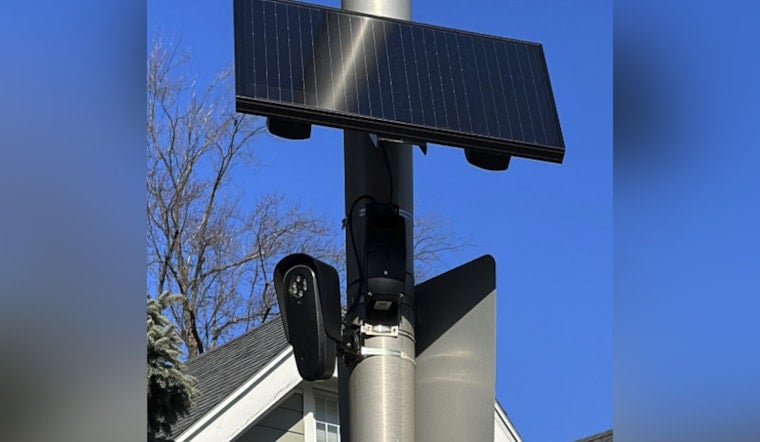
Jefferson City's council voted to renew its contract for Flock automated license plate readers through May 14, 2027, at a cost of $51,000, even as councilman Cody Holt cast the lone dissenting vote and warned that the potential invasion of public privacy outweighed the benefits of the cameras.
The renewal keeps the Jefferson City Police Department's network of Flock readers running across the city, a program Police Chief Eric Wilde says builds on more than two decades of automatic license plate-reading technology the department has already used. As reported by ABC17NEWS, the department operated 21 Flock automated license plate readers throughout the city as of last September, and Wilde has described Flock as one of the most effective tools he has seen in his career, crediting the cameras with helping solve three homicides.
A Split Council, One Loud No
Holt raised privacy and data-sharing concerns about the cameras during the debate, telling fellow council members he believes the risk to residents' privacy is not worth what the technology provides. Even so, Holt said he trusts the Jefferson City Police Department to use the cameras responsibly, a nuance that separated his objection from an outright rejection of the technology itself.
Other council members pushed back on that hesitation. Julie Allen said the benefits of Flock cameras outweighed concerns about their use, pointing to instances where the cameras had proven useful in law-enforcement matters, including a case in which Columbia police used Flock cameras to help make an arrest. Councilman Shane Kampeter supported continued use of the cameras, telling colleagues that systems like Flock can track a car before it even reaches the Missouri River bridge in Jefferson City. Chris Leuckel also backed the renewal, arguing police needed as many resources and assets as available, and Kampeter offered similar support for keeping the program running.
Police Point to Oversight, Not Just Results
Wilde told the council the department will continue training, establishing policy and auditing Flock use going forward, framing that oversight as the answer to concerns about potential misuse of law-enforcement tools. Holt, for his part, said he supports giving officers access to useful tools, even as he pressed for more scrutiny of how the data gets handled.
City officials have also acknowledged a practical limitation behind that oversight push: Jefferson City has insufficient staff to physically monitor the cameras in real time, leaving audits and case-code tracking as the primary check on how the system gets used. That gap mirrors a national pattern documented by DEV Community, whose review of investigative reporting found internal audits across multiple states have documented nearly 50 instances of officers accused or charged with improperly searching Flock's database for personal reasons, with recent cases in Florida and Georgia resulting in suspensions and criminal charges.
Vendor Under Pressure Nationwide
Jefferson City's vote lands amid mounting scrutiny of Flock Safety itself. On August 13, company CEO Garrett Langley announced the vendor is cutting its default data retention period from 30 days to seven and requiring audit monitoring tools and case-code entries for all law enforcement searches by the end of the year, according to Flock Safety. The Atlanta-based company now operates more than 120,000 automated license plate reader cameras nationwide across thousands of law enforcement agencies and private organizations.
The American Civil Liberties Union isn't convinced the changes go far enough. In an analysis also published August 13, the ACLU warned that Flock's new Evidence Mode feature could let agencies retain captured plate data indefinitely whenever a search is tied to an active case number, effectively creating a loophole around the shorter retention window.
Missouri Communities Split, Legislature Weighs a Ban
Jefferson City's renewal stands in contrast to how other Missouri municipalities have handled Flock. In neighboring Boone County, the Columbia City Council voted 5-2 in October 2024 to approve a $539,400 contract with Flock Group Inc. to install license plate readers and live-view intersection cameras across police and parks facilities, according to KBIA. But smaller Bolivar, Missouri, took the opposite path, with its Board of Aldermen voting on July 28 to immediately halt use of its Flock cameras and review options to exit its contract after residents raised privacy and data-sharing concerns, per CivIQ. Bolivar had originally acquired its cameras using a $50,000 state grant.
Nationally, more than 30 communities have ended their Flock agreements amid privacy, data-sharing and law-enforcement-access concerns, according to a national contract tracker cited by ABC17NEWS. Meanwhile, Missouri lawmakers introduced Senate Bill 1027 in January, which would prohibit state agencies and political subdivisions from installing or using automated license plate reader systems on public highways, with narrow exceptions for patrol vehicles and statutory registration checks. If it passes, the bill could create legal uncertainty for long-term municipal contracts like the one Jefferson City just renewed.
Crowdsourced surveillance-mapping data from DeFlock, updated through August 13, documented 91 automated license plate reader records within a 25-mile radius of Jefferson City, with 80 of them, or 87.9 percent, explicitly identified as Flock Safety equipment. St. Louis, meanwhile, took a different governance approach back in April 2024, when its Board of Aldermen enacted Board Bill 185 establishing Community Control Over Police Surveillance rules that require city council oversight and approval for municipal surveillance tools, per the ACLU of Missouri, capping six years of advocacy from civil liberties groups.
For now, Jefferson City is sticking with its cameras and betting that training, policy and auditing can address the misuse concerns that have upended Flock programs elsewhere. Whether that bet holds up may depend as much on what happens in Jefferson City as on what state lawmakers and the vendor itself decide to do next.



