

























































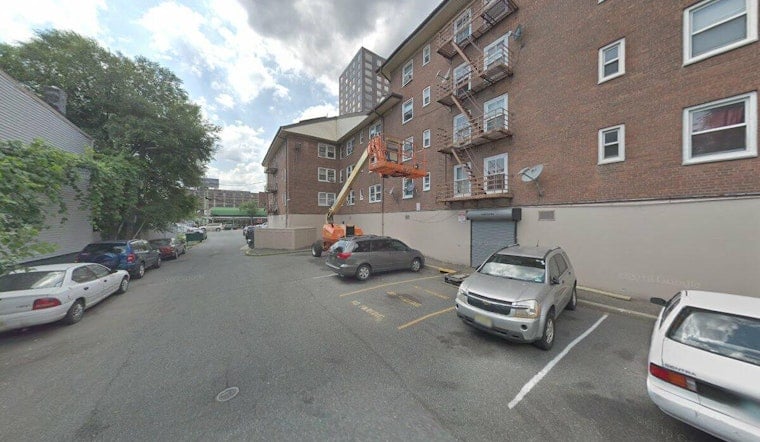
The long-planned overhaul of Jersey City's Holland Gardens public housing complex has grown into a 753-unit mixed-income community with retail, condominiums, and a new library branch, according to plans recently approved by the city's planning board. The project will replace five aging low-rise public housing buildings built in 1944 on a 3.3-acre site between Erie Street and Jersey Avenue, and between 15th and 16th Streets, with two new parcels split by a re-established 15th Street.
As reported by Jersey Digs, the Jersey City Planning Board approved the plan for 235 16th Street, formalizing a design from PS&S Architects that splits the site into a northern and southern parcel. The northern parcel will hold a 24-story building comprising three towers connected by a shared base, with 621 rental units and 24,000 square feet of commercial space. The development will have 391 parking spaces overall. The plan includes 375 bicycle spaces. The southern parcel will feature an eight-story building with 132 dwelling units, 22,000 square feet of retail space, and a five-story community building that will house both a Jersey City Free Public Library branch and Jersey City Housing Authority offices and outreach space.
A Long Road From Planning to Zoning Approval
The redevelopment traces back to plans that first emerged in 2023, when the Jersey City Housing Authority selected WinnDevelopment to lead the overhaul. That selection came with an estimated $500 million price tag, expected to generate roughly $28 million in ground lease payments over 30 years. WinnCompanies and the housing authority did not formalize the arrangement until January 22, 2025, when the two sides signed a Master Developer Agreement laying out the project's terms, as detailed by Better Blocks New Jersey.
Getting to this point required 12 zoning variances, with the most significant concerning the north building's maximum height in stories and feet, per Jersey Digs. The redevelopment plan subdivides the existing lot into two new lots and creates a new road between the two future buildings, effectively re-establishing 15th Street through the site.
Why Officials Chose Demolition Over Repair
The push to tear down and rebuild rather than patch up Holland Gardens stems from a blunt cost calculation. A 2019 engineering evaluation by consulting architects Kitchen & Associates found that basic capital repairs needed just to keep the aging complex operational would run $21 million, according to the Construction Equipment Guide. That finding pushed officials toward full redevelopment instead of piecemeal fixes to deteriorating mechanical systems and outdated accessibility features.
The site itself sits in a corridor that has transformed dramatically since 1944. It is now directly adjacent to recently built luxury high-rises in Ward E, including Soho Lofts and Cast Iron Lofts, near the Holland Tunnel, the outlet's report notes. That contrast between decades-old public housing and gleaming private towers has become part of the backdrop for the redevelopment's mixed-income design.
Unit Mix Shaped By Resident Input
The finalized 753-unit count breaks down into 31 studios, 431 one-bedroom units, 243 two-bedroom units, 42 three-bedroom units, and six units with four or more bedrooms, along with condominiums and senior units. That mix, Jersey Digs reports, was determined only after more than 20 community meetings with current residents.
The project replaces the 192 existing Holland Gardens units on a one-for-one basis, and the housing authority's right-of-return policy applies to all current residents, who are expected to return under the plan without displacement. Overall, more than 41 percent of the redevelopment's homes are designated affordable housing, per the same outlet's reporting. As of the planning board's approval, the housing authority had not announced a timeline for demolition and construction.
Condos, Federal Dollars, and a Mass-Timber First
Beyond rentals, the plan includes 56 condominiums, half of which — 28 units — are set aside as affordable homeownership opportunities for families earning between 60% and 120% of the Area Median Income, according to the City of Jersey City. Public housing redevelopments rarely include for-sale affordable units, making that homeownership piece a notable feature of the plan.
New Jersey's federal lawmakers have also thrown financial weight behind the project, requesting $4 million in congressional community project funding to help cover demolition of the existing structures and site preparation, per the Office of U.S. Senator Andy Kim. The five-story community building tied to the library and housing authority offices will be Jersey City's first mass-timber structure, and it is set to include an enclosed rooftop playground for children, according to Better Blocks New Jersey.
Fitting Into a Citywide Housing Squeeze
The redevelopment lands amid a broader regional housing crunch. Jersey City added nearly 26,000 housing units between 2010 and 2022 — triple the per-capita production of the wider New York metropolitan region — even as citywide market rents jumped 50% since 2015, according to Hoodline's prior reporting on the city's anti-displacement study. That climate underscores why the Jersey City Housing Authority, which serves more than 15,000 residents across roughly 7,100 units including about 2,500 conventional public housing units and 4,600 Section 8 vouchers, has leaned into a mixed-income model for rebuilding Holland Gardens.
Development plans call for completion by 2027, according to ENR New York. For the 192 families still living at Holland Gardens today, the coming years will test whether the housing authority's right-of-return guarantee and relocation assistance can deliver a smooth transition into a dramatically different neighborhood than the one their 1944 buildings were built for.





