

























































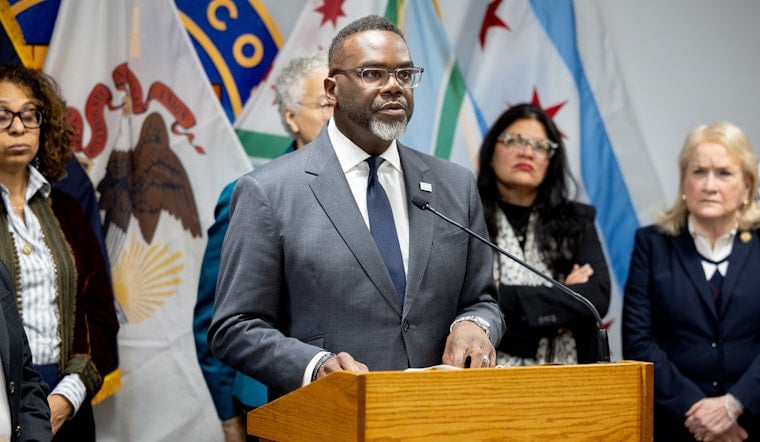
Mayor Brandon Johnson signed an executive order restricting Chicago's business with corporations tied to corrupt or abusive practices, a move that lands squarely on the city's own books: Chicago currently holds $3.19 billion in contracts with companies that also do business with ICE. The order does not cancel any of those existing deals, but it does force vendors to disclose their federal immigration enforcement ties going forward, along with allegations of excessive force, unlawful detention, unconstitutional policing, or discrimination connected to their government contracts.
The order, signed this week, requires companies to disclose contracts with other government or law enforcement agencies, including ICE, and to make those disclosures public, according to WBEZ Chicago. Current contractors and subcontractors must certify they have not committed a public integrity violation in the past five years and that they do not intend to commit one during the life of the contract. The Chief Procurement Officer will develop consequences for violations of the new rules, and the order also creates a 12-member Ethical Procurement Standards Task Force to help shape enforcement going forward.
Dorian Warren said Chicago will not use taxpayer dollars to support companies doing corrupt things, framing the order as a matter of where the city's money goes rather than a wholesale ban on doing business with federal immigration enforcement. That distinction matters: the order explicitly does not ban companies solely for holding contracts with ICE, and it does not apply to private equity firm Stonepeak, which seeks to take over Chicago's parking meters and owns Omni International, according to WBEZ's reporting.
Why Stonepeak and AECOM Sit at the Center of the Debate
Stonepeak's ownership of Omni International has already stalled one massive Chicago deal. As reported by WTTW, the City Council Finance Committee delayed a vote in July on a proposed $2.5 billion transfer of the city's 75-year parking meter lease to Stonepeak after aldermen raised objections over the firm's ownership of Omni International, a charter airline executing ICE deportation flights. Omni International has been criticized for carrying out those flights, and detainees on its planes were allegedly shackled and denied food and water for more than 10 hours, per the same reporting cited by WBEZ.
AECOM has the largest contract among companies identified by the Not With Our Money campaign, the coalition that in part prompted Johnson's order. AECOM oversees modernization of O'Hare International Airport, and the scale of that relationship is difficult to overstate: the Chicago Department of Aviation finalized a $1.455 billion Guaranteed Maximum Price agreement in June with AECOM Hunt Clayco Bowa to lead construction of O'Hare's new 19-gate Concourse D, part of the city's broader $8.78 billion ORDNext project.
Disclosure, Not Disqualification
The order also requires companies making more than $1 billion annually to disclose their corporate leadership and board composition, and requires large companies to disclose their diversity policies, mirroring an existing Illinois requirement that publicly traded companies headquartered in the state disclose demographic data. All companies doing business with the city must also report their efforts to recruit, hire, or promote formerly incarcerated people.
Johnson's team cited Palantir as a corporation profiting from contracts with both ICE and the war in Gaza, according to WBEZ's account of the order's framing. Under existing Chicago city code, contractors and subcontractors with convictions involving theft, deceit, hate crimes, perjury, or treason already face bans from city business, and a government oversight agency finding can disqualify a company outright. Johnson's order builds on that baseline while adding the new disclosure layer for allegations that have not necessarily been adjudicated in court.
Sheila Bedi said companies may engage in corrupt activities without being subject to criminal penalties, a point that underscores the limits of the new rules: the order could trigger action based on disclosed allegations, but it stops short of automatic disqualification for conduct that never reaches a courtroom, a gap advocates say leaves real enforcement questions unresolved.
Chicago as the First Domino
Chicago was the first city to take action under the Not With Our Money campaign, which advocates for governments to use their purchasing power to discourage companies from aiding what organizers describe as a militarized deportation campaign. The campaign is now in talks with New York City, Newark, New Jersey, and Minneapolis about similar measures, according to WBEZ.
The order fits into a broader pattern for Johnson, who has signed 26 decrees during his term, six of them in 2026 alone. It follows his January Executive Order 2026-01, known as “ICE On Notice,” which directed the Chicago Police Department to document and investigate alleged misconduct by federal immigration agents, as Borderless Magazine reported, and his October 2025 “ICE Free Zone” order barring federal agents from staging enforcement operations on city-owned property, a policy Hoodline covered in Johnson's ICE Free Zone order. Johnson said he has to do whatever is necessary, even as he is preparing to announce whether he will run for reelection.
Chicago's sanctuary posture stretches back four decades, to Mayor Harold Washington's 1985 executive order restricting city personnel from asking about immigration status, a policy later codified into the 2006 Welcoming City Ordinance and expanded under Mayor Lori Lightfoot in 2021, according to WTTW's historical reporting. That legacy sits alongside the Illinois Way Forward Act, which since 2021 has barred local law enforcement agencies and county jails from housing civil immigration detainees, one of the strictest such laws in the country per the National Immigrant Justice Center.
Nationally, the stakes behind the disclosure push are steep. At least 50 people died in ICE custody between January 2025 and mid-2026, with roughly half of those deaths occurring at facilities run by private prison contractors, according to data tracked by advocacy groups and reported by Common Dreams. The broader Not With Our Money campaign, led in part by coalitions including the Greater Boston Interfaith Organization, has mobilized more than $20 million in deposit withdrawal pledges aimed at pressuring banks to divest from private prison operators GEO Group and CoreCivic.



