

























































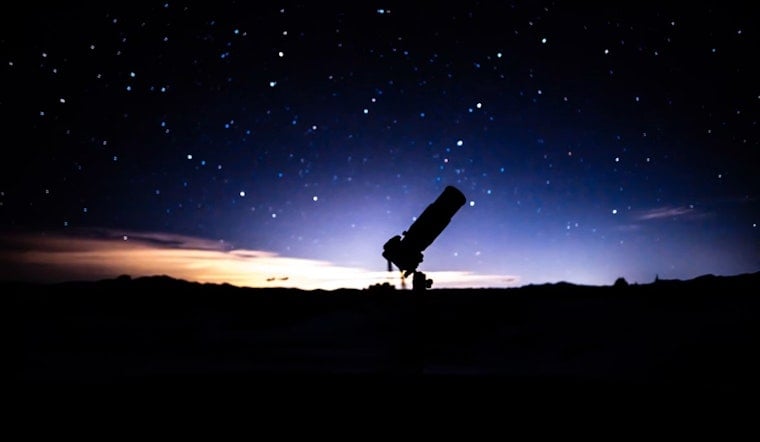
Julian is throwing open its football field to the cosmos tomorrow, offering a public observatory stacked with telescopes and binoculars for anyone hoping to catch the Perseid meteor shower streaking overhead. The second annual Dark Sky Festival runs from 3 to 11 p.m. at Julian Union High School, with gate admission set at $10 and advance tickets priced at $8, while youth aged 18 and younger get in free.
The event has moved to Julian Union High School this year after its debut in 2025, when the first Dark Sky Festival drew more than 2,000 attendees and was timed to coincide with the annual Perseid shower, according to The San Diego Union-Tribune. This year's timing lines up with a strong showing from the sky: the 2026 Perseid shower peaks overnight between Wednesday and Thursday, with astronomers projecting 50 to 100 meteors per hour under dark skies during a dark moon phase, per Space.com.
Those streaks of light are debris from Comet 109P/Swift-Tuttle, a comet that orbits the sun once every 133 years, shedding dust and rock that slam into Earth's upper atmosphere at roughly 130,000 mph, according to the Royal Museums Greenwich. Most of the meteoroids are no bigger than a grain of sand or a pea, but friction with the atmosphere superheats the surrounding air to thousands of degrees, producing the bright flashes festivalgoers will crane their necks to see.
Telescopes, a NASA Booth and Laser-Guided Sky Tours
The festival, hosted by the Julian Dark Sky Network, brings together astronomers, conservationists and outdoor enthusiasts for a night built around the football field's public observatory. Visitors can expect an exhibit from NASA, laser-guided naked-eye sky tours, and a talk on Indigenous cosmology delivered by a Kumeyaay historian, the Union-Tribune reports.
That cultural programming taps into a much older way of reading the night sky. In traditional Kumeyaay cosmology, the stars Western astronomy calls Orion's Belt represent 'Emuu, or Three Mountain Sheep, whose pre-dawn arrival at zenith around September 21 traditionally signals the autumnal equinox and the start of the acorn harvest season, according to the Museum of Us. The Kumeyaay Nation used a celestial calendar system to manage harvests, controlled burns and seasonal migrations across Southern California long before Julian's dark skies became a tourist draw.
Why Julian's Skies Stayed Dark
Julian earned its spot as an internationally recognized dark sky community in May 2021, becoming the 30th such community designated worldwide and only the second in California, according to DarkSky International. The mountain town, sitting at 4,235 feet, maintains a Bortle Dark Sky Scale rating of 3 to 4, putting it among the roughly 1% of populated U.S. locations where the Milky Way remains visible to the naked eye, per the Julian Dark Sky Network. Julian is one of the few places in San Diego County where the Milky Way still shows up overhead, the Union-Tribune notes, and that rarity didn't happen by accident. Nearby Borrego Springs got there first, becoming California's first certified International Dark Sky Community back in 2009 — only the second community in the world to earn the title, after Flagstaff, Arizona, according to the Anza-Borrego Desert Natural History Association.
Eddie Lain, co-founder of Friends of the Night Sky, told the Union-Tribune that light pollution is the simplest pollution to correct. Lain said he hopes attendees leave the festival with a better understanding of how to cut down on light pollution in their own homes and communities.
Decades of Lighting Rules Behind the Scenes
The dark skies over Julian trace back to a 1986 county ordinance that restricted outdoor lighting specifically to protect astronomical research at Palomar Observatory and Mount Laguna Observatory, according to a 1985 report in the Los Angeles Times. Under San Diego County's Light Pollution Code, unincorporated land within 15 miles of either observatory falls under strict Zone A rules requiring low-pressure sodium lighting and full shielding, while the rest of the county falls under the less restrictive Zone B, per the National Association of Counties.
In 2020, the county added a new Zone C lighting category, creating tailored rules that let unincorporated towns like Julian meet DarkSky International's certification requirements, the National Association of Counties reports. Local planning officials have also stepped up proactive enforcement of night-sky lighting codes this year, targeting unshielded commercial fixtures and excessive glare in rural parts of the county, according to the Valley Roadrunner.



