

























































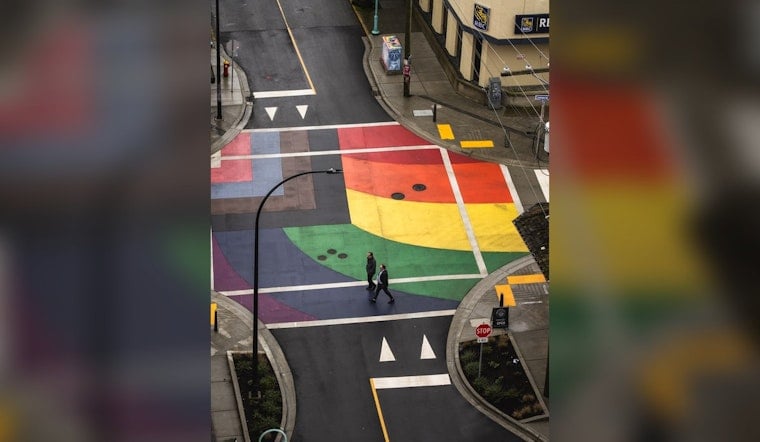
A once-temporary street mural at a dangerous Kansas City intersection has become permanent infrastructure after the paint and planters helped cut traffic speeds by 45 percent. The city's official account confirmed the update this week, retweeting a Bloomberg Philanthropies post celebrating the project's staying power under the Asphalt Art Initiative.
According to Kansas City
, the transformation began with temporary murals and street redesigns at a dangerous intersection, and the city has since made those changes permanent. Per the same post, the redesign increased the share of pedestrians who felt safe there threefold, and the city credited the effort with showing that creative ideas can become lasting solutions for safer streets. Kansas City, the official municipal account for Kansas City, Missouri, directs residents with service requests to @KCMO311.
The intersection in question is Westport Road, Wyandotte Street, and West 40th Street in Midtown, where Kansas City's original Asphalt Art project reclaimed more than 4,000 square feet of asphalt and cut crosswalk distances by 52 percent, according to Bloomberg Philanthropies. Local firm Street Smarts Design + Build worked with local artists on corner murals, curb extensions with planters and boulders, and two new stop signs, a combination that dropped average vehicle speeds from 25 mph to under 14 mph, as reported by the same organization. Decibel monitoring before and after the redesign also found a 14 percent drop in traffic noise, with ambient sound falling from 79 to 68 decibels.
From Midtown Pilot to Citywide Strategy
The Westport pilot's success led Kansas City to pursue a second $25,000 Bloomberg Asphalt Art grant, which funded a redesign of 12th Street and Benton Boulevard in the Independence Plaza neighborhood of Northeast Kansas City in August 2022, according to KCUR. That expansion pushed the city's tactical-urbanism approach beyond Midtown and into a historically underinvested corridor. The station's report also ties the projects directly to Kansas City's Vision Zero plan, passed by the Kansas City Council in May 2020 with a goal of eliminating traffic fatalities and serious injuries by 2030.
The city has since put real money behind that goal. Kansas City allocated $8 million toward Vision Zero for the 2025–2026 fiscal year to fund street redesigns and traffic-calming infrastructure along designated high-injury corridors, Hoodline previously reported in its coverage of a critical pedestrian crash near Main Street and Linwood Boulevard. That same report noted Smart Growth America's 2026 “Dangerous by Design” study ranked the Kansas City metro area among the 70 most dangerous metro areas in the country for pedestrians, underscoring why the city has leaned into low-cost street redesigns.
National Data Backs the Approach
Kansas City's results echo findings from a broader national study. A national Asphalt Art Safety Study published by Bloomberg Philanthropies in partnership with Sam Schwartz Engineering examined 22 U.S. street art projects and found a 50 percent drop in pedestrian and cyclist crashes, along with a 27 percent increase in drivers yielding to pedestrians. That data gives cities a research-backed case for treating paint, planters, and curb extensions as legitimate traffic-safety tools rather than mere decoration.
The legal groundwork for that shift solidified in December 2023, when the Federal Highway Administration released the 11th Edition of the Manual on Uniform Traffic Control Devices, explicitly recognizing and permitting what it calls “aesthetic surface treatments” in roadway intersections and curb extensions, according to the Federal Register. The update gives local governments clearer federal cover to install murals and similar treatments in intersections and plazas. That guidance does have limits: federal rules still prohibit altering standard transverse crosswalk lines with decorative colors, such as rainbow crosswalks, in order to preserve uniform driver expectations and visual contrast, per the Delaware Valley Trusts.
For Kansas City, the Westport redesign's shift from temporary trial to permanent fixture suggests city officials view the tactic as more than a one-off experiment. With Vision Zero's 2030 deadline approaching and pedestrian-safety rankings still poor, the city's asphalt art projects offer a low-cost model that other neighborhoods along high-injury corridors could see replicated in the years ahead.





