

























































Dr. Maryam Qayum, a 68-year-old physician from Montgomery County, has been sentenced to 12.5 years in federal prison for running an illegal opioid prescription scheme out of her Kingwood clinic. Recare Health Clinic issued more than 3 million opioid pills between 2022 and 2025, operating as a cash-only business that sold prescriptions directly to street-level drug dealers.
Qayum pleaded guilty in March 2026 to conspiracy to unlawfully distribute controlled substances, serving as Recare's sole prescribing physician, according to Click2Houston. Prescriptions for oxycodone and hydrocodone were often written without a legitimate medical purpose, and sometimes without Qayum ever seeing or examining the patient. Staff at the clinic referred to the dealers who paid for the fake visits as "providers," the outlet reported.
Before Recare became the center of the scheme, Qayum had been licensed to practice medicine in Texas since about 1998, working as a specialist in physical medicine and rehabilitation, according to the U.S. Department of Justice. The clinic operated out of a commercial office at 22323 Loop 494, Suite 4, in Kingwood, after previously running out of a nearby address at 22704 Loop 494, per the same filing.
A Handwritten Price List for Pills
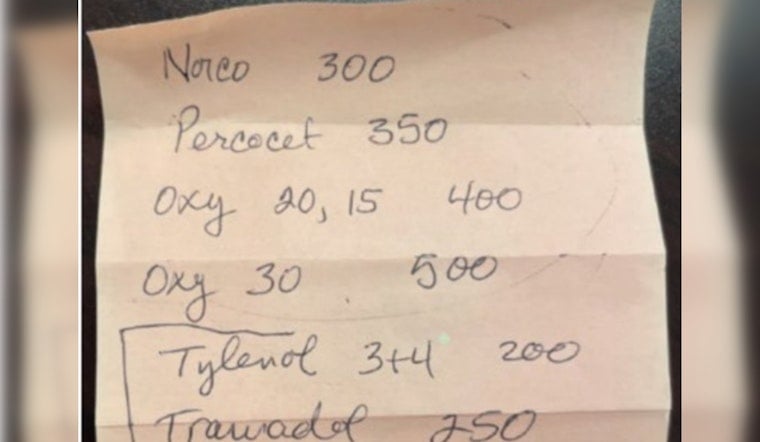
Federal agents who searched Recare recovered a handwritten pricing list detailing what dealers paid for controlled-substance prescriptions. Hydrocodone prescriptions typically cost about $300, while 30-milligram oxycodone prescriptions sold for as much as $500, the outlet's report on the case states.
Beyond oxycodone and hydrocodone, Qayum also unlawfully prescribed carisoprodol, a Schedule IV muscle relaxant sold as Soma that is frequently combined with high-dose opioids to produce a heightened high and a severe overdose risk, according to the Justice Department. Clinic staff also accepted cash tips from dealers to speed up prescriptions, and issued "credits" toward future visits whenever a brought-in fake patient failed to get the drug a dealer wanted.
Recruiting Fake Patients From the Street
The conspiracy relied on "crew leaders" who recruited homeless and impoverished people to pose as chronic pain patients, paying for the bogus visits and then seizing the resulting prescriptions for street resale, court documents show. Clinic employee Lester Stokes, 38, of Houston, served as an unlicensed security guard and gatekeeper, ushering crew leaders and their recruits through Recare to keep the illegitimate prescriptions moving, according to those same records.
Federal agents eventually executed a search warrant at the clinic, and law enforcement shut it down in 2025, according to Click2Houston's reporting on the case. Stokes was later sentenced to 63 months in prison for his role.
Co-Defendants Sentenced Across the Pipeline
Melvin Sampson, 56, of Houston, the scheme's primary street dealer, recruited patients and resold their medications on the black market. He was sentenced in June 2026 to 210 months, or 17.5 years, in federal prison, according to The Washington Times.
Tomi-Ko Bowers, 71, an advanced practice registered nurse who worked at Recare, was sentenced that same month to 96 months in prison. Bowers lived in Cleveland, in San Jacinto County, according to Tampa Free Press.
Jared Williams, 49, of Pearland, owned and operated the pharmacy Surge Rx and admitted to unlawfully distributing controlled substances by filling Qayum's illegitimate prescriptions. He was sentenced in July 2026 to 42 months in prison, according to Click2Houston.
Investigation and a Broader Crackdown
The Drug Enforcement Administration led the investigation into Recare, according to the Justice Department, though Click2Houston's report separately credited the Conroe Police Department with leading the probe. It is unclear from available records how the two agencies' roles fit together.
The case was prosecuted by the Department of Justice's Criminal Division Fraud Section and the U.S. Attorney's Office for the Southern District of Texas, court records show. That effort fell under the Health Care Fraud Unit's Texas Strike Force, part of a national health care fraud enforcement program that has charged more than 5,400 defendants nationwide since 2007, per the same records.
The Kingwood case echoes other Houston-area pill mill prosecutions this year; Hoodline previously reported on a Tomball doctor convicted over a clinic accused of pushing 1 million opioid pills. Federal strike forces have increasingly used prescription-volume data analytics to dismantle entire supply chains, from prescribing doctors to fill pharmacies to street distributors, rather than pursuing individual actors in isolation.





