

























































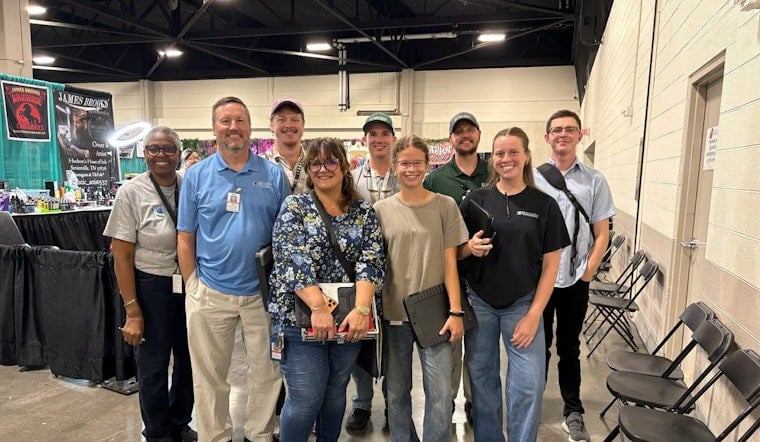
Roughly 100 tattoo artists set up shop inside the World's Fair Exhibition Hall last weekend, and before a single needle touched skin, Knox County's environmental health inspectors were on hand making sure every station met state sanitation standards. The three-day Knoxville Tattoo Convention ran from Friday, August 14 through Sunday, August 16, drawing artists and collectors for its 14th annual run in downtown Knoxville.
The Knox County Health Department detailed the inspection effort in a Facebook post showing photos from the event, confirming that its Environmental Health Division inspectors checked in on the roughly 100 participating artists working the convention floor. The event featured both live body art and tattoo contests, according to the department's post. The convention itself traces back to 2010, when it was founded by tattoo artist Danny Fugate and organized by Living Arts Expo, per 93.7 WVLZ.
How Health Officials Police a Pop-Up Convention
Tattoo conventions don't get a pass just because they're temporary. Under Tennessee Code § 62-38-205, events like this one may run for up to 10 days with local health department approval, and out-of-state or otherwise unregistered artists must pay a $50 state registration fee for a temporary permit good for up to 14 days, according to Justia Law. That temporary registration skips the written exams and apprenticeship hours normally required for a full state license, the same statute notes.
The sanitation bar, however, doesn't get lowered for a weekend event. State law requires temporary body art facilities to meet the same sanitary standards as permanent studios — limited-access tattooing areas, adequate sterilization equipment, approved sharps containers, disinfectant sprays at every station, and single-use water rinse cups, per the same source. Those are the exact items environmental health specialists are trained to check for when they walk a convention floor.
Training Ahead of the Weekend
The health department didn't wait until the doors opened to start its outreach. Days before the convention, the Knox County Health Department's Environmental Health Division held a free virtual Bloodborne Pathogen Training for Body Arts on August 13, aimed at local tattoo artists, piercers, and apprentices, the department said in an earlier Facebook announcement. Bloodborne pathogen training delivered by the county is officially recognized statewide by the Tennessee Department of Health as satisfying mandatory licensing prerequisites for body art technicians, according to Body Art BBP Course Approvals.
Age verification is another item on the inspection checklist. Tennessee Code § 62-38-211 makes tattooing anyone under 18 illegal statewide, with one narrow exception: 16- and 17-year-olds may receive a cover-up tattoo on an existing mark, but only if accompanied by a parent or guardian who provides written consent and proof of custody, per Justia Law.
Contests, Performances and a Renovated World's Fair Venue
Beyond the compliance sweep, the convention offered plenty for attendees to watch. This year's event featured daily live tattooing, burlesque and human suspension performances, and competitive judging across categories including Color Realism, Black & Gray Portrait, Cover-Up, and Worst Tattoo, according to Living Arts EXPO.
The venue itself made room for the crowd of artists and their equipment. The World's Fair Exhibition Hall offers nearly 70,000 gross square feet of contiguous exhibition space, equipped with 30-foot utility floor ports supplying the electricity, water, and drainage that temporary event setups need, according to the World's Fair Exhibition Hall. The building, originally constructed for the 1982 World's Fair, was renovated by the city in 2018.
Year-Round Oversight Beyond the Convention
The convention inspection is just one piece of a broader oversight system. Tennessee environmental health regulations require local specialists to conduct unannounced inspections of permanent tattoo establishments at least four times per year to monitor ongoing sanitation and sterilization standards, according to the Shelby County Health Department. State rules also require body art establishments to maintain a $10,000 surety bond to cover potential administrative fines or consumer restitution, per the City of Nashville Business Portal, before health departments will issue an operational permit.





