

























































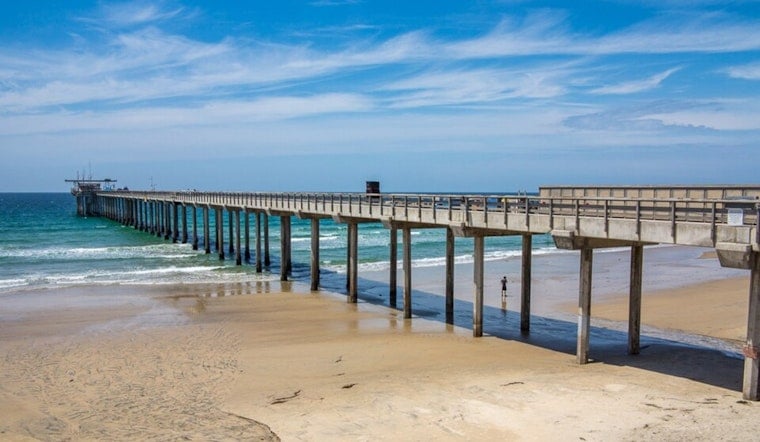
Crowds packed the sand beneath Scripps Pier this month as the setting sun slid perfectly between the pier's back pillars, drawing photographers, surfers and curious beachgoers to La Jolla Shores for the twice-a-year spectacle known as “Scrippshenge.” The 2026 alignment season kicked off on May 2 and returned again in August, giving spectators multiple evenings to catch the sun framed squarely within the 300-meter concrete structure.
The phenomenon, first detailed by The San Diego Union-Tribune, gets its playful name from a similar occurrence at Stonehenge in the United Kingdom, where ancient stones align with the sun during solstices. Scripps Institution of Oceanography geoscientist James Day explained that the alignment comes down to Earth's axial tilt: the planet's axis points toward the sun during Northern Hemisphere summer and away from it during winter, shifting where the sun sets along the horizon throughout the year. Twice annually, that shift lines the sun up precisely between the pier's back pillars.
A Naming Trend Born in New York
The “-henge” label attached to solar alignments isn't unique to La Jolla. According to PBS News, astrophysicist Neil deGrasse Tyson coined the term “Manhattanhenge” back in 1996 to describe sunsets framed by New York City's street grid, and the naming convention has since spread to local landmarks across the country. Scrippshenge is one of many local versions of that same idea, built entirely on architectural coincidence rather than any deliberate design.
That coincidence used to be a well-kept secret. Scripps Institution of Oceanography official Camilla Ingram has noted that Scrippshenge was historically known mainly within the local scientific community, but viewing crowds expanded significantly during and after the COVID-19 pandemic as smartphone camera quality improved and outdoor beach visits surged, per lajolla.ca. What was once a quiet observation among researchers and dedicated nature photographers is now a community spectacle drawing hundreds to the shoreline.
The Pier Behind the Photo Op
The structure at the center of all this attention wasn't built for photographers. The current 1,084-foot concrete Ellen Browning Scripps Memorial Pier was completed in 1988 at a cost of $3.95 million, replacing an original pier that had been battered by severe winter storms in the mid-1980s, according to UC San Diego Today. That original wooden research pier dated back to 1915 and 1916, built for $36,000 entirely through funding from philanthropist Ellen Browning Scripps after the marine biological association that would become Scripps Institution of Oceanography was incorporated into the University of California, as detailed by San Diego Magazine.
Since 1916, oceanographers at the pier have collected daily surface water temperature and salinity readings without interruption, creating one of the world's longest unbroken environmental datasets on ocean conditions, per Wikipedia. Mechanical pumps on the pier still draw up to 1.8 million gallons of ocean water daily into an elevated trough, using gravity to feed research laboratories across campus and public exhibits at the Birch Aquarium, San Diego Magazine reports. In 2018, members of the Scripps family provided more than $2.6 million in private funding to overhaul the pier's railings with corrosion-resistant stainless steel, ensuring the aging structure could keep withstanding the Pacific's battering wind and waves, according to the International Molybdenum Association.
Where the Public Can — and Can't — Watch
Despite the crowds gathering on the sand below, access onto the pier deck itself remains strictly limited to authorized UC San Diego personnel, scientific diving teams, and official guided public tours, according to Scripps Institution of Oceanography. That means the thousands who show up each spring and summer are confined to La Jolla Shores beach, watching the alignment unfold from below rather than from the structure itself.
The biannual alignment typically stretches across several consecutive evenings in early May and early-to-mid August, giving photographers multiple chances per season depending on cloud cover and marine layer conditions, per lajolla.ca. During this year's return, surfers paddling nearby paused to watch the setting sun alongside the crowds gathered onshore, adding to the mix of scientists, tourists and hobbyists all pointed toward the same narrow gap in the pillars.
A Crowd Scene Worth Its Own Spotlight
The density of that crowd has itself become part of the story. A 2023 photograph by UC San Diego staff photographer Erik Jepsen, capturing more than 100 photographers jostling for position beneath the pier, won a 2024 Silver Circle of Excellence award from the Council for Advancement and Support of Education, according to CASE.org. It's a reminder that a structure built to track ocean salinity and feed a research aquarium has, twice a year, become one of San Diego's most photographed sunset backdrops — proof that even a century-old scientific outpost can find itself unexpectedly famous.



.jpg)