

























































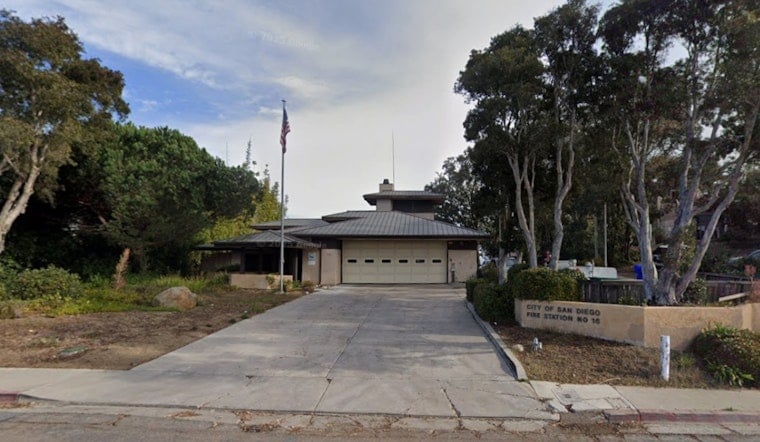
Firefighters at Fire Station 16 on Mount Soledad have spent more than four decades sleeping behind corrugated plastic doors that did not even reach the ceiling, resting in an open-concept dormitory carved up by makeshift partitions. That is finally changing. A community-driven renovation, nearly complete, is replacing the station's cramped sleeping quarters with insulated private rooms, full-height doors, new flooring, and individual lighting for the crews who protect La Jolla and its surrounding neighborhoods.
The project marks the first major renovation of the station since it opened in 1982, according to Times of San Diego. Parker Davenport, a member of the La Jolla Sunrise Rotary and a project manager with Arista Architects, donated his time to lead the effort after being recruited by retired architect and fellow Rotarian Tripp Bennett. Bennett previously helped lead a similar renovation of La Jolla's Fire Station 13 on Nautilus Street in 2007, giving organizers a template to follow nearly two decades later.
Davenport called the sleeping quarters the team's top priority, and Captain Paul Shuttleworth, who serves at Station 16, said a safe, comfortable place to rest between emergency calls is essential for his crew. Cindy Goodman described the station's former bedroom doors as corrugated plastic that failed to reach the ceiling, leaving little real privacy for firefighters trying to sleep between calls. The remodeled dorms now include mattresses, bedding, televisions, individual lighting, white-noise machines, and additional storage, along with insulated walls, full-height doors, new windows, flooring, lockers, cabinets, desks, and chairs.
Why Sleep Became a Safety Issue, Not Just a Comfort Upgrade
San Diego firefighters work 24-hour shifts that can stretch to as long as 96 consecutive hours during mandatory overtime, making restorative sleep between emergencies critical for both cognitive function and physical recovery. Wendy Moore said sleep deprivation is closely linked to mental health and cardiac issues, a concern that carries added weight given that the World Health Organization's International Agency for Research on Cancer officially reclassified occupational firefighting as a Group 1 human carcinogen in July 2022, citing chronic sleep disruption and night-shift fatigue as contributing hazards alongside chemical exposure. Moore said the renovation project had actually been in the works since before the pandemic, underscoring how long crews had waited for the upgrade.
Construction was phased so emergency response would continue uninterrupted throughout the project. During the work, firefighters have spent their nights at Fire Station 52 on the UC San Diego campus, a $22 million facility that opened in October 2024 and houses California's first all-electric fire engine, according to University City News. Firefighters still return to Station 16 during the day, and the station itself also received a new exterior and fresh interior paint as part of the work.
Rotary Clubs and Hundreds of Donors Fill a Funding Gap
The renovation effort was led by the Rotary Club of La Jolla, the La Jolla Sunrise Rotary Club, and the San Diego Fire-Rescue Foundation, an independent non-profit that funds station upgrades, specialized gear, and wellness programs that fall outside the City of San Diego's official operating budget. Rotary District 5340 provided an $11,000 grant, while the City of San Diego's Community Projects, Programs and Services fund contributed $5,200. Students at Evans School raised more than $8,000 through their annual gratitude project, and the broader effort drew support from architects, contractors, businesses, city staff, and hundreds of community donors, per the same Times of San Diego account.
The renovation costs nearly $150,000 in total, and as of late July, the San Diego Fire-Rescue Foundation reported the project remained on schedule and slightly under budget, according to the foundation. That cushion is expected to help seed a second phase organizers hope to begin: a renovation of the station kitchen, which depends on additional funding. The project also benefited from donated materials and services from local companies, and it is now in its final stages.
A Broader Pattern of Community-Funded Public Safety Upgrades
Fire Station 16, located at 2110 Via Casa Alta near Mount Soledad Memorial Park and the Soledad Reservoir, covers a primary response district of about 3.45 square miles. It is one of three fire stations within La Jolla proper, alongside Station 9 on Ardath Lane and Station 13 on Nautilus Street, which together with neighboring Station 52 cover the coastal peninsula, per the City of San Diego. The station traces its roots to a fireboat post at the Santa Fe Wharf near Market Street downtown before relocating to Harbor Lane in 1946, West Broadway in 1962, and finally Mount Soledad in September 1982.
Beyond the Station 16 dorm remodel, private philanthropic donations to the San Diego Fire-Rescue Foundation in mid-2026 also funded new rescue utility vehicles and Jet Skis for La Jolla Shores lifeguards, as well as flood rescue inflatable boats for SDFD swiftwater teams, according to the foundation. The pattern reflects how neighborhood fire stations increasingly lean on Rotary partnerships and community fundraising to cover interior upgrades that fall outside the city's capital budget, even as newer facilities like Station 52 have been built with millions in dedicated public funding.





