

























































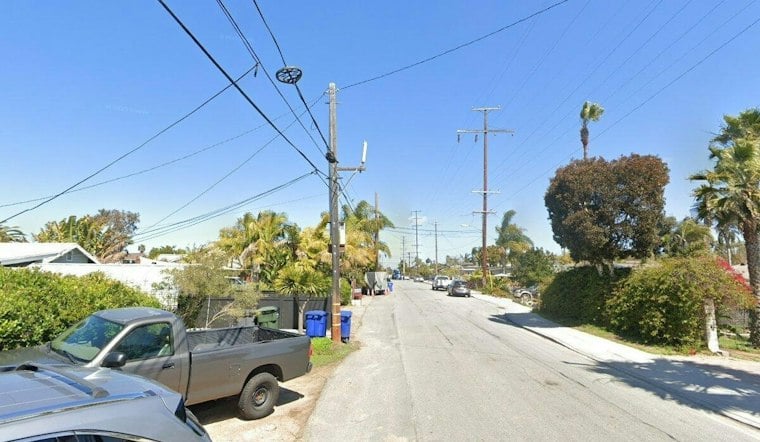
An Encinitas appeals board has ruled that city building official Joseph Romero acted within his authority when he tacked new 2025 code conditions onto a permit extension for the long-contested Clark Avenue apartment project, a decision that keeps alive one of the thorniest housing fights in the city. The board also recommended that the city and developer settle on select 2025 life-safety standards, including fire alarm rules and seismic reinforcement, rather than forcing a full redesign of the 199-unit proposal.
The ruling, reported by the San Diego Union-Tribune, found that Romero had the authority to add conditions when he approved a 90-day permit extension for the project in March 2026. The same ruling recommended the city and developer agree on select 2025 code standards tied to life safety rather than requiring a wholesale overhaul of the plans, according to the paper.
At the center of the dispute is WNG HHF Encinitas Apartments, L.P., which filed a formal appeal — Appeal No. 008834-2026 — on March 30, 2026, challenging Romero's determination that its permit applications needed to be redesigned to comply with the 2025 California Building Standards Code, according to city agenda materials filed with the City of Encinitas. Those 2025 standards include new fire alarm regulations and a requirement for all-electric buildings rather than natural-gas heating. Western National Group argued the project met the codes in place at the time.
A Years-Long Fight Over a 6.22-Acre Site
The project calls for 199 units spread across 15 three-story buildings on a 6.22-acre site on Union Street, east of Interstate 5. The developer successfully appealed the planning commission's initial denial, and the city council then approved the development in 2022, with 40 of the units designated as affordable, per the city's own agenda report. Since then, the project has been tangled in lawsuits filed by both the city and the developers, though the developers have withdrawn one of their suits, while the city's case is proceeding through the appeals process.
Part of the city's legal case, detailed by inewsource.org, alleged that access roads on Clark and Union streets fall short of the 24-foot width required under fire code and lack an adequate turnaround for fire vehicles. Nearby residents have separately raised concerns about traffic congestion and fire department access, concerns that have shadowed the project since its approval. Encinitas city council members have also said the developers should be required to conduct a full-scale environmental assessment.
Romero Defends His Authority to Add Conditions
Romero has said that city codes do not prevent him from adding conditions when approving a permit extension, and that the March 2026 extension was not the developers' first for this project. He has also pointed out that city codes have changed significantly since the original plans were filed back in 2022 — a gap the appeals board ultimately found did not strip him of his authority to update conditions.
The dispute has centered on whether the project must meet newer code requirements.
Marco Gonzalez, an attorney representing the developers, argued in a September 21, 2026 letter to the city that a proposed amendment to the appeals board's own rules should not be applied retroactively to WNG's already-pending appeal — a position laid out in the letter rather than a ruling from any court. That same letter described the board's existing structure as requiring 10 members, including four certified building officials, five licensed California design professionals and one accessibility advocate, with a quorum of six.
A Rare Test of California's Local Appeals Process
The ruling highlights the role of local appeals boards in resolving building-code disputes. According to the Terner Center for Housing Innovation at UC Berkeley, while state law gives builders the ability to challenge local code determinations through such boards, few California cities and counties have actually created them. The center has warned that inconsistent local interpretation of building codes across jurisdictions can compromise the feasibility of housing projects statewide.
The question of all-electric requirements carries its own local history. Encinitas became the first municipality in San Diego County, and the 50th in California, to adopt an all-electric reach code in 2021, according to The Coast News, before later temporarily suspending its building-electrification ordinance following a federal appeals court ruling. Neighboring Carlsbad explored alternatives such as higher building-efficiency standards rather than mandating all-electric construction amid similar legal uncertainty, the outlet reported.
Western National has already started grading work at the Clark Avenue site, even as the code dispute continues to play out. The city council itself has shifted since the project's 2022 approval, with four of five current leaders taking office afterward — a backdrop that has shaped the ongoing friction between the developer and city staff over how, and when, new rules should apply to a project years in the making.




