

























































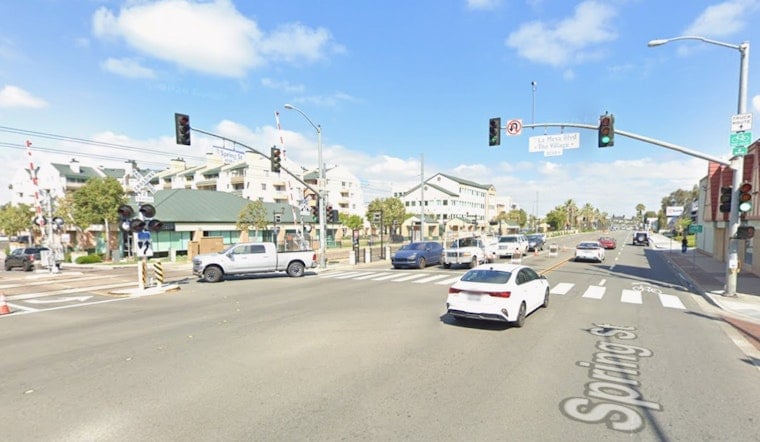
Fixing La Mesa’s trolley-versus-traffic standoff may require a construction project whose price tag dwarfs the city’s appetite: SANDAG has sketched options ranging from $428.7 million to $740.9 million, with no immediate plan to build any of them. The goal is to separate Orange Line trains from cars, pedestrians and bicyclists at the Spring Street crossings in the Downtown Village.
Those numbers came into focus last Tuesday, when SANDAG presented the results of a feasibility study requested by the La Mesa City Council. As reported by Times of San Diego, the proposals would cost roughly three to four times La Mesa’s annual budget and are not headed for construction anytime soon.
The study is tied to a future transit squeeze: SANDAG planning documents envision Orange Line trains running every 7.5 minutes instead of the current 15-minute spacing. The SANDAG budget says the project was created to examine grade separation, alternative rail alignments and road configurations along Spring Street.
Three Ways To Untangle La Mesa’s Trolley Crossings
The most ambitious concept would raise the tracks over the street, eliminating gate arms and trolley horns while creating a visually prominent guideway through the Village. A second option would place the trolley in a trench, but the underground-style approach was estimated at $740.9 million and would involve the longest, most complicated construction process, according to the council report.
SANDAG also considered a shorter elevated guideway that would cross only Lemon Avenue and La Mesa Boulevard, targeting the busiest intersection instead of all five Spring Street crossings. That scaled-back version still carried an estimated $428.7 million price tag, while lowering the street was set aside because of its potential impact on the Village’s retail shops.
The elevated concept received the warmest response from business owners and residents, but it also drew criticism over its industrial appearance and the possibility that trolley wheel noise could travel farther. One La Mesa resident told ABC 10News that the raised tracks appeared to be the worst of the options for the neighborhood.
For now, the project remains a planning exercise rather than a funded construction program. California’s state grants portal lists a $500,000 award for the study, but SANDAG told ABC 10News there is no identified funding to advance beyond the high-level feasibility work.
That leaves La Mesa with a familiar transportation headache and an unusually expensive menu of possible fixes. Mayor Mark Arapostathis summed up the city’s timeline with a joke about telling “our great-grandchildren” what happens next.




