

























































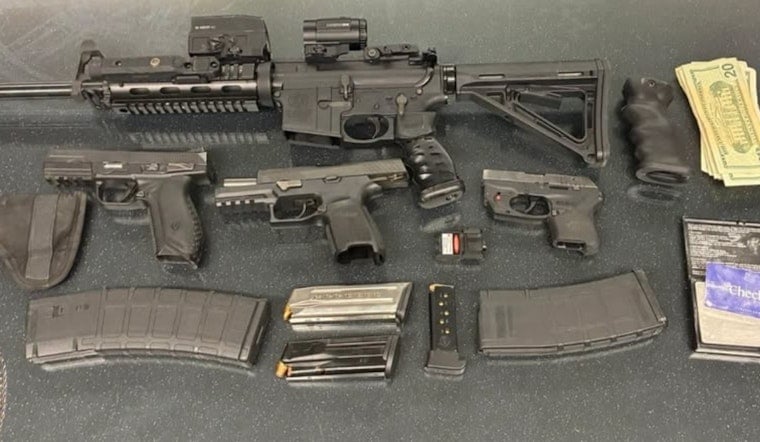
A Lakewood PD agent spotted a truck stopped dead in the middle of an active eastbound lane on August 20, its driver passed out behind the wheel. Rather than risk a confrontation or a chase, agents pinned the truck between two patrol vehicles, positioning their cars inches from its front and rear bumpers before attempting to wake the driver.
According to the Lakewood Police Department, agents first noticed a handgun sitting in the driver's door pocket before making contact. When the driver did stir, he reportedly ignored commands to keep his hands visible, a moment that made the earlier containment maneuver especially consequential. Boxing in a stationary vehicle before waking an incapacitated driver is a recognized anti-pursuit tactic, eliminating the chance of a high-speed chase erupting the instant the driver comes to, according to a discussion of the technique on Reddit.
Agents ultimately removed the driver from the truck and searched the vehicle, recovering four firearms in total, including the handgun spotted in the door pocket. Police say the driver has a history of armed robbery and assault on a peace officer, a record that carries lasting legal weight under Colorado law.
A Felon Barred From Ever Touching a Gun
Under state policy enforced by the Colorado Bureau of Investigation, anyone convicted of a violent felony — including assault on a peace officer or armed robbery — is barred for life from possessing, purchasing, or transferring firearms under both state and federal law. That prohibition is why the four guns found in the truck triggered a felony charge rather than a simple confiscation.
The driver was booked into jail on several charges, including possession of a weapon by a previous offender, or POWPO, under Colorado Revised Statutes § 18-12-108. That charge is classified as a Class 5 felony, carrying up to three years in state prison for a first offense and up to six years for repeat offenders, along with fines reaching as high as $500,000, according to the Right Law Group.
He also faces a charge of driving under the influence with two prior convictions. Because Colorado courts count qualifying impaired-driving convictions from any U.S. jurisdiction, a driver's history can follow them across state lines when prosecutors tally priors. Under C.R.S. § 42-4-1301, a third DUI with two priors remains a misdemeanor but carries mandatory jail time of 60 days to one year, a threshold that only escalates to a felony on a fourth conviction, per Prager Law. Statewide, Colorado logged 16,270 DUI cases in 2024, the vast majority handled as misdemeanors rather than felonies, the same source notes.
Case Now Heads to Jefferson County Prosecutors
The driver was booked into the Jefferson County Jail in Golden, where his case will be reviewed by the First Judicial District Attorney's Office under DA Alexis King, according to Timlin & Rye. That office, which covers Jefferson and Gilpin counties, has recently taken on other cases tied to Lakewood policing, including misconduct charges against a former Lakewood patrol agent filed in May. Formal charges in this case still must be filed by prosecutors, and the allegations against the driver remain unproven in court.
Lakewood, Colorado's fifth-largest city with an estimated population of 156,927 as of mid-2025, sits directly west of Denver across a 44-square-mile footprint, according to Every City in the USA. Its police department, whose sworn personnel are officially titled agents rather than officers, operates out of headquarters on South Allison Parkway, per the Live.Laugh.Denver. Real Estate Group.
This is not the first time this year that Lakewood agents have pulled an incapacitated driver out of active traffic. Back in February, agents responded to another unresponsive driver stopped at 20th Avenue and Wadsworth Boulevard whose blood-alcohol concentration measured 0.636 — a case Hoodline covered in detail at the time. Taken together, the two incidents point to a recurring challenge for Lakewood PD: impaired drivers coming to a stop, or passing out entirely, in the middle of live travel lanes before agents can even approach.





