

























































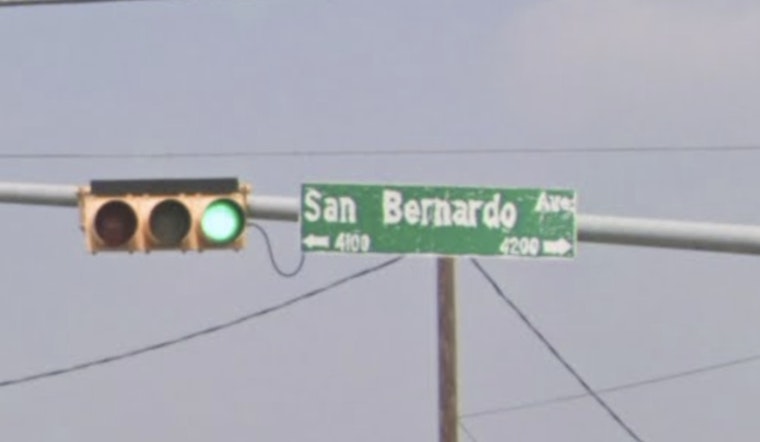
A 43-year-old man is behind bars in Laredo after police say he stabbed another man along San Bernardo Avenue and then hid under a pile of cardboard behind a nearby business until officers tracked him down. Jose Salazar now faces a second-degree felony charge of aggravated assault with a deadly weapon, and the weapon police say he used was something most people keep in a kitchen drawer: a small pair of scissors.
According to the Laredo Morning Times, the Laredo Police Department received a report on Tuesday that a man had been stabbed and had fled the scene in the 4200 block of San Bernardo Avenue. EMS crews treated the complainant at the scene, though the man's condition and identity have not been disclosed. Police say Salazar was arrested after the stabbing, and officers eventually found him hiding under cardboard behind a business nearby.
Officers seized a small pair of scissors as evidence and detained Salazar at the scene, the outlet's report notes. He was booked into the Webb County Jail and, as of Thursday, was being held on a $30,000 bond. Under Texas criminal procedure, suspects held on bonds of that size at county facilities must post the full cash amount or work through a licensed bail bondsman to secure release while their case moves forward, according to Hindieh Law.
How Scissors Became a Felony Weapon
It might seem strange that scissors could turn a street fight into a second-degree felony, but Texas law makes that leap fairly easily. Under Texas Penal Code § 1.07(a)(17), ordinary household items can legally count as deadly weapons if the way they're used, or intended to be used, is capable of causing death or serious bodily injury, per the Thiessen Law Firm. Texas appellate courts have repeatedly upheld that standard specifically in cases involving scissors, according to Justia Law.
That classification carries real weight for Salazar. Aggravated assault with a deadly weapon is a second-degree felony under Texas Penal Code § 22.02, punishable by two to 20 years in state prison and a fine of up to $10,000, according to Varghese Summersett. The charge could have been even more severe: the statute elevates aggravated assault to a first-degree felony, carrying five to 99 years or life in prison, when the victim is a public servant, security guard, family member, or a witness targeted in retaliation. Nothing in the case as reported suggests any of those enhancements apply here.
Limited Chance of Probation if Convicted
The charge also carries a designation that could shape Salazar's path through the justice system regardless of how a trial turns out. Aggravated assault with a deadly weapon is classified as a “3G” offense under Texas Code of Criminal Procedure Article 42A.054, which restricts judges from granting community supervision and affects how much of any eventual sentence must be served before parole becomes possible, per Varghese Summersett's analysis. Before the case can reach a district court trial, Webb County prosecutors will need to present it to a grand jury for indictment, unless Salazar waives that step, according to Hindieh Law.
A Corridor With a Recent History of Violence
The stretch of San Bernardo Avenue where the stabbing happened is a major commercial strip running parallel to Interstate 35, and it has seen other violent incidents this year. KFXV Fox News Rio Grande Valley reported a midnight shooting on the corridor in April and a drive-thru road rage stabbing at a nearby restaurant in June. Laredo's police department, which fields more than 500 sworn officers for a city of roughly 265,000 residents on an annual public safety budget near $84.9 million, according to Police Scorecard, has not detailed what led up to this latest confrontation. Municipal departments across South Texas commonly lean on targeted patrols along busy commercial zones to try to deter this kind of street violence, as Hoodline has reported before.
What sparked the altercation between Salazar and the man he's accused of stabbing remains unclear, and police have not released the condition of the man treated at the scene by EMS. Those details, along with any additional charges that could follow a grand jury review, are expected to emerge as the case moves through Webb County's court system.





