

























































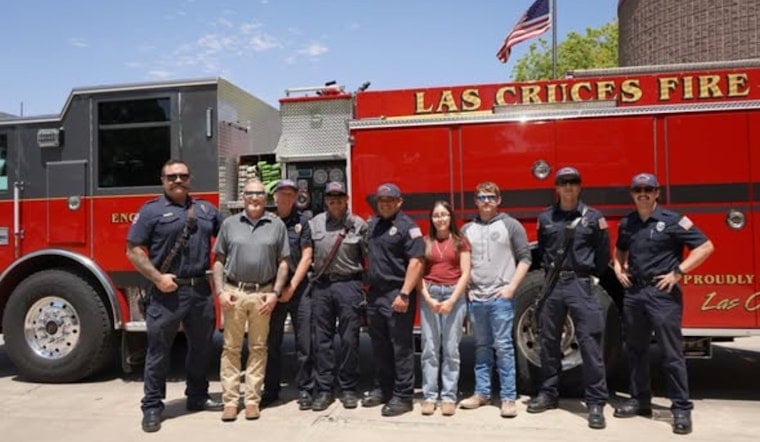
Keith Freeman is alive today because a stranger did not hesitate. When the Las Cruces resident went into cardiac arrest on March 7, a bystander immediately began chest compressions before firefighters and EMTs ever reached the scene, and that quick action helped keep Freeman alive until crews arrived to take over his care.
The Las Cruces Fire Department shared the story of Freeman's survival in a Facebook post, describing how he and his wife later came back to the station to personally thank the crews who responded that day, according to Las Cruces Fire. The department said the couple's visit “reminded” responders why they do the work they do. The identity of the bystander who started CPR has not been released, and the fire department has not said whether he has been publicly recognized beyond its own account of the incident.
A Chain of Survival That Started Before Crews Arrived
Las Cruces Fire credited the bystander's quick intervention as a direct contributor to Freeman surviving the emergency. The department also noted that responding crews train for cardiac emergencies every day, and that automated external defibrillator use can increase a person's odds of survival after cardiac arrest when one is available.
That framing lines up with what national data shows. According to 2025 guidelines from the American Heart Association, roughly 350,000 out-of-hospital cardiac arrests occur every year in the United States, with a fatality rate near 90 percent — but immediate bystander CPR can double or triple a patient's chances of survival. Separate research published by the same organization in November 2024 found that CPR administered within two minutes of a cardiac arrest produces the best odds of survival and preserved brain function, though some survival benefit remains even if compressions begin as late as 10 minutes in.
How Las Cruces Fire Stacks Up Nationally
Freeman's case fits into a broader pattern for the department. The City of Las Cruces reported that LCFD responded to 14,527 emergency medical calls citywide in 2023 and achieved a field return of spontaneous circulation rate of 34 percent across all cardiac arrest calls — a measure of how often a patient's pulse is restored before ever reaching the hospital.
A peer-reviewed study published in EMS Airway in March 2021 found LCFD achieved a 35 percent return of spontaneous circulation rate with an average EMS response time of 6.8 minutes, outperforming the global pooled average of 29.7 percent. That same study noted that 54 percent of cardiac arrests in Las Cruces were witnessed by either bystanders or responders, underscoring how often someone nearby has the chance to intervene before help arrives. The department's capacity to respond quickly is bolstered by its staffing: as of a February 2021 report from the Las Cruces Bulletin, LCFD maintained 170 firefighter-EMTs, including 46 certified paramedics, and operated three 24-hour dedicated Squad ambulances built to get advanced cardiac life support started on scene.
Legal Protections for Bystanders Who Step In
New Mexico law offers legal cover for people who step in during emergencies like Freeman's. Under the state's Cardiac Arrest Response Act, Good Samaritans who use an automated external defibrillator to render emergency care are protected from civil liability, provided they do not act with willful, wanton, or reckless misconduct, per Justia Law. The state also requires facility AED programs to meet registration and maintenance standards.
New Mexico administrative code additionally requires all 911 telecommunicators who give pre-arrival medical advice to obtain Emergency Medical Dispatcher licensure and CPR certification within a year of being hired. Those rules mean a dispatcher can often walk a caller through hands-only CPR before crews even leave the station, adding another layer to the chain of survival that helped Freeman.
Part of a Broader Local Push on Emergency Response
Freeman's recovery comes amid a series of specialized initiatives from the Las Cruces Fire Department in recent years. In March 2023, the department launched Project LIGHT — Lessen the Incidence of Grief, Harm & Trauma — which pairs a firefighter or paramedic with a social worker to respond to non-violent behavioral health calls, overdoses, and cardiac arrest scenes six days a week through 911 dispatch.
The department's emergency medical work has also drawn individual recognition. LCFD's Mobile Integrated Healthcare program lead, Paul Ford, was named New Mexico's EMS Provider of the Year in October 2024 for his leadership in EMS education and community care, a program he has led since 2017, as per Hoodline. For Freeman and his wife, the thanks they extended to the crews at the station were personal — but the department's broader message is that survival in moments like his depends on a full sequence of people acting fast, starting with the stranger who did not wait for help to arrive.





