

























































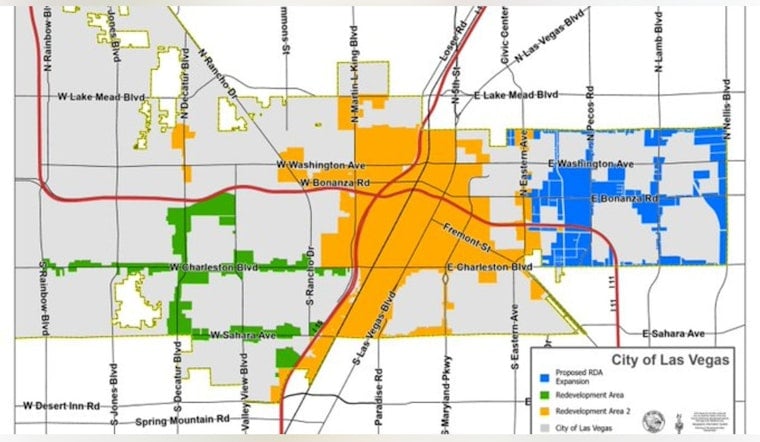
The Las Vegas City Council voted Wednesday to adopt Redevelopment Area 3, a new plan covering roughly 1,350.23 acres of noncontiguous land across East Las Vegas within Ward 3. The district is bordered by Owens Avenue to the north, Nellis Boulevard to the east, Charleston Boulevard to the south, and 21st Street to the west, according to a map and announcement shared by the city.
According to the City of Las Vegas, the vote formally establishes the boundaries for a redevelopment plan targeting parcels across that stretch of the East Las Vegas valley. The designation was backed by a municipal blight study conducted ahead of the vote, which found that 64% of properties within the proposed district showed visible physical deterioration, while roughly 81 acres of vacant land were contributing to public safety issues and illegal dumping, per Citizen Portal.
A Long-Planned Piece of the Nuestro Futuro Vision
Establishing RDA 3 fulfills a primary recommendation of the “Nuestro Futuro, East Las Vegas Special Area Plan,” which the Las Vegas City Council formally adopted back in June 2023 to transform aging commercial corridors into walkable, mixed-use hubs, according to a staff report filed with the city. The new district is not a single construction project but a regulatory and financial framework, giving the city power to offer small business grants, subsidize infrastructure, assemble land, and spur private investment along commercial corridors in the ward.
The Las Vegas Redevelopment Agency, originally established in 1986 under Nevada Revised Statutes Chapter 279, had previously managed only two districts. Redevelopment Area 1 covers about 3,948 acres in downtown Las Vegas, while Redevelopment Area 2 covers about 1,049 acres along major commercial corridors like Sahara Avenue and Charleston Boulevard, the city's Redevelopment Agency notes. RDA 3 marks the agency's first expansion beyond that original two-district footprint.
Tax Increment Financing Unlocks New Funding Stream
Adoption of the plan unlocks tax increment financing, or TIF, allowing property tax revenue growth within the 1,350-acre boundary to be captured and reinvested locally into infrastructure improvements, land assembly, and commercial grants rather than flowing into the city's general revenue. That mechanism, detailed in filings reviewed by Bedrock, is the central financial tool the council's vote puts into motion, though how quickly TIF revenues accumulate to fund noticeable public improvements remains an open question for the district going forward.
Ward 3 is represented by Councilwoman Olivia Díaz, who was appointed Mayor Pro Tem on July 1, 2026, and serves a district of more than 109,000 residents that is over 65% Hispanic, with more than 37% of workers employed in the service industry, according to the city. Public outreach ahead of the council vote included a dedicated June 24 community meeting at Desert Pines High School featuring live headset translations in Spanish and English, following formal mail notifications sent to all property owners within 500 feet of the boundary.
Regional Review and a Broader 2050 Growth Strategy
Because the RDA 3 boundary lies within one-half mile of both the City of North Las Vegas and unincorporated Clark County, planners were required to process a “Project of Regional Significance” notification for the district, a step that reflects its inter-jurisdictional footprint. The creation of RDA 3 also aligns with the City of Las Vegas 2050 Master Plan, adopted in July 2021, which shifts municipal planning focus toward urban infill and revitalization as raw undeveloped land in the valley grows scarcer.
RDA 3 complements other major projects already underway in Ward 3, including the transformation of the former city-owned Desert Pines Golf Course into more than 1,500 mixed-income housing units, community space, and workforce training facilities — a project Hoodline previously covered as the golf course closure. The ward has also seen recent recreational investment, including a splash pad groundbreaking at Gary Reese Freedom Park led by Díaz, and the city has separately rolled out incentive programs, security grants, and rebate offerings available across its redevelopment districts.
Questions remain for future reporting on how existing small business owners and low-income residents in the district will be protected from potential displacement or gentrification as investment flows in, and how RDA 3's finances and planning will interface with neighboring North Las Vegas and Clark County jurisdictions in practice.





