

























































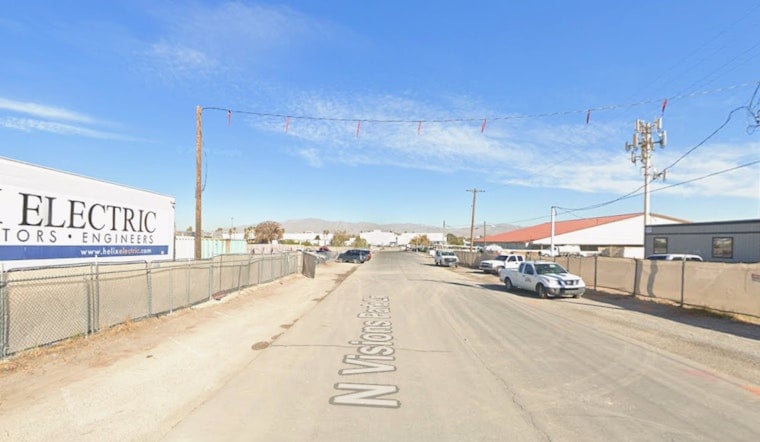
Clark County officials cut the ribbon this week on Visions Park, a 99-unit affordable housing complex at 950 Visions Park Lane built from the ground up for people who are blind or have severe vision loss. The $40 million project sits on 4.5 acres next to the Blind Center of Nevada campus near Cashman Field, giving residents direct access to the job training, meals and daily support programs the center already runs on-site.
Clark County put in $8 million toward the project through its Community Housing Funds, according to a post from Clark County Nevada. That county contribution was just one piece of a much larger financing puzzle. As FOX5 Las Vegas and the Blind Center of Nevada have detailed, the full $40 million budget was assembled from $4 million in City of Las Vegas ARPA funding, a $1.25 million grant from the Federal Home Loan Bank of San Francisco, State of Nevada Home Means Nevada funds, and matching endowment grants from the Engelstad Foundation and Beverly Rogers.
Built With Blindness in Mind
The complex was designed by Creative Design Group and built by B&H Construction with features aimed squarely at residents with severe visual impairment, including custom high-contrast lighting, wide doorways, roll-in showers and audio-tactile flooring that emits distinct acoustic cues to help residents navigate, per reporting from FOX5 Las Vegas. Those adaptations make Visions Park the first multi-family residential community built ground-up in Nevada specifically for visually impaired individuals, the station notes.
Hoodline first reported on the project when it broke ground in September 2024, when the estimated budget stood near $30 million. That figure has since climbed to $40 million as the full slate of public and private funding came together ahead of this year's grand opening.
Cutting Commute Times for Blind Center Members
Locating the complex directly next to the Blind Center's North Bruce Street campus is expected to save residents an estimated one to two hours in daily commute time each way when they head to job training, meals or other specialized programs, according to FOX5 Las Vegas. Many visually impaired residents rely on public paratransit, which can involve long transit delays, making a next-door location more than a convenience.
The financial stakes behind that convenience are steep. Blind Center of Nevada data shows more than 90% of its members live below the extreme low-income threshold, and over 70% of legally blind Southern Nevadans are unemployed and depend solely on Social Security Disability benefits of $1,000 or less per month.
How the Waitlist and Vouchers Work
Property manager Accessible Space Inc. opened the Section 8 Project-Based Voucher waiting list in June, ahead of resident move-ins that began in July and August. The nonprofit administers the property alongside the Southern Nevada Regional Housing Authority, and the waitlist applies preference to applicants who meet the federal criteria for statutory legal blindness — defined as central visual acuity of 20/200 or less in the better eye with correction, or a visual field of 20 degrees or less.
U.S. Senator Catherine Cortez Masto toured the site in April to promote federal housing legislation, including the 21st Century ROAD to Housing Act, and to spotlight the Federal Home Loan Bank's Nevada Targeted Fund, according to the Office of U.S. Senator Catherine Cortez Masto. Her office notes that Cortez Masto helped establish that targeted fund, which directed federal grant dollars toward building Visions Park.
A Statewide Housing Shortage
The project lands in the middle of what the National Low Income Housing Coalition calls the nation's most severe shortage of affordable housing. The coalition's 2026 reporting found only 16 to 17 available and affordable rental homes for every 100 extremely low-income renter households statewide, and roughly 10 to 13 per 100 in the Las Vegas metro area alone.
Clark County's $8 million grant came from its $120 million Welcome Home Community Housing Fund, a county initiative created to finance construction or rehabilitation of more than 3,100 affordable housing units across Southern Nevada, according to Clark County Nevada. Whether that fund will back similar targeted supportive housing for other disabled populations remains an open question as the county continues allocating its remaining dollars.




