

























































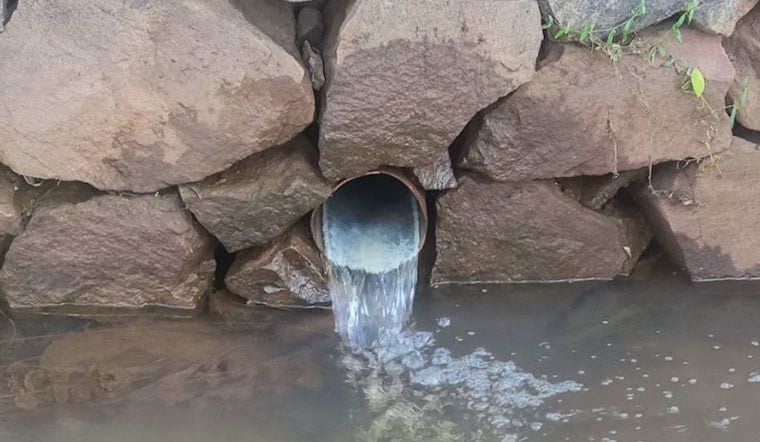
A week after Missouri regulators confirmed raw and partially treated sewage was pouring out of Leadwood's wastewater plant, updated testing shows E. coli levels in the Big River still sitting far above what officials consider safe for swimming or wading. The Leadwood Water Treatment Plant site itself registered 1,732.9 colony-forming units of E. coli per 100 milliliters, while downstream sites at Bone Hole swimming basin and Hunt Street Leadwood Access came back at 80.1 and 73.8 CFU per 100 mL respectively — both still above the 190 CFU per milliliter threshold officials use to warn against contact, but showing the contamination has spread well beyond the plant itself.
Missouri's Department of Natural Resources released the updated results this week, according to KSDK, which reported that officials are now warning the public not to swim anywhere along the Big River stretch from Leadwood Access to Owl Creek Park in St. Francois County. Mounts Big River Access, further downstream, showed 150.0 CFU per 100 mL, and public health advisory signs posted along the affected stretch warn both people and livestock to avoid contact with the water. Officials attribute the contamination to seriously degraded and ineffective treatment equipment at the Leadwood plant.
The scale of the problem became clear earlier this month, when testing at the plant's outfall and a point 300 yards downstream showed E. coli concentrations exceeding 2,419 CFU per milliliter — the maximum level Missouri's state lab equipment can even measure. An upstream access site still registered 866 CFU/mL, according to KFMO, which reported that the testing was triggered after residents complained about visible sewage discharge in the river. Those readings dwarf the state's regulatory standard for whole-body contact recreation waters, which under 10 CSR 20-7.031 caps a single sample at 235 CFU per 100 mL and sets a monthly average limit of 126 CFU per 100 mL.
Regulators Found Raw Sludge Weeks Before Warnings Went Out
State inspectors had already documented the underlying failure well before advisories reached the public. During a June 29 site visit, Missouri DNR confirmed untreated solids discharging directly from the Leadwood facility outfall into the Big River watershed — a sign, per the agency, that the plant's mechanical treatment system had been faltering since 2023. The Leadwood Wastewater Treatment Facility discharges into an unnamed tributary of Eaton Branch roughly 0.1 miles above where it meets the Big River, with elevated bacteria detected as far as Bone Hole Access, three to four miles downstream, the agency's records show.
On August 4, the City of Leadwood signed a binding Administrative Order on Consent with the state, Order No. 2026-WPCB-1890, setting up a legal framework for engineering reviews and long-term plant upgrades. State officials had been negotiating with the city over permit noncompliance since May. To help stabilize the situation on the ground, the Department of Natural Resources is installing a replacement pump designed to move sludge and solids from the plant clarifier to the sludge holding basin, which officials say should help the plant treat wastewater more efficiently and reduce E. coli levels released into the river, per KSDK's reporting.
The stopgap fixes have required help from beyond city limits. The neighboring City of Bismarck assisted in clearing a plugged return line and agreed to accept excess biosolids, while the Missouri Rural Water Association drafted a sludge management plan, the outlet notes — a reflection of the fact that Leadwood lacked the internal capacity or working equipment to clear the accumulated sludge on its own.
A Town Already Flagged for Financial Mismanagement
The infrastructure collapse lands against a backdrop of documented financial trouble. A prior Hoodline report detailed a February state audit that gave Leadwood a Poor financial rating after finding officials spent $103,360 in federal COVID-19 relief funds on improper employee bonuses instead of wastewater infrastructure, and failed to conduct required annual utility audits. Auditors found that 88% of the city's federal SLFRF funds were misused between 2021 and 2022.
With an estimated 2026 population of just 1,152 residents and a poverty rate of 36.01%, Leadwood has limited means to fund a multi-million dollar plant replacement on its own, according to World Population Review data. The city is now seeking low-interest loans through the state's Financial Assistance Center, and local and state officials say immediate repairs and long-term system upgrades will need support from state emergency funds. Leadwood is also considering additional treatment options to improve plant operations going forward.
Part of a Wider Pattern Across Missouri
Leadwood's crisis is not an isolated case. A July report from Environment America found that nearly 70% of tested recreational water sites across 17 states, including Missouri, exceeded EPA-recommended bacterial safety thresholds at least once over a two-year evaluation period, with aging municipal infrastructure cited as a leading driver of bacterial spikes in Midwestern streams — a trend Hoodline examined statewide earlier this month.
The Big River has faced separate safety concerns elsewhere along its course. In May, Jefferson County council members voted 5-2 to extend a ban on swimming and wading at Rockford Park through April 2027, though that restriction stemmed from dangerous hydraulic undercurrents rather than bacterial contamination. For now, officials continue to recommend against swimming anywhere the water tests above 190 CFU per milliliter, a bar the Big River near Leadwood is still failing to clear.



