

























































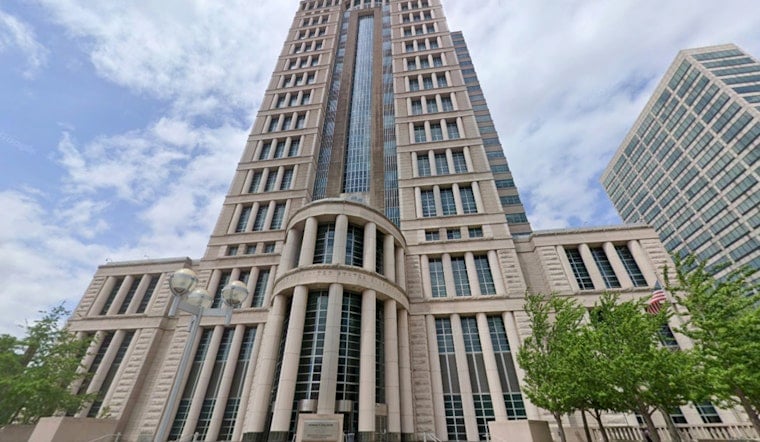
New U.S. citizens sworn in at the Thomas F. Eagleton U.S. Courthouse in downtown St. Louis will no longer be able to register to vote inside the building. A court order issued August 6 directs the League of Women Voters and other third-party nongovernmental groups to halt voter-registration activities inside the courthouse, forcing volunteers to set up on the public sidewalk instead.
The order came from the U.S. District Court for the Eastern District of Missouri, which told the League to move its sign-up work outside the building, according to the St. Louis Post-Dispatch. Court officials said they acted out of an abundance of caution, per the same report, and noted the ban should not affect naturalization ceremonies conducted by judges inside the courthouse itself. The League said other chapters and organizations around the country received similar emails, though it described the St. Louis courthouse as the only one in the country known to have issued an administrative order of this kind.
The League has a longstanding practice of registering new citizens at the courthouse right after naturalization ceremonies, calling the nonpartisan work a mainstay of its volunteer activity for decades. That civic-integration mission traces back to the organization's founding in 1920, following ratification of the 19th Amendment, according to the Campaign Legal Center. Chief Judge Stephen R. Clark, who has led the Eastern District of Missouri's bench since 2018 and became chief judge in 2022, oversees administrative orders for the district, per Ballotpedia.
League Pushes Back, Requests Meeting With Chief Judge
The League has requested a meeting with the chief judge and says it plans to do everything it can to persuade the court to reconsider the August 6 decision. A different chief judge, identified in the Post-Dispatch report only as Chief Judge Julie A., declined to provide a copy of the underlying court order. The League also said the situation in St. Louis is unique and it has contacted the St. Louis city and county election boards as it works out its next steps.
Locally, voter registration records and polling operations fall under the St. Louis City Board of Election Commissioners, a bipartisan four-member panel appointed by the Missouri governor and required by state law to split evenly between Democrats and Republicans, according to the City of St. Louis. For now, the League plans to register new citizens on the sidewalk outside the courthouse and says it remains committed to continuing the work jointly with partner groups.
A Narrow Window Before Missouri's Registration Deadline
The timing adds pressure. The next naturalization ceremony at the courthouse is scheduled for September 22, and Missouri's deadline for residents to register ahead of the November 3 general election is October 7 — leaving newly sworn citizens roughly two weeks to get registered. Missouri law requires mailed registration applications to be postmarked at least 27 days before an election, according to the Fair Elections Center.
Local university volunteers are also affected by the shift. Groups like WashU Votes at Washington University in St. Louis regularly partner with the League of Women Voters of Metro St. Louis to train volunteers who help with registration outside naturalization ceremonies, according to the Gephardt Institute at Washington University in St. Louis.
A Broader National Fight Over Registration Access
The St. Louis order arrives amid a shifting national landscape over voter registration at naturalization events. On August 3, a federal judge in Maryland issued a preliminary injunction blocking a U.S. Citizenship and Immigration Services rule that had restricted nongovernmental groups from conducting voter registration at administrative naturalization ceremonies, in a lawsuit brought by the national League of Women Voters, per the Campaign Legal Center. Following that ruling, USCIS issued a policy alert on August 12 temporarily restoring 2017 guidance allowing outside groups to distribute and collect voter registration applications at administrative ceremonies — those run by USCIS rather than federal judges.
That federal policy reversal stands in contrast to the independent authority individual courts hold over their own buildings. Executive Order 14248, signed in early 2025, had already revoked a Biden-era order that instructed federal agencies to expand voter registration access and work with third-party groups on federal property, according to Holtzman Vogel. The Eagleton Courthouse itself is a hard building to miss — a 29-story, 557-foot tower dedicated in 2000 at a cost of $186 million, and, according to Wikipedia, the largest single courthouse in the United States by square footage. Beyond hosting the Eastern District of Missouri, it also serves as regional headquarters for the U.S. Court of Appeals for the Eighth Circuit, which hears federal appeals from seven Midwestern states.





