

























































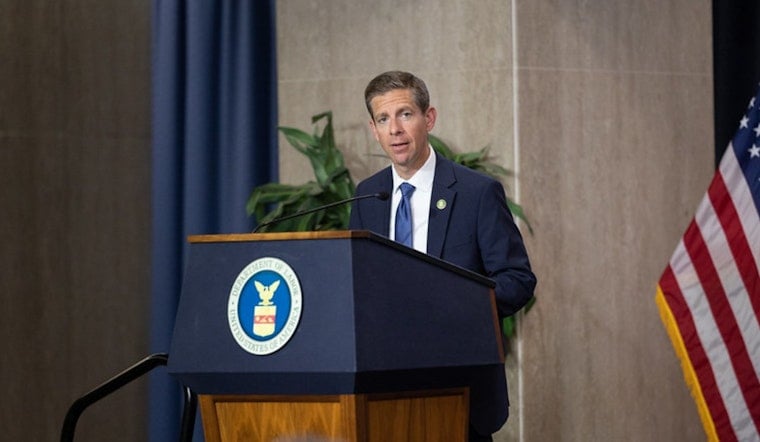
Rep. Mike Levin sat down with labor, environmental and consumer groups in Del Mar this week to preview a House Democratic plan aimed at gas and utility prices, telling the gathering that rates are climbing and families are falling behind. The San Diego County Democrat, who has represented the 49th Congressional District in Congress since January 2019, said energy bills are crushing consumers even as the price of gasoline in San Diego has jumped from $4.69 a gallon on February 28 to $5.69 on Sunday.
House Minority Leader Hakeem Jeffries appointed Levin as co-chair of an affordability working group, and Levin said the group will develop legislation covering gas and utility prices, with plans to introduce bills within the first hundred hours, first hundred days and first year of a Democratic House majority, according to The San Diego Union-Tribune. Levin said a final version of the plan will be released before the November election, when he faces Republican challenger Armen Kurdian in a rematch for the seat.
Levin pointed to the war in Iran as a driver of higher gasoline prices and said he plans to raise, reasserting congressional war powers authority over that conflict as part of the working group's agenda. He also cited opposition to presidential tariffs imposed on Canada and Mexico. The president has said he would cut electric bills in half and dramatically reduce gasoline prices, but Levin said, per the same account, that energy costs have moved in the opposite direction of those promises.
The Numbers Behind the Frustration
San Diego Gas & Electric has increased its average residential rates by 97% over the past ten years, according to a Public Advocates Office report cited in the Union-Tribune's account, while Southern California Edison's rates climbed 101% and Pacific Gas & Electric's rose 69% over the same period. California's average residential electricity rates have grown faster than inflation, the paper noted, and separate federal data show the state's average rate hit 33.25 cents per kilowatt-hour in May, the second highest in the nation behind Hawaii and roughly 80% above the national average, according to CaliEnergy.
The financial strain is showing up in unpaid bills. A June report from the Public Advocates Office at the California Public Utilities Commission found that more than 2.4 million California households, or 20.6%, were behind on their energy bills as of May, including 253,820 SDG&E customers who owed an average past-due balance of $501. Overall utility debt among the state's investor-owned utilities exceeded $1.5 billion, the office reported.
SDG&E's Own Rate Request Looms
Even as regulators tally the arrears, SDG&E is pursuing its own increase. The utility presented a 2028 General Rate Case proposal to state regulators in July requesting an average 8.6% bump in monthly residential electric bills to fund grid reliability, wildfire mitigation and infrastructure work, according to KPBS, which reported that the CPUC review process takes roughly 18 months before a final decision. Hoodline previously covered that request in SDG&E's bid for an 8.6% hike.
The rate request comes as SDG&E's parent company continues to post strong earnings. Sempra, the San Diego-based corporation, reported first-quarter GAAP net income of $1.04 billion, up 15% from $906 million a year earlier, with its California utility operations generating about $720 million of that profit, Hoodline reported in its coverage of Sempra's 15% profit jump. The company has also reaffirmed a five-year, $65 billion capital investment plan focused on regulated infrastructure.
Some relief has already reached ratepayer bills through state programs. The CPUC shifted the delivery timeline of the Cap-and-Invest-funded California Climate Credit this year, sending $49.36 electric credits directly to SDG&E residential accounts in August and September to help offset peak summer cooling costs, with gas customers having received a separate $32.58 credit in April. Separately, following a 2024 CPUC ruling under Assembly Bill 205, SDG&E introduced a $24.15 monthly base service fee for standard residential customers in late 2025 while cutting volumetric per-kWh delivery rates by roughly 10%; low-income households enrolled in CARE or FERA pay reduced fixed charges of $6 or $12.
Levin Defends State Climate Policy, Vows to Protect LIHEAP
Levin argued that California's renewable-energy benefits outweigh its drawbacks, pointing to state investments in reducing greenhouse gas emissions and air pollution, renewable energy, distributed generation and vehicle electrification. California has pledged to derive 100% of its electricity from carbon-free sources by 2045 or sooner and maintains a renewables portfolio standard with mandatory targets for electricity providers. The state's cap-and-invest program, administered by the California Air Resources Board, sets a legally binding declining limit on about 80% of California's greenhouse gas emissions and requires industries to buy allowances for each metric ton they emit, an arrangement meant to push cleaner technology adoption. The board also approved a 2022 scoping plan committing to no new natural gas-fired power plants.
Levin said he intends to protect the Low Income Home Energy Assistance Program, which the Trump administration proposed eliminating during budget talks earlier this year. California was allocated $236.7 million in LIHEAP block grant funding for the current federal fiscal year, according to the California Department of Community Services & Development, with eligible households able to receive up to $1,500 in direct bill assistance.
Kurdian Pushes a Different Fix
Kurdian, a retired Navy captain who lives in Vista, countered that the energy industry does not need mandates and argued that over-regulation and California energy policies have made refinery work difficult in the state. He said drillers should have the opportunity to extract more oil, framing the state's climate rules as a driver of higher costs rather than a solution. Kurdian advanced past two other Republicans in the June primary to face Levin again in November.
The political stakes are steep for Levin's plan. Republicans currently hold a 218-212 advantage over Democrats in the House, which has four vacancies, one created when Eric Swalwell resigned from Congress in April following multiple allegations of sexual misconduct. An independent member caucuses with the Republican Party, meaning House Democrats would need to flip a net of four seats in November to secure a majority and move the working group's legislation forward. Whether that plan reaches voters as a finished product depends on both the November outcome and the report itself, which remains in draft form.





