

























































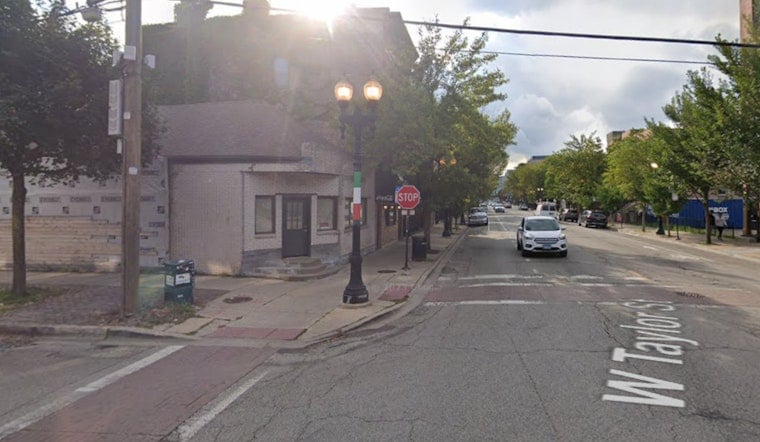
The vacant Taylor Street storefront that will soon house Chicago’s exiled Columbus statue is racing toward an October opening, with structural renovations complete and roughly four weeks of work still ahead. The Florence Scala Italian American Museum, at 1501 W. Taylor St. in Little Italy, now plans to open on October 12 after renovations were not finished in time for an initially hoped-for August debut, even as the neighborhood’s Taylor Street Little Italy Festa runs through Sunday just outside its doors.
Ron Onesti, president of the Joint Civic Committee of Italian Americans, has been in talks to create the museum since 2024 and found the vacant Taylor Street property that same year, according to Block Club Chicago. His company also runs the Taylor Street festival now underway, the outlet reports. The museum’s exterior was mostly finished ahead of the street festival, and its interior is currently a single room with exposed brick and wood flooring, per the same account.
Moving a 4,500-Pound Icon
The statue at the center of it all — a 4,500-pound bronze Christopher Columbus sculpted in 1893 for the World’s Columbian Exposition Italian Pavilion, according to the Chicago Park District — is currently being cleaned inside a park district warehouse, Block Club Chicago reports. Getting it into the museum will require a large hole in the ceiling and a crane, since Onesti said the statue cannot simply be wheeled inside because of its weight and the building’s floors. Once installed, it will rest on a concrete platform inside the museum as its centerpiece.
The statue’s journey to Taylor Street traces back to a 2021 lawsuit that Onesti’s committee filed over its removal from Arrigo Park, the outlet notes. Chicago officials pulled the Columbus statues from Grant Park, Arrigo Park and South Chicago’s Drake Fountain in July 2020, after the monuments had drawn protests, vandalism and calls for removal that same month. The Arrigo Park statue was ultimately given to Onesti’s committee as part of a 2025 settlement, according to the report — an agreement that, per the Chicago Park District, resolved the litigation by loaning the statue to the JCCIA for indoor display while permanently barring its return outdoors.
A Settlement That Split Opinion
That deal also required construction of a replacement statue dedicated to Frances Xavier Cabrini, the patron saint of immigrants. The new Cabrini monument will go up on the same Arrigo Park plinth where Columbus once stood, according to WTTW, after Cabrini won roughly 38% to 40% of the 3,900 votes cast in an early-2026 Chicago Park District online poll that also included physicist Enrico Fermi, Justice Antonin Scalia and activist Florence Scala herself, as reported by CBS News.
Not everyone in Chicago’s Italian American community has embraced the compromise. Lou Rago, president of the Italian American Human Relations Foundation of Chicago, has called the arrangement “cultural treason” and “a burial,” arguing the statue is being hidden from public view, according to the Chicago Contrarian. Onesti has instead framed the museum as a way to protect the statue, saying the community seeks respect and sensitivity for its cultural importance and describing it, per Block Club Chicago, as an icon of faith and hope for Italian Americans. The Chicago Monuments Project, an advisory panel established by then-Mayor Lori Lightfoot, had recommended in August 2022 that all three city-owned Columbus statues be permanently retired or kept in storage, after reviewing more than 500 public monuments citywide, according to CBS News.
Named for a Neighborhood Fighter
The museum’s namesake, Florence Scala, co-founded the Harrison-Halsted Community Group in 1961 to oppose Mayor Richard J. Daley’s urban renewal plan that razed much of Little Italy to build the University of Illinois Chicago campus, according to background compiled by MAS Context. Scala fought to protect immigrants threatened by hostile development and policing tactics on the Near West Side, and she was targeted by a bombing attack in 1962 amid that fight, per Block Club Chicago. Her resistance effort included an injunction lawsuit that reached the U.S. Supreme Court before closing in March 1963.
The exhibits inside will trace that broader history. The museum will include a chronological history of Italians in Chicago, with exhibits focused on Italian immigration to the city between 1880 and 1970, Block Club Chicago reports — spanning from Henri de Tonti’s movement through the Chicago area with the French military in the 1600s to the 1891 New Orleans mob lynching of 11 Italian Americans, an event often cited alongside the 1892 establishment of Columbus Day as a recognition of Italian American heritage and history.
Before urban renewal reshaped the area, the Near West Side was one of Chicago’s most integrated neighborhoods, with Italian and Greek immigrants making up roughly 46% of the population in 1960 and African Americans about 53%, according to Segregation by Design. The Joint Civic Committee of Italian Americans, founded in 1952 as an umbrella coalition representing more than 60 local organizations, has served for decades as the primary civic voice for the community, according to Fra Noi. Hoodline previously reported on the federal court fight over the statue’s removal, part of the yearslong dispute that now culminates with the statue’s planned move indoors this fall.





