

























































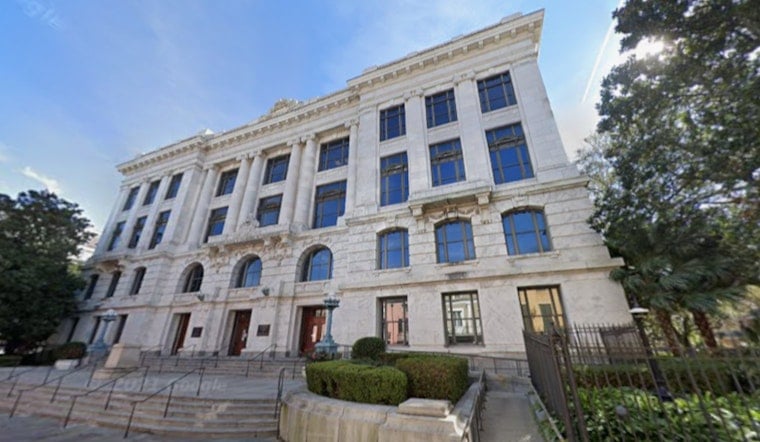
A jury in Plaquemine took just 35 minutes to decide that The Advocate defamed Louisiana Supreme Court Justice Jefferson Hughes III in a 2019 editorial, awarding him $300,000 late Monday night — far short of the $10 million he had sought. The verdict capped a trial that dug into Hughes's handling of a child custody case decades earlier, when he was a district judge in Livingston Parish, and his romantic relationship with one of the attorneys involved.
The civil defamation trial opened with jury selection and opening statements on August 18 at the Iberville Parish courthouse in Plaquemine, according to NOLA.com. The case centered on a 2019 editorial that followed a front-page Sunday story published two days earlier, both stemming from Hughes's rulings in a custody case involving a boy's parents in the late 1990s. The editorial accused Hughes of turning his handling of the case into what it called a mockery of justice, alleging he ruled on the matter while his girlfriend, attorney Berkley Durbin, represented the boy's mother.
Hughes and his attorneys countered that the timeline was wrong — that Durbin had removed herself from the custody case in August 1998, months before the two began dating toward the end of that year, and well before Hughes issued his final ruling in March 1999. The justice testified he never ruled on any of Durbin's cases while the two were dating, and noted a subsequent order in the matter was signed by a different attorney, not Durbin. He acknowledged presiding over an unrelated case in July 1999 in which Durbin appeared as a lawyer.
A Newsroom Partnership Faces Scrutiny in Court
The 2019 investigative reporting that preceded the editorial was a joint project between The Advocate and New Orleans CBS affiliate WWL-TV, according to WWL-TV. That original reporting revealed three formal apology letters in which Hughes acknowledged that justice suffered in the case, letters written years after he presided over it and that had previously drawn scrutiny from federal prosecutors and the Louisiana Judiciary Commission, per the same investigation. Child welfare advocates had objected to Hughes's custody decision shortly after his final ruling, according to facts presented at trial.
The Advocate later agreed to run a front-page story about Hughes's views a few weeks after the editorial ran, and in 2022 the paper issued a clarification revising the editorial to state that Durbin had left the custody case before Hughes's final ruling. Attorney Charles Hughes, who represented the justice alongside Carl “Trey” Woods III and Caleb Didriksen, argued that The Advocate should have corrected its error sooner. Speaking after the verdict, he said the case was never about the size of the jury award, adding that justice was served.
Defense Cited Judicial Secrecy Rules as a Roadblock
Attorneys for The Advocate, led by Scott Sternberg, argued the editorial did not assert what Hughes claimed and that the justice failed to prove the paper's journalists intended to publish false information — the actual malice standard public officials must meet in defamation cases. Sternberg urged jurors to read the underlying articles themselves before reaching a decision. Ahead of trial, defense attorneys complained that Louisiana's judicial secrecy rules blocked them from inspecting confidential state Judiciary Commission files on Hughes, saying, according to WBR Independent, that they had to defend the paper “with one hand tied behind our back.”
During trial testimony, defense attorneys did manage to introduce official records of Hughes's 2021 Louisiana Supreme Court censure to cross-examine a witness who admitted having no prior knowledge of the justice's public disciplinary record, the outlet reported. That censure, detailed by AP News, came in June 2021 after Hughes entered a consent agreement acknowledging he had improperly attempted to influence a political operative's campaign support during a 2019 Supreme Court election, a case unrelated to the custody matter at trial. He was ordered to pay more than $2,000 in investigation costs.
Decades of Secrecy Around Judicial Discipline
The clash over the Judiciary Commission's confidential files reflects a broader pattern in Louisiana, which operated under nearly 50 years of near-total secrecy regarding judicial misconduct complaints before instituting reforms in 2020 that limit district judges to a maximum of one secret admonishment every six years, according to WWL-TV. Hughes's underlying custody rulings came during his tenure as a district judge in Livingston Parish before he was elected to the First Circuit Court of Appeal in 2004 and then to the Louisiana Supreme Court in 2012, winning reelection without opposition in 2018, according to a Wikipedia summary of his career.
Hughes originally filed his civil defamation lawsuit against Advocate owner Capital City Press back in June 2020, but the case spent three years tangled in pre-trial appellate litigation over nonparty discovery subpoenas issued to the Louisiana Judiciary Commission, with the Louisiana First Circuit Court of Appeal weighing in on those disputes in 2023, according to FindLaw. Jury foreman Robert E. Davis later said jurors were ready to get the hell out of here after a marathon final day of testimony, a comment that underscored just how quickly the panel moved once deliberations finally began.
A Verdict That Bucks the Usual Odds
Kevin Hall, speaking on behalf of Georges Media Group, which owns The Advocate, thanked the jurors for their service and said the company stands by its journalism and remains committed to independent reporting. Under the First Amendment, publications generally have room for minor errors when the overall gist of a story is correct, and are permitted to express opinions and make news judgments — the legal terrain The Advocate's attorneys tried to hold as they argued Hughes had not proven actual malice.
The $300,000 verdict is notable nationally because successful defamation judgments by elected public officials against news organizations remain rare given that high constitutional bar. As The Guardian noted, the outcome landed just three days after an Alabama jury awarded $9.25 million against The New York Times in a separate high-profile media libel suit, adding this case to a string of recent setbacks for news organizations in public-figure defamation trials nationwide.





