

























































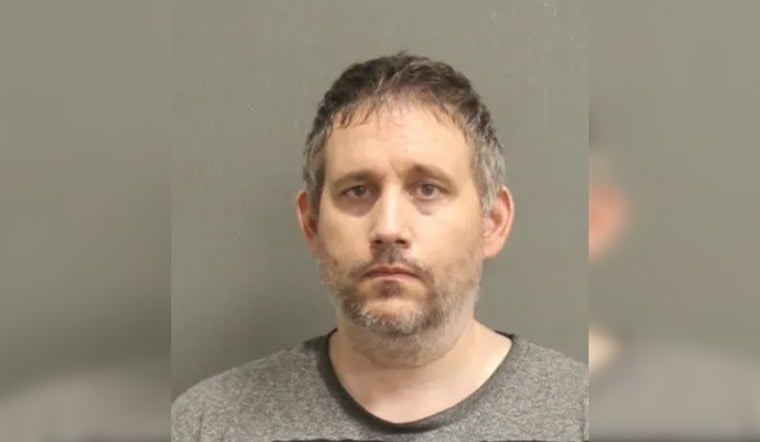
A 44-year-old convicted sex offender living in the Madison neighborhood of Nashville is accused of using artificial intelligence to create a child sexual abuse image and uploading it to Discord, according to the Metro Nashville Police Department. Timothy Waite II was already registered as an offender against children when detectives with the department's Special Victims Division took him into custody Wednesday and charged him with aggravated sexual exploitation of a minor.
Nashville metropolitan government officials confirmed Waite was actively on parole at the time of the arrest, according to Nashville.gov, meaning he was under state supervision when detectives showed up at his door. Detectives executed a search warrant at Waite's home along Donna Drive in Madison, as reported by WKRN News 2. The investigation was set in motion by a CyberTip from the National Center for Missing and Exploited Children that prompted the search warrant, per that report.
Waite remains jailed on a $45,000 bond, according to booking records cited by WKRN. Police say he faces additional anticipated charges as forensic work on the case continues.
A Prior Record That Triggered Tennessee Registration
Waite's placement on the state's offender monitoring list did not originate in Tennessee. According to the Tennessee Sex Offender Registry, as reported by The Tennessean, Waite was already designated as an offender against children because of two prior convictions for indecent assault. Those convictions happened out of state, and Tennessee law requires that out-of-state sexual offense convictions be mirrored on the local registry once someone relocates, according to the same registry records.
That prior designation is part of why Waite was under active parole supervision when the CyberTip surfaced. The station's report ties his history directly to the monitoring status that put him on police radar once the new allegation emerged.
How Tennessee's AI Laws Apply Here
The charge against Waite rests on a relatively new legal framework. In 2024, Tennessee enacted Public Chapter 911, amending Tennessee Code § 39-17-1002 to explicitly expand the definition of “material” under child sexual exploitation laws to include content created, adapted, or modified by artificial intelligence, according to the Law Office of Andrew C. Beasley. That change means prosecutors do not need to prove a real child was depicted in order to bring charges over synthetic material.
Under Tennessee law, aggravated sexual exploitation of a minor is a felony carrying penalties ranging from three to fifteen years in prison and fines of up to $10,000 per count, according to Knox Defense, with sentencing scaling based on factors such as the number of explicit files involved. Tennessee lawmakers have also targeted the tools themselves: Governor Bill Lee signed Senate Bill 741 into law in June 2025, criminalizing the possession, distribution, and creation of software specifically designed to generate AI child sexual abuse material, according to the Tennessee Bar Association, establishing distinct felony tiers for distributing or manufacturing that kind of software.
A Surge In CyberTips Nationwide
The tip that led investigators to Waite's door reflects a broader spike in reports involving generative AI. Mid-year data from the National Center for Missing and Exploited Children showed CyberTipline reports involving generative AI child sexual exploitation soared to 440,419 between January and June 2025, compared to 6,835 during the same period in 2024, according to MissingKids.org. Total annual reports involving generative AI grew from 4,700 in 2023 to 67,000 in 2024 and roughly 1.5 million by the end of 2025, per the organization's separate data release.
Tennessee is not alone in updating its statutes to catch up with that growth. As of this month, 46 states have enacted laws specifically criminalizing AI-generated or computer-edited child sexual abuse material, with more than half of those laws passed between 2024 and 2025, according to Enough Abuse.
It remains unclear whether federal charges from the U.S. Attorney's Office for the Middle District of Tennessee or additional state counts will follow as forensic analysis of seized electronic devices continues, an open question that has not yet been resolved by authorities.





