

























































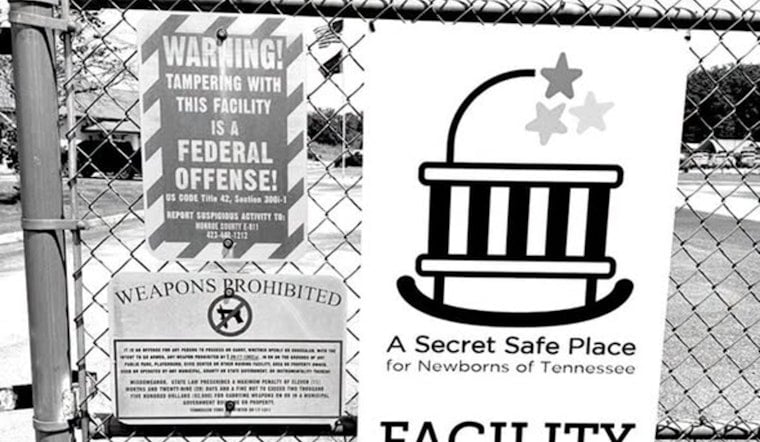
The Monroe County E911 Center in Madisonville has become a certified Secret Safe Place, giving mothers in the area a round-the-clock option to anonymously and legally surrender an unharmed newborn without fear of prosecution. The designation adds a staffed, 24-hour facility to Tennessee's Safe Haven network at a location already central to emergency response in the county.
April White, director of the Monroe County E911 Center, said the center's participation is intended to protect mothers and ensure surrendered babies are cared for, according to Monroe County Emergency Management. The center, located at 3473 New Highway 68 in Madisonville, is staffed 24 hours a day, seven days a week, ensuring someone is always present to receive a surrender. White also noted that 146 babies have been surrendered to Safe Haven facilities across Tennessee so far in 2026, per the same Facebook post.
Under Tennessee's Safe Haven Law, a mother may surrender her baby confidentially and is granted complete immunity from criminal prosecution for doing so. The law currently allows surrenders during the first 45 days of a newborn's life, an expansion from the original 72-hour window that grew to 14 days in 2020 before reaching 45 days in July 2025, according to A Secret Safe Place for Newborns of Tennessee.
How a Surrender Actually Works
A mother arriving at the center is not required to provide personal information or answer questions, and staff must not judge, persuade, or influence her decision. If she wishes, trained staff will accompany her to a private room. The Secret Safe Place process asks only for medical information about the newborn and requires no paperwork from the person surrendering the child.
Rather than being left alone, the baby is handed directly to a trained operator. Staff place identification bracelets on the newborn's wrist and ankle, and the mother receives a matching bracelet along with a packet explaining that she has 30 days to reclaim the child if she changes her mind. Staff must protect the identity of the mother and baby even if the mother is recognized.
Once the handoff is complete, the newborn will be examined at a nearby hospital, with emergency medical services transferring the baby there after the mother leaves. The Department of Children's Services is notified of the surrender and meets the newborn at the hospital to begin the process toward foster placement and potential adoption, according to American Adoptions.
Strict Rules Bind Facility Staff
Safe Haven facility employees follow strict training guidelines that bar a long list of actions. They are prohibited from asking a surrendering person to identify themselves, from detaining or pursuing them, and from taking photos or videos of the encounter. Employees also cannot harass, bully, intimidate, discriminate against, or retaliate against anyone who surrenders a child, and they may not express personal opinions meant to influence the decision.
Confidentiality extends beyond the moment of surrender. Staff are prohibited from discussing a surrendering person's situation on social media or with news outlets, beyond acknowledging that the facility holds Safe Haven status. A sign posted at the facility states that tampering with the surrender site is a federal offense, citing U.S. Code Title 42, Section 3001-1.
A Law Born From Tragedy in East Tennessee
Tennessee's Safe Haven Law traces back to the October 2000 death of an abandoned infant in Townsend, in neighboring Blount County, which prompted state lawmakers to pass the original law in June 2001, according to A Secret Safe Place for Newborns of Tennessee. Since then, 147 infants have been safely surrendered statewide, a cumulative figure distinct from the 11 surrenders recorded during all of 2025, per the Tennessee House Republican Caucus. That distinction matters because the two numbers are often conflated in public discussion of the program's reach.
State lawmakers have continued to expand the law's scope. In May 2026, Tennessee enacted House Bill 1844, which added ambulance stations to the list of approved surrender locations and codified continuous staffing and monitoring requirements for designated facilities, ensuring availability even when emergency crews are out on calls.
Part of a Growing Statewide Network
Monroe County joins a mix of staffed centers and automated equipment across the state. By August 2026, Tennessee had installed 33 Safe Haven Baby Boxes, part of a national network exceeding 460 temperature-controlled surrender devices, according to WBIR-TV. In nearby Knox County, Knoxville Fire Department Station 17 logged its second healthy infant surrender in March 2026 since installing a baby box there in February 2023, per the City of Knoxville.
Madisonville, the Monroe County seat, is home to more than 49,000 residents across the broader county, according to U.S. Census Bureau estimates. The Safe Haven concept itself dates to Texas in 1999 and has since spread to all 50 states, with more than 5,000 infants relinquished nationwide through late 2025, according to the Charlotte Lozier Institute. Hoodline has previously reported on a newborn surrendered at Atoka's baby box in January, part of the same statewide safety net now reaching Monroe County.





