

























































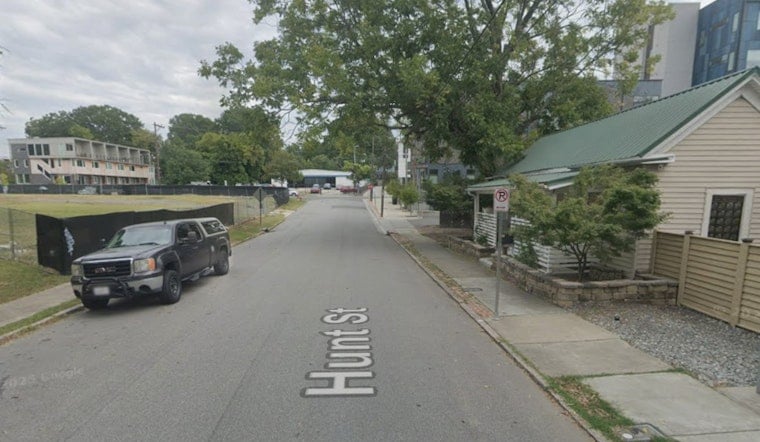
A man and a woman were shot in the 100 block of Hunt Street in Durham shortly after 2 a.m. Sunday, with both victims turning up separately at a local hospital suffering non-life-threatening injuries. Durham police are asking anyone with information about the shooting to come forward as investigators work to piece together what happened before dawn.
The shooting was first reported by WRAL, which noted that the two victims arrived at the hospital separately rather than together, leaving open the question of exactly how the shooting unfolded and whether the man and woman were together at the time of the gunfire. Durham police have requested that anyone with information provide it to investigators, though no suspect description or motive has been released.
The 100 block of Hunt Street sits in downtown Durham's Central Park district near North Mangum Street, an area that mixes historic structures with newer residential development, including the Durham Central Park Cohousing Community and modern condominiums, according to Open Durham. It's a walkable pocket of the city with easy access to Durham Central Park, making Sunday's gunfire all the more jarring for residents there.
A Block With a Violent History
This isn't the first time gunfire has struck this stretch of Hunt Street. In September 2023, 23-year-old Romero Eathel Bent was shot and killed during a party on the same block, a case in which the Durham Police Department asked partygoers to share videos and photos to help identify suspects. That homicide remains unsolved nearly three years later, and it's unclear whether Sunday's shooting has any connection to the earlier case.
Sunday's incident also lands in the middle of a brutal summer stretch for Durham. Just over two weeks ago, the city saw four fatal or critical shootings within a 10-day span on Melbourne Street, East Main Street, Middle Street, and Lane Street, as Hoodline has previously reported. Community leaders have voiced growing alarm over how quickly one shooting has followed another.
Citywide Numbers Point to a Rough Year
Through August 8, the Durham Police Department had logged 340 criminal shooting incidents so far in 2026, resulting in 121 people shot — 15 of them fatally — a slight uptick from the 329 shootings recorded over the same stretch in 2025, though still below the 417 shootings tallied by that point in 2024. City data reported by the City of Durham shows Part 1 violent crime rose 4.6% in the first quarter of 2026 compared to the same period a year earlier, reaching 365 recorded incidents, driven largely by a 44.4% jump in homicides, from nine to 13. Property crime, by contrast, fell 6.1% over that same first-quarter window.
City Response Includes Both Police and Community Programs
Durham city and county leaders convened a joint Summit on Saving Lives in June, bringing together law enforcement, health departments, and community groups to coordinate strategies aimed at reducing gun violence, with recommendations from that working group published in mid-2026. The city has also leaned on its Holistic Empathetic Assistance Response Teams, known as HEART, which operate under Durham's Community Safety Department and have fielded more than 14,000 non-violent mental health and quality-of-life calls since launching in 2022, diverting those situations away from armed police response.
Even so, the Durham Police Department is stretched thin. As of August 2026, the department reported 420 sworn officer positions filled out of 531 budgeted slots, leaving 111 vacancies — a 20.9% vacancy rate — even as detectives work to solve a growing backlog of shooting cases, according to figures from the City of Durham.
How to Report Information
Anyone with information about Sunday's shooting can contact Durham CrimeStoppers, which pays anonymous tipsters cash rewards ranging from $100 to $2,000 for information leading to an arrest in felony cases. Tipsters use code numbers so their identities are never revealed, and tips can be submitted 24/7 by phone at 919-683-1200 or online through the city's CrimeStoppers program.
Potential Charges if a Suspect Is Identified
Should investigators identify a shooter, North Carolina law lays out a tiered set of penalties depending on intent and injury. Under North Carolina General Statute § 14-32, assault with a deadly weapon inflicting serious injury or with intent to kill is a Class E felony punishable by up to 63 months in prison. If both intent to kill and serious injury are proven, the charge escalates to a Class C felony, which carries a mandatory minimum active sentence of 44 to 98 months under the state's structured sentencing guidelines.




