

























































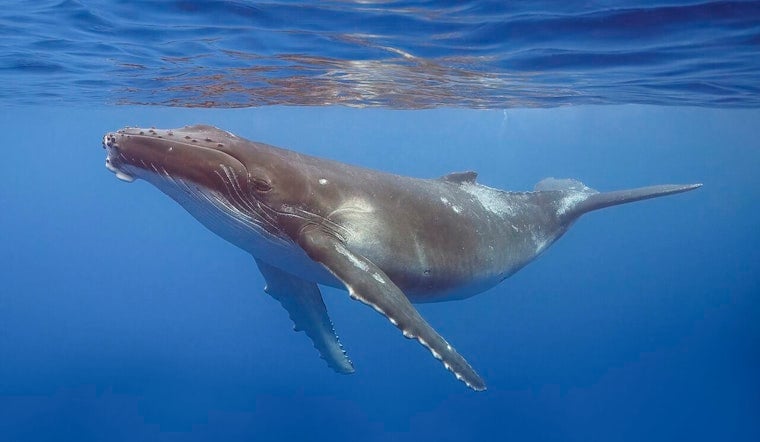
A whale’s underwater concert may be following a surprisingly precise dive chart. New research suggests male humpback whales match distinct song themes to specific portions of their dives, including the ascent, descent and deepest stretch underwater. The finding adds a physical dimension to one of nature’s most elaborate vocal performances.
The study examined 16 singing humpback whales off Maui during a six-year research project that ran from 2018 through 2024. The research, led by Julia Zeh, found that whales can repeat their songs continuously for up to 16 hours, according to the New York Post.
Scientists Matched Whale Songs To Their Movements
Researchers used small, non-invasive suction-cup tags to record both underwater sound and movement. The tags were attached from small boats or with the help of drones, then detached after losing suction so researchers could retrieve the recordings and compare each song with the whale’s depth and motion.
The project’s study data archive describes a tight correspondence between dives and songs. Themes heard during ascents and descents were relatively consistent across whales and years, while a larger variety of themes appeared during the deepest portion of a dive.
That pattern suggests the whale is not simply producing a song on autopilot while swimming. Song sections tied to changing depth may be constrained by oxygen, buoyancy or other physical demands, while sections produced at a relatively constant depth may have more room to vary and signal a male’s individual quality, the New York Post reported.
The Deepest Part May Be The Most Competitive
The researchers say the variation near the bottom of a dive could reflect sexual selection, meaning that males may have more freedom to make their songs stand out when their bodies are not working through major changes in depth. It is a hypothesis, not a final answer, but it offers a new way to think about why humpback songs are organized into recurring themes rather than being one long underwater improvisation.
The work builds on Zeh’s doctoral research at Syracuse University, where her dissertation findings also identified stereotyped dives that were tightly linked to the whales’ acoustic performance. The newer study is billed as the first to connect an entire humpback song structure with a complete dive cycle.
The practical payoff could extend beyond understanding whale courtship. If researchers can learn to associate particular song themes with depth and movement, acoustic recordings collected without tagging may eventually help estimate where a whale is in the water and what it is doing.
That possibility matters in noisy ocean habitats, where ship traffic and other human-made sounds can interfere with marine mammal communication. Zeh now works with NOAA Fisheries, using passive acoustic monitoring to study humpback movements and marine mammal ecology.
Researchers Still Need To Test Whales Beyond Hawaii
The study’s whales were selected to represent the larger Hawaiian breeding population, but the authors caution that the pattern may not apply everywhere. Humpback song traditions differ between populations and hemispheres, so researchers would need comparable tag data from breeding grounds around the world before treating the dive-song relationship as universal.
The timing is notable because other 2026 studies are also showing that humpback song is more flexible than it sounds. Research published in Animal Behaviour found that singing whales can shift pitch when another singer joins, while a separate study in Marine Pollution Bulletin found seismic air-gun noise shortened song cycles. Taken together, the findings suggest that humpback songs are shaped by social competition, the physical demands of diving and the increasingly crowded acoustic world beneath the waves.





_calf_Moorea_2.jpg)