

























































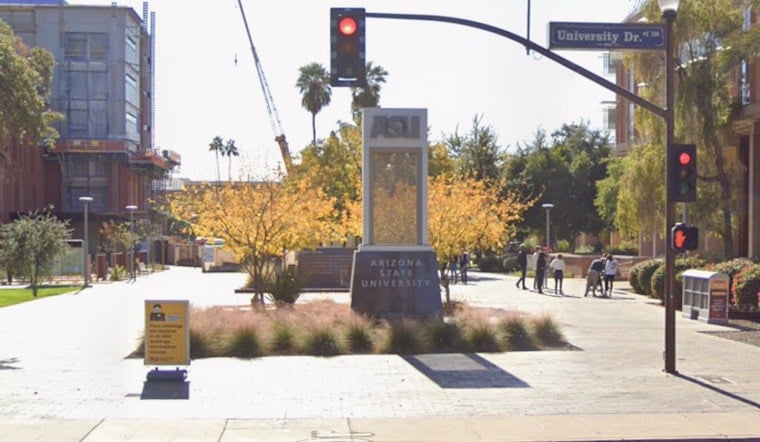
A 33-year-old Mesa man is facing multiple felony charges after police say he spent years secretly filming men inside bathroom stalls at Arizona State University's Tempe campus, with investigators eventually uncovering what they describe as a personal video archive spanning roughly five years. Christopher Michael Sutherland was arrested Tuesday after a victim photographed him fleeing Noble Library and later confronted him directly, setting off a rapid campus-wide manhunt that ended at ASU's business college.
ASU police received reports of a suspicious person taking a picture over a bathroom stall inside Noble Library, according to Arizona's Family. A victim saw a phone positioned over the stall and later photographed Sutherland as he fled the building. That image proved crucial: the victim confronted Sutherland directly, and the university's Real Time Analysis Center then tracked him from the library to the business college, where officers detained him.
Sutherland was ultimately taken into custody after the victim confirmed he was the person seen in the bathroom, and he was caught while allegedly filming his last victim, per court documents cited by the outlet. Investigators believe Sutherland has no affiliation with Arizona State University, and he is not a student or staff member there.
What Investigators Found on His Phone
According to court paperwork, a folder on Sutherland's phone allegedly contained dozens of videos of men inside bathroom stalls, some of them undressed, filmed from underneath and above the stall partitions without their knowledge. He agreed to show an officer multiple videos saved in the folder, and investigators say a Google Photos folder on his account contained still more secret videos and photos, while additional material was stored on his home computer.
Per court documents, Sutherland told investigators the filming had continued for five years and that he secretly filmed people at least once a month. He allegedly described the behavior as an urge, and per his police interview, he admitted he had gone to campus specifically intending to film men inside bathroom stalls, saying his victims never knew he was recording or that he watched the footage later for his own pleasure.
Charges and Booking Details
Police say Sutherland recorded two people without their knowledge inside the Noble Library bathroom and secretly filmed three additional people in bathrooms inside the business college. He faces one count of voyeurism and one count of unlawful viewing and recording tied to those incidents, according to Arizona's Family's reporting.
He was booked into the Maricopa County jail on felony counts of burglary, voyeurism, and unlawful recording, along with a misdemeanor trespass charge, and his bond was set at $50,000, per KTAR. Police also booked him on one count of burglary and one count of criminal trespass tied specifically to his presence inside university buildings he was not authorized to enter.
Why the Charges Reach Beyond Simple Trespassing
Arizona's third-degree burglary statute, A.R.S. § 13-1506, applies when someone enters a non-residential building with intent to commit a felony inside, according to JacksonWhite Law, which is a Class 4 felony punishable by up to 3.75 years in state prison. That statute helps explain why prosecutors elevated the case beyond misdemeanor trespass, since investigators say Sutherland entered campus buildings specifically to secretly record people.
Arizona's voyeurism law, A.R.S. § 13-1424, defines the offense as knowingly invading someone's privacy without consent for sexual stimulation in places where they have a reasonable expectation of privacy, per Shouse Law Group. It carries a Class 5 felony penalty of up to 2.5 years in prison and $150,000 in fines, though the charge escalates to a Class 4 felony if captured footage is disclosed or distributed. Arizona's surreptitious recording statute, A.R.S. § 13-3019, separately criminalizes secretly capturing video or photos of people in private spaces like restrooms regardless of proven sexual intent, according to the Feldman Royle Law Firm.
Noble Library keeps open visitor hours for the general public from 7 a.m. to 5 p.m., with access after that restricted to ASU students, faculty, and staff, per the Arizona State University Library. Police documents noted that university buildings display signs restricting use to affiliated members, a detail that supports the trespass and burglary charges against Sutherland, who investigators say has no ties to the university.
How Campus Cameras Closed In
ASU's Real Time Analysis Center, established in summer 2023, integrates feeds from roughly 3,000 to 4,000 campus security cameras, license plate readers, and live 911 transcriptions, according to ASU News. The center is staffed around the clock by analysts monitoring feeds across all four Phoenix-area ASU campuses, and it was that infrastructure that allowed officers to follow Sutherland's movements from the library to the business college after the victim's photo gave them a starting point.
That surveillance network operates independently of the city's own camera systems. The City of Tempe suspended its municipal license plate reader data-sharing network this month amid Valley-wide privacy concerns, but ASU Police continue to run their own network of roughly 20 campus-based Flock cameras that feed directly into the Real Time Analysis Center, as Hoodline previously reported.
Part of a Broader Local Pattern
Sutherland's arrest comes just two days after a Tempe high school security employee was arrested on felony voyeurism charges when an internal video audit uncovered unauthorized access and downloading of campus locker room footage, held on $100,000 bond. In July, Tempe police also arrested a local resident on burglary and voyeurism counts after detectives caught him secretly recording women through residential windows near Parkway Boulevard.
ASU's Tempe campus projected record on-campus enrollment exceeding 55,500 students for the current academic year, part of a daily population surge that pushes Tempe's daytime population from 191,000 permanent residents up to as many as 320,000 people. That volume of foot traffic through open campus facilities like Noble Library underscores the monitoring challenge campus police face in balancing public access with privacy protection.
Investigators have not detailed how many additional victims may exist beyond the five confirmed in the Noble Library and business college incidents, given Sutherland's alleged admission that the filming spanned roughly five years at a rate of about once a month. That timeline, along with the contents of his Google Photos folder and home computer, leaves open questions about the full scope of the alleged surveillance and how authorities might identify others who were recorded without their knowledge.





