

























































More than 3,000 homes and buildings across Miami-Dade County could be jacked up on taller foundations or fitted with flood barriers under a $4.5 billion plan released this week by the U.S. Army Corps of Engineers. The proposal, which covers everything from single-family houses in Cutler Bay to fire stations and wastewater treatment plants, marks the latest step in a federal effort that began after Hurricane Irma struck in 2017.
The Army Corps of Engineers and Miami-Dade County released the Phase II Draft Report on Wednesday, opening a public comment window that runs through September 18, according to the Miami Herald. The plan targets more than 3,000 properties across the county, including over 400 homes in Cutler Bay, over 400 in Miami Beach, and more than 1,000 in Homestead, along with 275 businesses and government buildings identified for floodproofing rather than elevation. The federal government has found more than 6,000 properties at medium or high risk of destructive flooding in the coming decades, though the current plan focuses construction funding on the roughly 3,200 properties deemed highest priority.
From Concrete Walls to Raised Foundations
This nonstructural approach represents a dramatic reversal from the Army Corps' original 2020 proposal, which called for six miles of concrete walls standing 6 to 13 feet tall along the Miami-Dade coast at an estimated cost of $4.6 billion. Miami residents and officials fiercely opposed those walls, and the Miami Downtown Development Agency reportedly paid a consultant to generate images showing what the barriers might look like covered in graffiti and trash. One Miami commissioner went so far as to call the proposed walls “the Berlin Wall,” per the Herald's reporting.
The backlash was intense enough that the Army Corps paused the Back Bay study altogether in 2021. Miami-Dade Mayor Daniella Levine Cava formally requested a study extension in September 2022 to give the agency time to reconsider its approach, according to Miami-Dade County. That pressure eventually led the Assistant Secretary of the Army for Civil Works to approve a National Economic Development Policy Exception in June 2024, allowing the project to move forward based on public safety and social cohesion in environmental justice communities instead of the strict cost-benefit ratios the Army Corps normally requires. U.S. Army Corps of Engineers Chief of Engineers Lt. Gen. Scott A. Spellmon signed the official Chief's Report on August 26, 2024, formally endorsing voluntary home elevations and building floodproofing for eventual Congressional authorization.
How the Elevation Process Would Work
Under the current plan, the Army Corps would elevate 2,800 single-family homes and 430 multifamily buildings, which the agency defines as quadplexes or smaller, while floodproofing roughly 275 other properties, including about 175 commercial businesses, warehouses, government buildings and churches. Home elevations, per the Herald, involve jacking structures up with heavy machinery and building taller foundations, a process that can take several months and may require homes to be raised a maximum of 12 feet, though many will need only a few additional feet. Dry floodproofing, used for nonresidential buildings, includes temporary or permanent flood barriers and water pumps.
Project funding covers the full cost of elevation itself, but it does not cover residents' costs of finding somewhere else to live while construction is underway, the Herald reports. Property owners are also on the hook for fixing outdated wiring or unpermitted work, such as garage-to-bedroom conversions, before their homes can be accepted into the elevation program, since the Army Corps can only take on homes that fully comply with the latest building code. Miami-Dade County is looking into funding or programs to help residents cover those code-related repairs, and Christian Kamrath said the county will do everything it can to make the elevation program viable for residents, according to the Herald's reporting.
Who Pays, and When
Under Section 103 of the Water Resources Development Act of 1986, nonstructural flood projects like this one require a 65% federal, 35% non-federal cost split, according to the Legal Information Institute. That means Miami-Dade County must pay around $1.3 billion of the construction costs, and the county will also be responsible for 100% of future operation, maintenance, repair and replacement expenses over the project's lifetime. Renters displaced during elevation work are entitled to temporary relocation assistance benefits under the Uniform Relocation Act, with that obligation falling on Miami-Dade as the local sponsor.
The $4.5 billion estimate assumes every targeted building agrees to elevation or floodproofing, and the timeline is long: the Herald reports the overall property protection effort is expected to take at least 16 years, with Congress needing to fund project design in 2028 and construction potentially beginning in 2032. Justine Woodward said the Army Corps will work with Miami-Dade County to identify which project components move forward first, since the two must select a smaller portion of the suggested work list as an initial construction step.
A Nature-Based Piece of the Puzzle
Alongside the elevation work, the Army Corps' recommended plan includes a proposed $180 million Nature-Based Solutions Pilot Program, cost-shared at $117 million federal and $63 million local, to test mangrove and reef restoration alongside the building elevations. That echoes an element of the shelved 2020 draft, which had included mangrove plantings in South Dade before the plan was overhauled. The second part of the original study, a large structure meant to protect the coast from storm surge, has been shelved entirely, according to the Herald.
The stakes for inaction are steep. Miami-Dade County climate vulnerability modeling indicates proactive adaptation could safeguard up to $385 million in local tax revenue that would otherwise be lost to daily tidal inundation by 2070, according to Miami-Dade County. The Herald reports the county could face more than $54 billion in economic damages without the plan, and the Southeast Florida Regional Climate Change Compact projects regional sea levels will rise 10 to 17 inches above 2000 levels by 2040 and 21 to 54 inches by 2070. Miami-Dade has an average elevation of just six feet above sea level and is expected to see at least two feet of sea-level rise by 2060, per the Herald's reporting.
How Residents Can Weigh In
Miami-Dade County has looked to other places for guidance, discussing home-elevation strategies with the city of Norfolk, Virginia, which manages elevation of around 1,000 properties, as well as with Harris County, Texas, and the state's Elevate Florida program. Residents can submit comments on the draft plan by email to [email protected] through September 18.
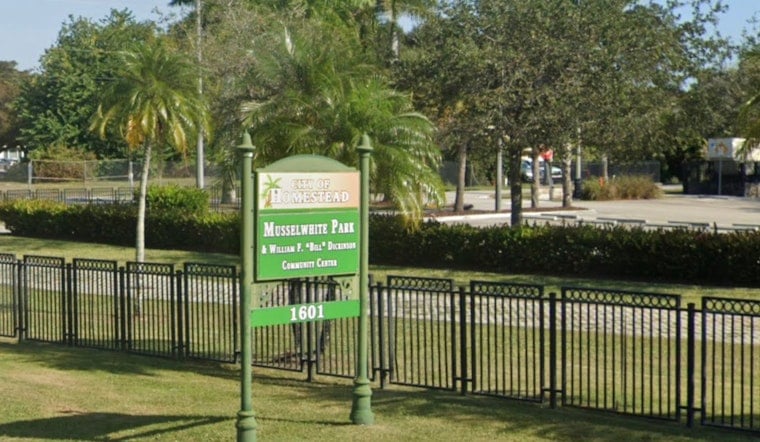
The Army Corps and Miami-Dade County will also host a series of public meetings to explain the draft plan and gather feedback. An in-person open house is scheduled at the William F. Dickinson Community Center in Homestead, located at 1601 N Krome Ave., on September 1 from 6 to 7:30 p.m., followed by another at the Overtown Performing Arts Center in Miami, at 1074 NW Third Ave., on September 2 during the same hours. A virtual webinar will follow on September 9, also from 6 to 7:30 p.m.





