

























































A Fulton County man is behind bars after Milton police say he left a pair of camera-equipped smart glasses perched on top of a neighbor's car, lenses aimed directly at a 13-year-old girl's bedroom window. Christopher Hall was booked into the Fulton County Jail on August 15 on a charge of unlawful eavesdropping or surveillance, and he has not been released.
According to Atlanta News First, the incident traces back to June 27, when the victim's mother's car was parked in the driveway of their Milton townhome. Police believe Hall placed the recording sunglasses on top of that car, angled toward the teenager's bedroom, where the blinds happened to be open at the time. Milton police identified Hall as the suspect only after reviewing earlier footage already stored on the glasses themselves.
How Investigators Traced the Glasses Back to Hall
Detectives pieced together the suspect's identity by studying background details captured in previous recordings on the device, according to WSB-TV. Investigators matched trees, utility poles, surrounding townhomes and even a pet dog visible in the stored footage to features around Hall's own property, effectively tracking him back to his home using landmarks captured in his own recordings. That forensic approach, built entirely from clues embedded in the device's own memory, is what led police to Hall rather than any tip or witness identification.
An unidentified woman described to the station as an acquaintance of Hall offered a different explanation for how the glasses ended up pointed at the girl's window. She told the outlet that Hall may have accidentally left the glasses facing the bedroom after becoming intoxicated at a social gathering. Reporters who went to Hall's Milton residence seeking comment directly got no response.
A Felony Under Georgia's Surveillance Law
Georgia law draws a hard line between security cameras on your own property and using a device to secretly watch someone else's private space. Under O.C.G.A. § 16-11-62, property owners can install surveillance for security purposes on their own curtilage, but the statute explicitly bars using technology to clandestinely record activity inside another person's private space where they have a reasonable expectation of privacy, according to FindLaw.
The penalties are steep. Anyone convicted under Georgia Code § 16-11-62 and § 16-11-69 of unlawful eavesdropping or surveillance by using a device to observe or record another person in a private place out of public view faces a felony sentence of one to five years in prison, fines up to $10,000, or both, per Justia Law. Because the charge is a felony rather than a misdemeanor, Hall has stayed in custody even as Fulton County works to ease jail crowding.
Why Hall Is Still Sitting in the Fulton County Jail
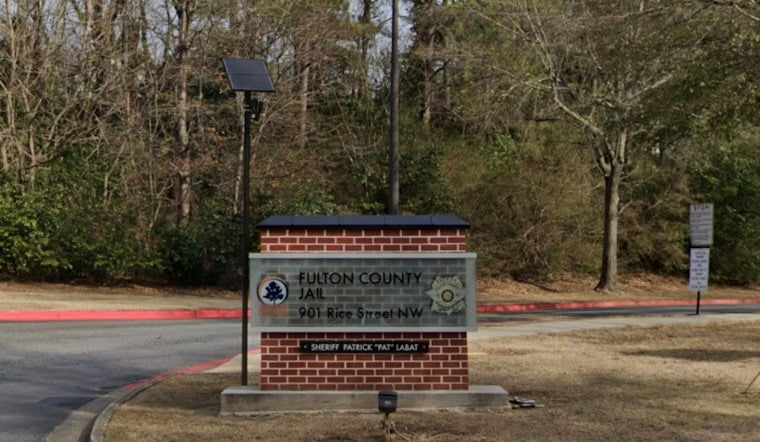
Fulton County Sheriff Patrick Labat put policies in place in July restricting intake of low-level misdemeanor arrestees at the Rice Street jail to manage chronic overcrowding, but felony charges like eavesdropping still get full booking and detention, as Hoodline previously reported. The Rice Street facility was built in 1989 with a design capacity of 1,125 detainees but housed more than 2,900 inmates as of mid-2025, a strain that has drawn federal civil rights monitoring of the jail's operations.
Hall's case is not an isolated one in metro Atlanta this year. In July, Atlanta police arrested a man at a Glenwood Avenue Kroger on the same felony eavesdropping charge after he allegedly positioned a recording device over an occupied bathroom stall. In February, Bartow County prosecutors charged a paramedic with 40 felony counts of unlawful eavesdropping after a hidden camera disguised as a clock turned up inside an emergency services station restroom.
Smart Glasses Boom Collides With Privacy Concerns
Hall's arrest lands amid a broader surge in camera-equipped wearables. Global smart glasses revenue nearly doubled year-over-year in the second quarter of 2026, with major manufacturers shipping millions of AI-powered devices even as privacy pushback mounts, according to Gizmodo. Multiple state court systems, including in New York and Philadelphia, have banned the devices from judicial facilities entirely over covert recording concerns, according to legal and technology analyses published this month.
The proliferation of the gadgets has already prompted local institutional responses. Just days before Hall's arrest became public, Polk County schools banned Ray-Ban Meta glasses over cheating and spying fears, underscoring how quickly the technology has outpaced rules governing its use. Investigators have not said whether additional footage was found on Hall's device beyond the recordings that led them to his home, and it remains unclear whether further charges will follow or how the court will weigh the claim that the glasses were left pointed at the window by accident.





