

























































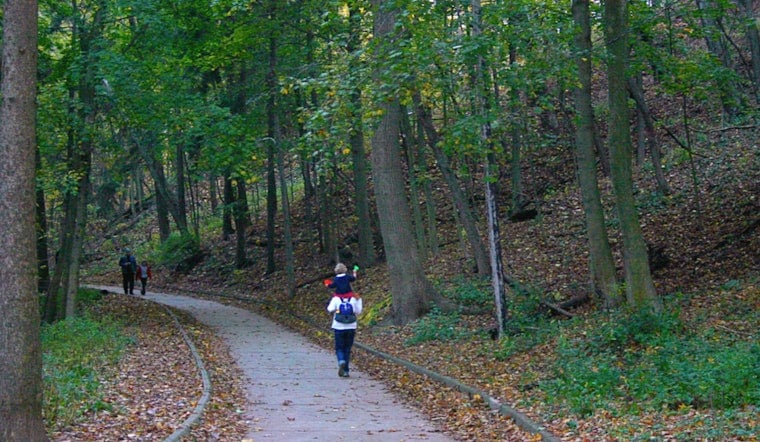
Milwaukee County Parks plans to begin demolition in October on a heavily degraded asphalt trail ramp that connects downtown Milwaukee directly to the Oak Leaf Trail through Juneau Park. The sloping path, which runs from E. Mason Street down to Lincoln Memorial Drive, has fallen into disrepair, and its replacement is being funded through tax dollars generated by Northwestern Mutual's massive downtown office redevelopment.
According to Urban Milwaukee, the project will replace roughly 1,400 linear feet of asphalt access ramp with shoulders between Lincoln Memorial Drive and Mason Street. A Milwaukee County public procurement notice issued in July puts the target for substantial contract completion at November 15, targeting a quick turnaround before winter weather sets in.
The rebuild is one piece of a much larger financial arrangement tied to Northwestern Mutual's $500 million redevelopment of its 540,000-square-foot North Office Building into an 18-story glass tower downtown. Milwaukee's Common Council approved a $40.48 million Tax Incremental Financing plan for the project in March 2023, and the city set aside $10 million in tax increment revenues for public infrastructure within a half-mile of the site. That pool of money includes $250,000 earmarked specifically for the Juneau Park trail ramp, along with $400,000 for broader Juneau Park improvements and $100,000 for Cathedral Square Park.
A Corporate Consolidation Behind the Concrete
The infrastructure dollars exist because Northwestern Mutual agreed to major concessions in exchange for the TIF district. The insurer committed to closing its suburban Franklin campus, relocating roughly 2,000 employees downtown, and growing its downtown workforce to 5,750 employees by 2030, according to the same TIF documentation. Incremental property tax revenue generated by that consolidation is what's now funding the trail work and other nearby public projects, the Juneau Park trail sitting squarely inside the half-mile radius the city targeted for reinvestment.
Riders and pedestrians should expect detours along Lincoln Memorial Drive and across the Mason Street Bridge once construction gets underway. That bridge is itself fresh off a $2.65 million structural repair project completed by Milwaukee County and WisDOT in late 2025 after engineers found severe concrete deterioration, meaning the detour route was, until recently, a construction zone of its own. The bridge is owned by Milwaukee County Parks but managed by the county's transportation department, a distinction that matters as the two projects intersect during the coming detour period.
Part of a Bigger Trail Overhaul
The Juneau Park ramp is not an isolated fix. Per Urban Milwaukee's reporting, Milwaukee County Parks intends to reconstruct several other pedestrian and bicycle trails in poor condition across the parks system, including new connections through Kohl Park and a link to Bender Park. The county is also adding mileage to the broader Oak Leaf Trail network as part of the effort.
The scale of that network helps explain why maintenance has become such a persistent challenge. Milwaukee County Parks data shows the Oak Leaf Trail spans more than 135 miles across 14 color-coded branch lines, with its busiest stretch — the Brady Street Bridge — logging 566,134 user passes in 2024. Yet the department relies on just four dedicated full-time staff to maintain the entire system, according to Media Milwaukee, leaning on seasonal workers and public issue reports to keep up with repairs after decades of county budget reductions.
First Master Plan Update Since 2007
The Juneau Park rebuild comes as Milwaukee County Parks works on its first update to the long-range Trails Network Plan since 2007. The updated plan builds on the county's 2023 Northwest Side Connections Plan, which prioritizes expanding non-motorized trail infrastructure in historically disinvested neighborhoods, and will serve as an official appendix to the county's 2050 Park and Open Space Plan, according to Milwaukee County Parks.
The Oak Leaf Trail's importance extends beyond county lines. It functions as the central hub for the Route of the Badger, a regional initiative led by the Rails-to-Trails Conservancy aiming to build a 500-mile interconnected multi-use trail network across seven southeast Wisconsin counties. Once rebuilt, the Juneau Park ramp will let riders reach the Milwaukee River Line and Milwaukee's downtown zipline without ever leaving the off-street trail, per Urban Milwaukee's account of the project.
Juneau Park itself carries its own history along the Lake Michigan bluffs where the trail runs. Established in the late 19th century, the park is home to an 1887 bronze statue of Solomon Juneau, the French-Canadian fur trader who purchased land between the Milwaukee River and Lake Michigan to found Juneau Town and later served as Milwaukee's first mayor in 1846, according to background compiled by Juneau Park Friends.
Environmental and Safety Backdrop
Trail modernization projects like this one also carry environmental compliance requirements. As Hoodline reported last year in coverage of the Wisconsin DNR's incidental-take rules for endangered plants, expanding trail corridors to 10 feet near the state-threatened seaside crowfoot plant can require state authorization, though it's not clear from available records whether that specific plant is present along the Juneau Park stretch. State law allows such incidental-take authorizations when public safety and transportation benefits justify limited ecological impacts.
The Juneau Park project also lands amid a string of Oak Leaf Trail safety and infrastructure stories across the county this year, from a Hoodline report on an assault investigation along the trail's Franklin segment to ongoing bluff erosion threatening another stretch of the trail in Cudahy's Sheridan Park. Those separate incidents underscore the pressure on a trail system that serves hundreds of thousands of users annually with a maintenance staff that has, for years, remained a fraction of the network's size.





