

























































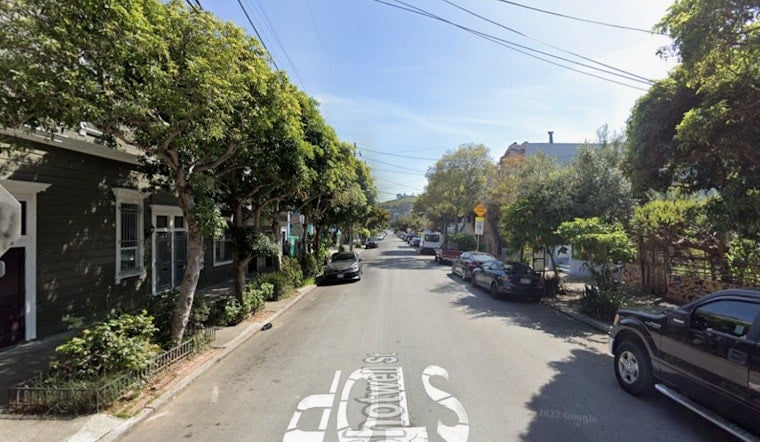
For decades, Capp and Shotwell streets in San Francisco's Mission District have been ground zero for the city's open-air sex trade, and despite traffic posts, concrete barriers, warning letters and a new state law criminalizing buyers, residents say the activity has simply drifted a few blocks over rather than disappeared. Veronica Benitez, who was born and raised on 18th Street, watched the disruption upend her family's sleep and nighttime routines for years before they ultimately moved out of their longtime San Francisco home.
According to the San Francisco Chronicle, San Francisco police have made more than 130 arrests for alleged prostitution in the Mission since the start of 2025, and 16 of those arrests came under the state's new sex-buying law that took effect January 1. The Chronicle, in reporting by Anna Bauman, found that despite enforcement and years of physical infrastructure, sex workers themselves say the barriers and police presence have done little to interfere with their business. Benitez's family eventually left San Francisco altogether for a small town outside the Bay Area, according to the same report.
Barriers Went Up, Business Moved On
San Francisco installed traffic posts on Capp Street between 18th and 22nd streets in 2023, then added concrete barriers on Shotwell Street between 19th and 21st streets the following year after residents there filed a public nuisance lawsuit accusing the city of simply displacing the problem rather than solving it. That 2024 legal pressure, which came from five Shotwell Street residents, is detailed in reporting from Mission Local. The barriers did bring some relief — the Chronicle reports the Shotwell installations reduced noise, trash and related violence on the affected blocks, and sex work became more diffuse and less intense in their wake.
But the underlying trade did not vanish. Per the Chronicle, it shifted from Capp and Shotwell to blocks several streets away, and families near 18th Street have since asked the city to address the newly displaced activity and increase police patrols, with some considering whether to push for barriers farther down Shotwell Street as well. San Francisco's Board of Supervisors approved an 18-month extension of the Capp and Shotwell closures in June, a program the Chronicle reports will cost $39,000 through October 2027.
A Supervisor Questions the Data
Supervisor Stephanie Cajina voted to extend the street-closure program, but only on the condition that the SFMTA report back on its outcomes — and she said the extension itself was not a data-driven decision. That skepticism is borne out by the transportation agency's own admission: SFMTA staff told the Chronicle they had not studied the street-closure program's effectiveness or its impact on nearby blocks, leaving the city without hard evidence on whether the bollards actually curb the trade or simply relocate it.
Not every resident experiences the trade the same way. Katie Miles said the occasional sex work on her street had never impacted her family, a contrast to the disruption Benitez described. Sex workers interviewed by the Chronicle described a starker reality on the street: a woman named Rena, 25 and originally from Sacramento, said she tries to avoid working near children, while a worker named Soleil said sex workers have a quota to meet and described police sometimes dispersing people with a loudspeaker. In one incident cited in the report, a sex worker pepper-sprayed a neighbor who was recording loud late-night activity.
New State Law Targets Buyers, Not Workers
The legal landscape shifted dramatically in the years leading up to this moment. In 2022, State Sen. Scott Wiener authored a bill that decriminalized loitering with intent to commit prostitution — a measure known as the Safer Streets for All Act, which repealed Penal Code Section 653.22 and let people previously convicted under it petition for record sealing, according to ACLU California Action. That law aimed to stop discriminatory profiling of transgender, Black and Brown women, but it also stripped police of a tool they had used against sex workers directly.
California reversed course on the buyer side this year. The new state law, Assembly Bill 379, authored by Assemblymember Maggy Krell, took effect January 1 and made loitering with intent to purchase sex a misdemeanor, with violators facing fines of $1,000 that fund a newly created Survivor Support Fund, according to LegiScan. During legislative debate last year, Wiener opposed the anti-loitering provision, arguing that reintroducing intent-based loitering offenses hands police subjective discretion that can lead to profiling of marginalized communities, as reported by Courthouse News Service.
Under the new framework, prosecutors can use repeatedly circling a block, beckoning to pedestrians or making unauthorized stops as evidence against buyers. San Francisco police send warning letters to registered vehicle owners seen soliciting sex near the Shotwell corridor — 65 in total since the program began, though fewer than 10 have gone out since August 2025, suggesting the pace has slowed even as arrests continue. Police also conduct sting operations every week and say they try to pursue human traffickers while offering resources to people believed to be trafficking victims.
Neighboring Oakland Tries the Same Playbook
San Francisco isn't alone in leaning on buyer-focused enforcement. Oakland implemented similar tactics along International Boulevard in early 2026 under the same state law, resulting in 56 arrests of male sex buyers during targeted human-trafficking investigations in the first four months of the year, according to KRON4. The parallel effort underscores that commercial sex displacement and buyer demand remain a regional challenge rather than one confined to a single Mission District corridor.
The financial cost of San Francisco's approach has also drawn scrutiny. The city spent more than $250,000 on the initial set of bollard installations on Capp Street in 2023 before extending similar barriers to Shotwell, a price tag that has fueled questions about whether physical infrastructure is the most effective tool against a trade that has persisted on these blocks for decades. Local businesses have adapted in their own ways — Shotwell's Saloon owner David Hall began closing his bar at midnight in 2024 to shield patrons from street solicitation and harassment.
On a recent Saturday night, about half a dozen sex workers stood on Shotwell near 18th and 19th streets, a scene that illustrates how, even after years of barriers, letters and arrests, the trade continues to find its footing on the Mission's residential streets. Hoodline previously reported on the Shotwell barrier rollout in 2024, and again this year when an emergency police response shut down a 22nd Street block near Capp Street tied to the same long-running dynamic.





