

























































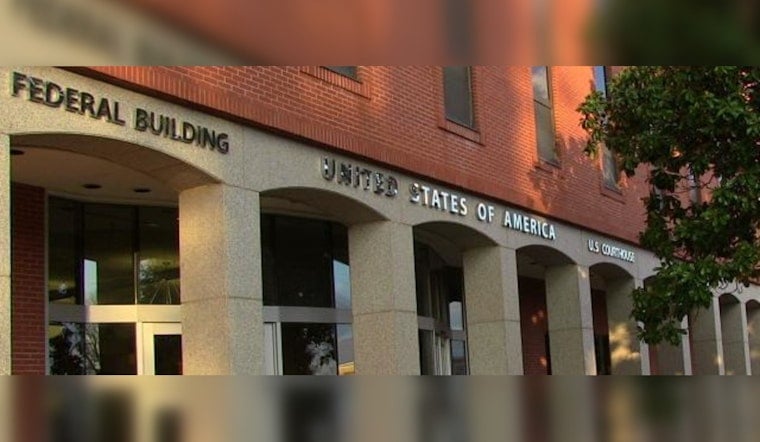
A Mississippi attorney who once worked for the Small Business Administration is accused of exploiting his insider knowledge of the agency's disaster loan approval process to help generate more than $11.5 million in fraudulent payments. Prosecutors say Lakieth Faulkner worked directly with borrowers seeking Economic Injury Disaster Loans, then allegedly devised a kickback scheme with co-conspirators to siphon the money once it hit their accounts.
According to WREG.com, Faulkner is accused of generating over $11.5 million in fraudulent loan payments by leveraging his understanding of how the EIDL approval process works. Federal prosecutors in the Northern District of Mississippi have identified Tierra Scott, a former Internal Revenue Service employee, as a key co-conspirator in the scheme, according to the U.S. Attorney's Office. The indictment alleges that co-conspirators colluded to siphon loan payments directly from the SBA, combining Faulkner's agency experience with Scott's knowledge from her time at the IRS.
A District Drowning in Pandemic Fraud
The case lands amid what U.S. Attorney Scott F. Leary describes as an overwhelming wave of pandemic relief fraud across northern Mississippi. Leary said the Northern District of Mississippi received $2.2 billion in Paycheck Protection Program loans, and he estimated that roughly $1 billion of that total — nearly half — was fraudulent, per the U.S. Attorney's Office.
Leary announced the Faulkner case as part of a broader series of fraud enforcement actions stretching across the southeastern United States, an effort that also involved Mississippi state authorities. He was joined in the announcement by Colin McDonald, who serves as assistant attorney general of the Justice Department's National Fraud Enforcement Division, along with other DOJ leaders and federal and state law enforcement partners. The Justice Department has described the wider crackdown, announced in late July, as targeting more than $350 million in losses spanning SNAP benefits, SBA loans, housing assistance, and tax fraud, as Hoodline reported in its coverage of the DOJ's Southeast sweep.
New Federal and State Task Forces Take Aim
The Faulkner case emerges from a newly reorganized federal enforcement structure. The Justice Department formally created the National Fraud Enforcement Division on April 7, consolidating criminal tax, healthcare, and public-benefit fraud units under McDonald's leadership, according to the U.S. Department of Justice. That consolidation was meant to centralize the government's response to large-scale theft of taxpayer funds following years of piecemeal pandemic-fraud prosecutions.
Mississippi has also built its own response. State Attorney General Lynn Fitch launched Joint Task Force Vigilance with $2.5 million in funding to hire dedicated state prosecutors and investigators who work alongside federal authorities, according to a report from SCT Online. The task force represents a dedicated multi-agency operational unit built specifically to chase down public benefit fraud in the state, on top of the DOJ's newly formed anti-fraud task forces spanning Mississippi, North Carolina, and Florida.
Why Charges Can Still Be Filed Years Later
Faulkner's alleged conduct dates back to the early pandemic years, but federal prosecutors still have time to bring charges. Legislation enacted in August 2022 extended the statute of limitations for criminal prosecution of PPP and EIDL fraud from five to ten years, according to the U.S. Small Business Administration. That change gives federal agencies until at least 2030 to prosecute loans originated in 2020, a window that helps explain why cases like Faulkner's are only now surfacing in court.
The stakes for defendants convicted under these statutes are severe. Under 18 U.S.C. § 1343, federal wire fraud charges carry enhanced maximum penalties of up to 30 years in prison and $1 million in fines when the fraud is connected to a presidentially declared major disaster or emergency, according to the Legal Information Institute — well above the 20-year maximum for standard wire fraud.
A National Pattern of Pandemic Relief Abuse
Faulkner's case fits into a much larger national pattern. A June 2023 report by the Small Business Administration's Office of Inspector General estimated that more than $200 billion, over 17 percent of all COVID-19 EIDL and PPP relief funds, was disbursed to potentially fraudulent actors nationwide, according to CBS News, with $136 billion of those losses tied specifically to the EIDL program. By May 2023, federal investigations into COVID-19 relief fraud had already produced more than 1,000 indictments, 800 arrests, and 500 convictions nationwide, recovering roughly $30 billion before the new centralized fraud division even existed, per the House Committee on Small Business.
Closer to home, the Northern District of Mississippi's U.S. Attorney's Office collected $5.29 million through civil and criminal actions during fiscal year 2025 and seized another $1.17 million through asset forfeiture, according to DeSoto County News. Those recovered funds have supported victim restitution and ongoing law enforcement initiatives, though it remains unclear how much of the $11.5 million allegedly tied to Faulkner's scheme could ultimately be recovered.
Several open questions remain as the case moves through federal court. It is not yet known whether additional SBA or IRS insiders will be implicated beyond Faulkner and Scott, nor how much of the stolen $11.5 million might be clawed back through asset forfeiture. Hoodline has previously covered related pandemic-loan fraud cases in the region, including a Marshall County couple's PPP fraud charges, underscoring how widespread these schemes have become across northern Mississippi.





