

























































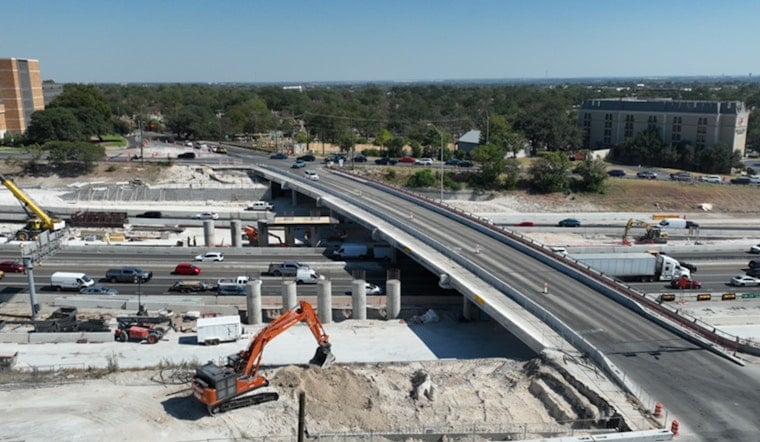
Drivers crossing Interstate 35 on Martin Luther King Jr. Boulevard finally have all four lanes back after two years of lane shifts and temporary closures. Construction workers finished configuring the bridge into its final lane setup on August 9, restoring a key link between East Austin and DKR Stadium, Moody Center, and downtown just as the University of Texas prepares for football season.
The bridge is now fully operational, according to TxDOT spokesperson Bradley Wheelis, who told The Austin Chronicle that traffic needed to move in its final configuration before the new school year and UT football season kicked off. The $34.4 million bridge segment is part of the broader I-35 Capital Express Central project, an eight-mile, $4.5 billion corridor overhaul stretching from U.S. Highway 290 East to State Highway 71/Ben White Boulevard, according to the Austin Monitor. TxDOT awarded the MLK bridge contract to Harper Brothers LLC, which broke ground on the reconstruction in October 2024.
Finishing Touches Still Coming
Even with cars flowing again, the bridge isn't entirely done. Construction crews have begun installing shared-use paths, wider sidewalks, and barriers separating drivers from pedestrians and cyclists, work the Chronicle's reporting indicates should wrap up within the next month or so. Permanent lane striping and pavement markers aren't expected until December, and lane closures on the MLK segment will be limited mostly to nighttime hours in the meantime.
TxDOT is also planning two pedestrian-only bridges flanking the MLK overpass where it crosses Lady Bird Lake, additional structures meant to keep foot and bike traffic separated from cars during especially busy events. Wheelis said the pedestrian-only bridges are designed specifically to protect pedestrians, and the agency is coordinating closely with the University of Texas and Moody Center to limit congestion during peak event days. TxDOT said it tries to avoid major construction work during UT home games.
Why MLK Went First
Completing the MLK bridge ahead of the rest of the corridor was a deliberate sequencing choice, intended to preserve a reliable interstate crossing while other bridges in the project remain under construction. Major reconstruction on the adjacent University and Downtown segments of I-35 isn't slated to begin until 2027, with the entire CapEx Central corridor not expected to wrap until early 2033, according to Community Impact.
TxDOT plans to rebuild at least 14 bridges crossing I-35 in total, with many of the rebuilds incorporating pedestrian- and cyclist-friendly features similar to what's now going in at MLK. The agency also intends to add two new high-occupancy vehicle lanes on I-35, aimed at encouraging carpooling and bus ridership to help reduce overall congestion. Beyond MLK, TxDOT's full design for the corridor calls for more than 19 miles of new shared-use paths, 13 urban trail connections, and dedicated pedestrian-only bridges at 3rd Street, 4th Street, and 15th Street, per the agency's own TxDOT project materials.
The Bigger Fight Over I-35
The MLK milestone lands against a backdrop of ongoing tension over the highway's larger footprint. Interstate 35 originally opened through Austin in 1962, physically cementing racial and socioeconomic segregation between East Austin and downtown that traced back to the city's 1928 master plan, according to the Austin Monitor. The Capital Express Central project's own promise — walkable “cap and stitch” decks that would eventually connect Austin's east and west sides with green space and other amenities over the sunken highway — is meant to address some of that same divide.
But that vision remains only partially funded. In May, the Austin City Council reaffirmed a $104 million commitment, financed through a $63 million state infrastructure loan and $41 million in local debt, to build the foundational support structures for future deck caps, as reported by Community Impact. Building the full vision of decks covering nearly 14 acres of lowered highway lanes would cost an estimated $400 million on top of that, with another $260 million needed for park amenities and roughly $9 million a year in ongoing maintenance — a gap local policymakers have yet to close.
Meanwhile, the project continues to face legal opposition. Grassroots group Rethink35 and co-plaintiffs sued TxDOT in federal court to halt the $4.5 billion expansion, arguing the state failed to adequately study fine-particulate air pollution and community health impacts; a judge heard summary judgment arguments in the case in September 2025, according to KVUE. State environmental filings also show the corridor expansion requires acquiring 54 acres of right-of-way, displacing more than 100 homes and businesses, per the Austin Monitor's earlier reporting.
What Comes Next
For now, completion of the MLK bridge is expected to bring at least some relief to downtown traffic congestion, even as the interstate through Central Austin remains under construction for the foreseeable future. CapEx Central is the middle piece of a three-part regional overhaul, flanked by the $606 million CapEx North segment and the $548 million CapEx South segment, where Hoodline previously covered weekend bridge closures tied to that phase of work.
Both TxDOT and the Capital Area Metropolitan Planning Organization are funding the Capital Express Central effort, and crews are scheduled to begin rebuilding east-west crossings in the University and Downtown segments in 2027. Until then, MLK Boulevard stands as the corridor's first finished chapter — a preview of what drivers, cyclists, and pedestrians can expect, and a reminder of how much work, and how much money, still lies ahead.





