

























































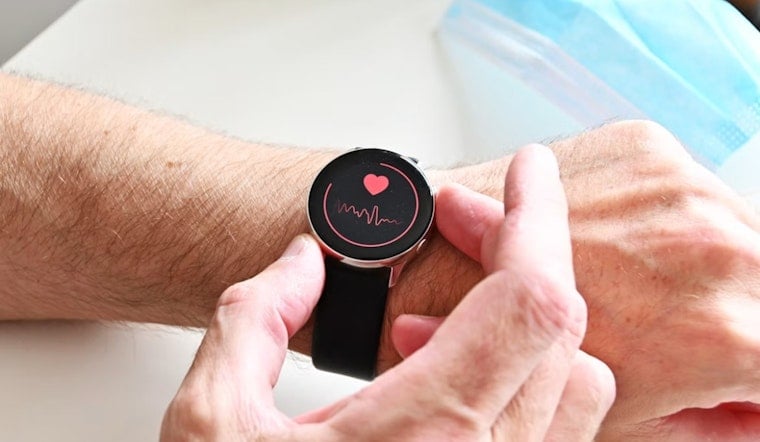
Raul Martin was working out at his gym when he noticed his heart racing in a way that didn't feel right. The 64-year-old Mountain View resident glanced at his smartwatch and saw a heart rate of about 200 beats per minute — far outside anything he'd experienced during his usual routine of walking three to five miles a day and doing resistance training. He called over a security guard for help, and the guard called EMTs.
Martin was taken to El Camino Health in Mountain View, where doctors discovered he had severe coronary artery disease. It's the kind of blockage that can build silently for years — the American Heart Association notes that roughly 20% of heart attacks and ischemic heart disease episodes are silent, causing damage without the chest pain or other warning signs many people expect, and that physical exertion can increase oxygen demand on narrowed arteries enough to trigger sudden severe tachycardia. Martin's case fit that pattern: an active man with no prior chest pain, undone mid-workout by an arterial problem his watch caught before his body gave any other sign.
A Rare Robotic Fix for a Common Killer
Doctors offered Martin a robotic-assisted minimally invasive coronary bypass procedure rather than the traditional open-chest surgery most patients receive. Dr. Nels Carroll performed the operation at El Camino Health's Heart and Vascular Institute; he joined the health system with prior robotic cardiac surgery experience from Southern California and is one of only a few Bay Area surgeons offering the technique, according to El Camino Health. The hospital performed its first robotic-assisted coronary artery bypass graft using Intuitive Surgical's da Vinci platform this past spring, as reported by eWeek.
Coronary artery bypass grafting is the most common cardiac surgery performed worldwide, yet only about 1% of those procedures are done with robotic assistance, per The Robot Report. Adoption has been limited by high equipment costs and a steep learning curve for cardiothoracic surgeons, which helps explain why El Camino Health is one of relatively few facilities offering the technique at all. Traditional bypass surgery requires surgeons to divide the breastbone, and per El Camino Health, those patients typically remain hospitalized for five to seven days.
Home in Days, Walking the Halls the Next Morning
Martin's robotic procedure was performed through three or four small incisions between his ribs instead of a full sternotomy. He walked the hospital halls the day after his operation, covering an hour around the floor, and he returned home just a few days after surgery. Dr. Carroll said the minimally invasive approach causes less pain and enables faster recovery, and El Camino Health notes that robotic procedure patients can generally leave the hospital days sooner than traditional bypass patients.
Martin said he felt better after this surgery than after any previous procedure he'd had, and he has since returned to his usual routine. He said the operation put him on a trajectory toward lifelong cardiovascular health. Intuitive Surgical, which makes the da Vinci platform used in the operation, is headquartered in Sunnyvale — right next door to El Camino Health's Mountain View campus, according to research published on PubMed Central.
The Stakes Behind One Alert
The numbers behind Martin's diagnosis are sobering on a national scale. The Centers for Disease Control and Prevention reports that heart disease killed 919,032 people in the United States in 2023, with coronary artery disease alone responsible for more than 371,000 of those deaths, and CAD affects roughly 1 in 20 U.S. adults aged 20 and older. A 2024 clinical study of 1,000 robotic coronary bypass procedures found a surgical mortality rate of 0.6% and a conversion rate to open sternotomy of 3%, offering a benchmark for how the technique compares with traditional open-chest surgery.
El Camino Health's Heart and Vascular Institute holds a 3-Star Rating from the Society of Thoracic Surgeons, placing it in the highest quality tier nationwide — a distinction fewer than 10% of cardiac surgery programs across the country achieve. Consumer smartwatches, meanwhile, remain cleared by the FDA only as early warning tools rather than diagnostic devices, using optical sensors to flag abnormal pulse rates rather than confirm a diagnosis. In Martin's case, that early nudge was enough to get him to the right hospital before a silent blockage turned catastrophic.





