

























































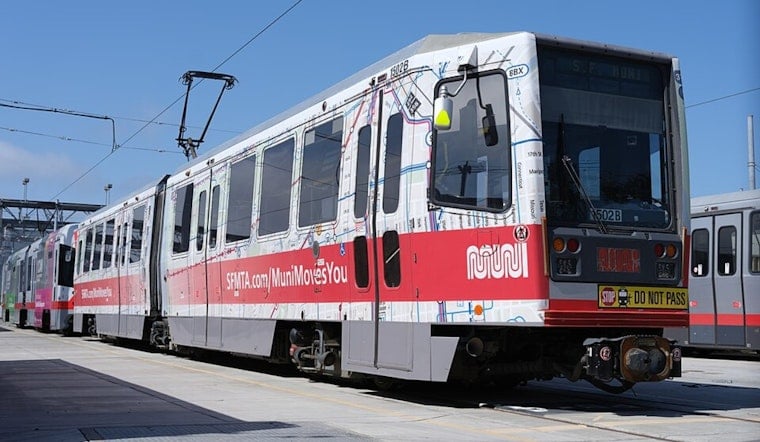
Skip the tap on a Muni bus or train in San Francisco these days, and you might be looking at a $134 citation. The San Francisco Municipal Transportation Agency is widening fare enforcement across the Muni system, hiring 20 additional fare inspectors and rolling out a public awareness campaign at stations around the city as officials try to close a staggering budget hole.
The push comes as SFMTA faces a structural deficit of $307 million for the 2026-27 fiscal year, according to ABC7 Bay Area. SFMTA Director of Transportation Julie Kirschbaum said the agency is still working to determine how many riders are not paying their fares, even as it currently has between 30 and 40 fare inspectors spread across the entire system. Fare inspectors board buses and trains to check for proof of payment, requesting identification from riders who can't show they paid and issuing citations — including scanning a driver's license when it's used as ID — to those who come up empty.
Kirschbaum also acknowledged a structural limitation that separates Muni from its regional counterpart: the agency lacks the capital funding to install higher fare gates like those BART has been rolling out. That gap matters — a GrowSF analysis published in February found that BART's $90 million systemwide “Next Generation” tall fare gate project, which replaced 20-year-old low turnstiles across 50 stations, has cut observed fare evasion from 22% to 10% and is generating an estimated $10 million in additional annual revenue. Without that kind of capital investment, Muni is left leaning on inspectors, cameras, and public messaging instead of physical barriers.
Riders Say They're Watching Fare Gates Get Bypassed
Light rail riders have reported seeing people bypassing fare gates altogether, and Muni rider Warren Lee suggested the agency install higher fare gates similar to BART's, per ABC7. SFMTA rider Whitney Urbiztondo said credit card payment makes paying fares more convenient, a small but telling detail in an agency-wide effort to reduce friction for people who do want to pay. The agency has also launched a public awareness campaign promoting fare payment at multiple stations, and in one advertisement it leaned on local baseball rivalry to encourage compliance.
The numbers suggest enforcement visibility genuinely moves the needle. KTVU reported in April 2025 that SFMTA recorded a 30% reduction in observed Muni fare evasion after nearly doubling its inspection shifts per hour compared with mid-2024, when evasion had climbed to nearly 21%. A related dataset covered by Transit Talent found revenue collected per boarding passenger rose 6% between February 2024 and February 2025, with SFMTA estimating that ramped-up enforcement could add up to $5 million in annual revenue.
Why Muni's Revenue Problem Runs Deeper Than Fare Dodgers
The fiscal pressure behind this enforcement push isn't new, and it's bigger than any single festival weekend or fare-jumper. An SPUR study covered by SFist found that Muni fare revenue fell 66%, from $283 million in 2015 to $97 million in 2024, driving a 53% drop in per-passenger fare collection even as ridership rebounded to more than 70% of pre-pandemic levels. SPUR attributed part of that widening gap to expanded free and discounted rider programs alongside uncollected fares. Muni already provides free rides for all youth, and Clipper START offers eligible low-income households a 50% discount on Muni and regional partner systems.
State lawmakers have added their own pressure. California's 2023 transit bailout package required both SFMTA and BART to submit formal plans to study and reduce fare evasion as a condition of receiving state operating subsidies, tying emergency funds to demonstrated fiscal accountability, the same SFist report noted. SFMTA has since made policy changes to shore up its finances beyond citations alone: the SF Standard reported the agency approved a multi-year budget plan eliminating the 15-cent Clipper card discount, standardizing digital and cash fares at $3 and raising single cable car fares.
Equity Safeguards Built Into the Crackdown
The enforcement expansion comes with built-in exceptions designed to avoid penalizing low-income riders. Per a December 2024 SF Standard report, SFMTA waives its $130 to $134 administrative fine for most first-time offenders who enroll in income-based discount programs like Lifeline or Clipper START, with inspectors distributing multilingual flyers about those programs during field checks. In May, SFMTA launched its broader “Fares for Our Future” initiative, setting the standard citation at $134 and requiring 6,000 agency employees to actively tap their own Clipper cards to model visible payment compliance as part of 100-day and six-month action plans meant to rebuild public trust.
The timing of this latest enforcement push follows the Outside Lands festival weekend in Golden Gate Park, where Mayor Daniel Lurie said about 75,000 people attended each day and reported no major disruptions throughout the weekend. SFMTA allowed festival ticket and wristband holders to ride public transit for free and deployed extra field inspectors during the event, while also announcing street closures and geofenced areas limiting where ride-hailing services could operate beforehand. Muni recorded 1.3 million passenger trips over the festival weekend, a sizeable increase SFMTA attributed to the event, with ridership up 7% compared with an average summer weekend. The 5-Fulton, 5R-Fulton Rapid, and N-Judah lines alone carried roughly 160,400 trips between Friday and Sunday, a 13% increase over the previous year, and SFMTA spokesperson Erica Kato said the agency will conduct an in-depth analysis of the weekend's transportation successes and challenges.
Fare enforcement has been an uneven story in San Francisco before. Hoodline's 2017 analysis of citation patterns found enforcement was heavily concentrated near SFMTA headquarters rather than spread across outer neighborhoods, a contrast to the systemwide push now underway. SFMTA has also been investing in automated enforcement technology elsewhere in its operations — the agency approved $15.6 million last November to upgrade automated camera ticketing on Muni buses with license plate readers and GPS, aiming to boost transit lane enforcement citations by 500%.
Notably, Muni issued nearly twice as many fare citations in July 2025 as it did in July, according to ABC7's reporting, an unexplained shift that underscores how much enforcement intensity can vary month to month even as the agency scales up its inspector corps. With the structural deficit still looming over the 2026-27 fiscal year, SFMTA officials appear to be betting that a mix of higher fines, more inspectors, and public messaging can narrow the gap that physical infrastructure alone can't close without the kind of capital funding BART has already spent on its own gates.





