

























































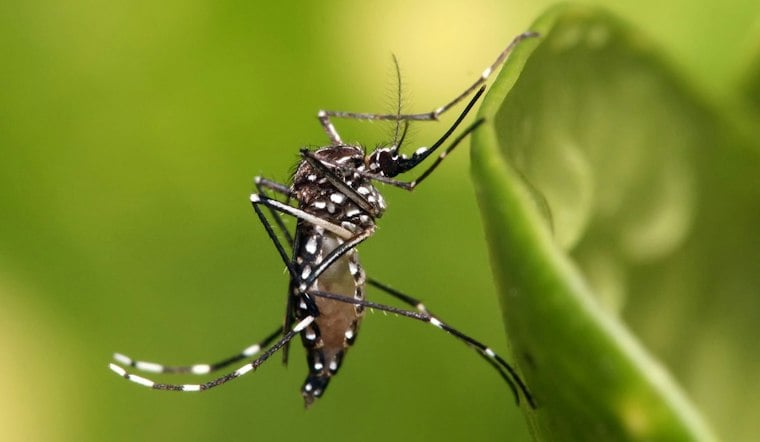
An invasive mosquito species capable of spreading dengue, Zika and other diseases has turned up in the White Oaks neighborhood of San Carlos, the third such detection in San Mateo County in under three months. The Aedes aegypti mosquito — a small, black-and-white insect measuring about one-quarter inch that bites aggressively during the day — is not native to California but has become established in many counties across the state and elsewhere in the United States.
The San Mateo County Mosquito and Vector Control District says the risk of disease spreading from the find is very low, according to the San Mateo Daily Journal. District staff plan door-to-door property visits in the area to search for standing water where mosquitoes can breed, and they will also set extra traps to track down more Aedes aegypti, per the same report. Officials are checking properties nearby to determine just how far the population may have spread.
This is not an isolated incident. Earlier this year, the district recorded detections in the Friendly Acres neighborhood of Redwood City on July 27 and in unincorporated North Fair Oaks on September 10, according to the San Mateo County Mosquito and Vector Control District. Vector control officials noted that San Carlos represents the third localized neighborhood finding in under three months, underscoring a steady geographic creep of the species through the county this year.
A Species That Breeds in a Bottle Cap
Aedes aegypti mosquitoes lay their eggs in small outdoor containers, including saucers under potted plants, bird baths, fountains, toys, old tires, yard drains, and small puddles that collect in outdoor containers. A female of the species lays roughly 100 eggs per batch and needs as little as a bottle cap's worth of stagnant water to complete her breeding cycle, according to Bay Pest Solution Inc. Unlike native marshland mosquitoes, this species breeds almost exclusively in artificial residential containers, which is why vector control crews cannot eradicate a population without residents granting yard access and dumping out standing water themselves.
The district assigns certified field technicians to specific geographic zones to make those property checks happen. Devon MacDonald is designated as the primary technician covering Belmont, Redwood Shores and San Carlos, per the district's staff listings.
How the Mosquito Got Here in the First Place
San Mateo County has dealt with this invader before. The district says Aedes aegypti was found in Menlo Park from 2013 to 2015, and KQED describes eradication efforts. Genetic research by Yale University in 2014 traced those original Menlo Park mosquitoes to air or rail commercial transport from the southeastern United States, rather than migration across the U.S.–Mexico border, as reported by Yale News. The findings suggest officials should also look at air and rail transportation from other regions.
To catch new arrivals early, the district deploys water-filled ovicup traps lined with seed germination paper at high-risk introduction points such as cemeteries and plant nurseries, then confirms species identity from harvested eggs using an in-house quantitative PCR DNA barcode test, per the district's surveillance program.
Aedes aegypti in California
The species was first documented in Central and Northern California back in 2013.
How the Work Gets Paid For
San Mateo County property owners help fund the district through property taxes and benefit assessments, according to the Palo Alto Daily Post. District programs and services are provided to all San Mateo County residents at no additional charge.
Residents who want more information, or who want to report standing water or a suspected mosquito, can reach the San Mateo County Mosquito and Vector Control District at 650-344-8592 or through smcmvcd.org. With visits planned in White Oaks, officials are counting on residents to clear out saucers, drains, and puddles on their own properties.





