

























































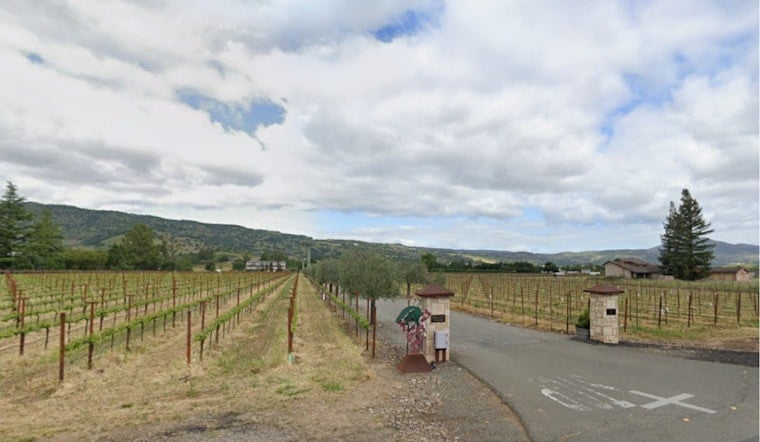
Napa County supervisors have pushed a contentious appeal over Hagafen Cellars until November 3, giving a neighbor and the pioneering Silverado Trail winery more time to hash out a private deal over visitor caps, traffic and a proposed screen of relocated olive trees. The winery, authorized for 7,825 annual wine tasting guests under its use permit, was found by a county report to have hosted as many as 9,719 guests a year, and the fight over how to fix that overage has become a test case for Napa's long-running effort to legalize decades of unpermitted winery operations.
The board of supervisors considered the appeal on Tuesday, according to The Napa Valley Register, before continuing the matter to give neighbor Ariane Matschullat and Weathervane Ranch time to negotiate directly with the winery rather than fight it out at a public hearing. Hagafen Cellars, founded in 1979 by Ernie and Irit Weir as California's first fully dedicated kosher winery, moved to its 12-acre Silverado Trail site northeast of Napa in 1986, according to Wikipedia, and its wines have reportedly been served at White House state dinners since 1981.
What the Appeal Actually Argues
Matschullat and Weathervane Ranch appealed after the Napa County Planning Commission legalized Hagafen's violations following hearings on March 18 and April 1, and after the county issued a CEQA exemption for the fix. The appeal argues the county should not reward longstanding noncompliance with additional entitlements, and it claims the winery committed repeated blatant violations that produced more traffic than the use permit anticipated. It also contends the increased winery use affects traffic, noise and neighborhood conditions, and that the underlying project increases visitation, operational days and the overall intensity of use.
A central technical dispute in the appeal is over what baseline the county should use to measure environmental impact. The appeal challenges Napa County's use of Hagafen's already-elevated violation levels as the CEQA environmental baseline, instead requesting that the winery's original use-permit entitlements serve as that baseline. Community critics have separately argued that treating unpermitted operational levels as the baseline effectively lets illegal activity escape environmental review, a concern raised in Soda Canyon Road forum discussions of the county's compliance process.
In its written response, the county said the CEQA baseline must reflect actual physical conditions when environmental analysis begins, and it maintained that appellants provided no evidence that traffic actually poses a problem. The county has acknowledged unauthorized visitation at Hagafen continued since at least 2018.
Olive Trees and a Path Back to Compliance
Matschullat and Weathervane Ranch presented negotiated conditions of approval that would require Hagafen Cellars to create a screen of relocated olive trees planted 15 feet apart, with the winery committing to promptly replace any that are dead, dying, damaged or missing. Supervisor Belia Ramos objected to how the county would enforce that olive-tree provision, though the specifics of her concern were not detailed further in the county record covered by the Register.
Under the appeal, Hagafen would have been required to halt illegal visitation and cap annual visitors at 7,825 while it works toward compliance. Non-participating wineries with significant violations elsewhere in the county must generally operate within their entitled limits for a full year before seeking any changes, though participating wineries have been allowed to continue certain violations unrelated to health or safety while awaiting a hearing. If Hagafen and its neighbors fail to reach a private agreement, the appeal will proceed to a full hearing when supervisors reconvene in November.
A Program Built for This Exact Fight
Hagafen Cellars is effectively the slow-motion finale of Napa County's Voluntary Code Compliance Program, approved by supervisors in December 2018 to let noncompliant wineries and other businesses apply by March 29, 2019, to legalize unauthorized operations rather than face immediate punitive enforcement, according to a county grand jury response. Forty-seven businesses applied, including Hagafen; 38 completed the review process while nine applications were abandoned or left pending. The county has said it treated Hagafen the same as the other 37 compliance-program participants that completed the process over the past seven years, and noted the program never guaranteed that violations would ultimately be legalized — Hagafen could still seek use-permit changes only after demonstrating sustained compliance.
The county has legalized violations in virtually every completed compliance-program case, and Hagafen's overage fits a pattern seen elsewhere in the valley. Castello di Amorosa reported hosting 427,000 tasting guests in 2019 against an approved cap of just 25,000, while Diamond Creek Vineyards hosted 2,444 annual visitors against a permitted limit of 520, according to a 2021 Napa County Planning Commission agenda letter. In February, the county approved a similar use-permit modification for Hourglass Winery under the same compliance program following its destruction in the 2020 Glass Fire, authorizing up to 10,270 annual tasting and marketing guests — a case Hoodline previously covered.
Water Audit California Watches From the Sidelines
Environmental group Water Audit California submitted a letter for the Hagafen appeal hearing, adding the case to a wider legal campaign the group has waged across the valley. Water Audit sued Napa County in Superior Court in June 2021, claiming the county violates the Public Trust Doctrine by approving winery expansions without measuring cumulative groundwater depletion on streams like Soda Creek. In the Hagafen matter, the group claims the county is not meeting its public trust responsibility regarding well pumping and Soda Creek specifically, while the county maintains it is satisfying those requirements; that broader dispute remains pending in Napa County Superior Court.
The group has used similar leverage to extract concessions elsewhere. In July, Water Audit California reached a groundwater monitoring agreement with Castello di Amorosa over Nash Creek, following a May settlement with Arrow & Branch Winery that added well-data reporting rules and a $25,000 payment. Water Audit has also filed a lawsuit against Jackson Family Investments’ Inn at the Abbey resort project and contested approvals for Bonny’s Vineyard winery in Oakville, part of what it treats as a systematic effort to preserve an administrative record for litigation. Napa County's Groundwater Sustainability Plan, adopted in 2022, cut allowed extraction for new valley-floor wells to 0.3 acre-feet per acre from a historic 1.0 acre-foot standard, though pre-existing wells remain unconstrained by the lower cap.
The county's handling of Hagafen also stands in contrast with its more aggressive posture toward wineries that skipped the amnesty program entirely. Napa County won a $3.96 million post-trial judgment and injunction against Hoopes Vineyard over unauthorized wine tastings, a ruling the Pacific Legal Foundation challenged in February as unconstitutionally excessive. Critics say that gap — between wineries that enrolled in the 2018 compliance program and those prosecuted in court — has fueled the sense of unfairness driving appeals like Hagafen's.
For now, the outcome hinges on whether Matschullat and Hagafen can settle privately before November 3. If they can't, supervisors will have to weigh the winery's decades of Napa Valley history against a neighbor's insistence that repeated violations shouldn't be rewarded with more room to grow.





