

























































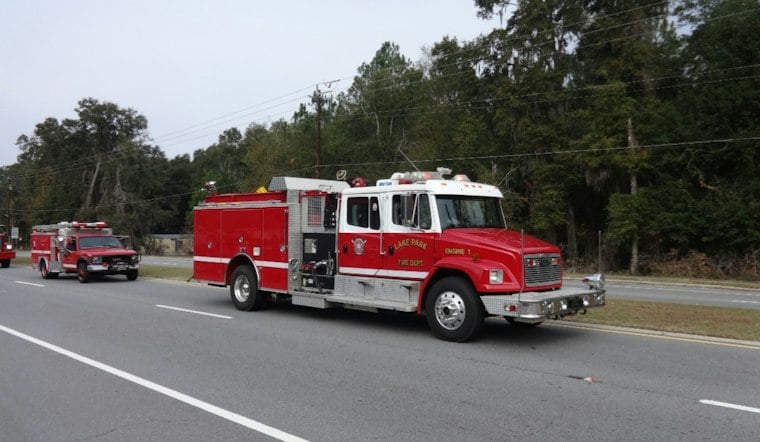
Fire agencies and water companies gathered on the banks of Clear Lake near Clearlake Oaks on August 27 to test a new tool meant to keep water flowing when the next wildfire knocks out the county's regular hydrants: portable fire hydrants that pump directly from the lake itself. It is a workaround born of necessity in a county where roughly two-thirds of the land has burned in the last 15 years, and where state lawmakers have repeatedly left rural water systems out of new wildfire safety mandates.
The demonstration came two weeks before the Lucas Fire sparked on September 10 in Mendocino and Lake counties, according to The Napa Valley Register. The 4,128-acre Lucas Fire was sparked by lightning. As the fire spread, Lake County water official Shannon Banks called local water companies to help set up new hydrants, and the county deployed two portable units at Keeling Park that pump water straight from Clear Lake.
A Gap State Law Doesn't Fill
A Gap State Law Doesn't Fill The push for independent water sources reflects a structural problem that California's proposed wildfire legislation does not solve for places like Lake County. Senate Bill 1153, authored by state Sen. Anna Caballero, would shield public water agencies from a legal duty to build or maintain infrastructure for wildfire suppression, and establish that water pressure loss during a wildfire does not count as a substantial cause of property damage under inverse condemnation law, according to the Los Angeles Times. Hoodline detailed the bill's passage in its earlier report on the proposed legal shield for California water agencies facing dry-hydrant lawsuits.
If signed, the bill would require urban retail water suppliers serving 3,300 or more residents in high or very high fire hazard zones to build incident-specific wildfire response procedures into their emergency plans starting January 1, 2028, per LegiScan. That threshold specifically excludes smaller rural water agencies like those serving Lake County. The Napa Valley Register's report notes that the bill Caballero introduced requiring larger urban suppliers to add wildfire procedures to their disaster plans was still awaiting Governor Gavin Newsom's signature, and does not cover smaller rural agencies such as Lake County's.
State Assemblymember Steve Bennett secured a law requiring water providers in fire-prone parts of Ventura County to maintain 24 hours of backup power or water. But Bennett failed to secure a broader statewide requirement for detailed fire-preparedness reporting from water suppliers, according to the same report.
Lessons From the Eaton Fire
The stakes of water system failure during a firestorm were laid bare during the January 2025 wildfires in Los Angeles County. Fire chief Willie Sapeta led a strike team deployed to Altadena during the Eaton Fire, which killed 19 people and caused firefighter injuries and widespread neighborhood destruction, per the Register's reporting. With hydrants overwhelmed, Sapeta's crews used swimming pools as water sources, and getting a domestic water delivery to the fire line took about 45 minutes to an hour by water tender.
The Eaton Fire ultimately burned 14,000 acres and destroyed 9,413 structures, according to data from the FEMA Geospatial Resource Center, making it the second most destructive wildfire in California history. During the same round of fires, the 117-million-gallon Santa Ynez Reservoir sat empty and offline for repairs during the Palisades Fire, leaving higher-elevation hydrants without adequate pressure as neighborhoods burned, the Los Angeles Times reported. A state report found in November 2025 that Los Angeles water supplies overall were robust, even as individual failures like the reservoir shutdown drew scrutiny, the Register noted.
No Statewide Rulebook for Firestorms
Local water systems across California are generally designed for ordinary house-fire response, not for firestorm conditions that overwhelm entire neighborhoods at once, and state agencies have not issued specific recommendations or guidance beyond basic measures, per the Register's account. UCLA researcher Gregory Pierce said there are no rules, guidelines, or best practices that clearly delineate responsibility for wildfire water readiness.
San Francisco maintains a separate emergency firefighting system. The San Francisco Public Utilities Commission describes a high-pressure network with two pump stations, two storage tanks, one reservoir, and roughly 135 miles of dedicated pipe, as well as Bay-water suction connections and fireboats, kept entirely separate from the city's drinking water. A proposed $535 million 2026 Earthquake Safety and Emergency Response bond would put $130 million toward expanding that system into the city's outer western neighborhoods, according to SPUR.
Clear Lake as a Backup Plan
Without that kind of dedicated infrastructure or state funding, Lake County has had to build its own patchwork solution. Fires in the county destroyed roughly 3,200 homes and buildings between 2012 and 2024, according to the Register's reporting, a toll that pushed local water companies to meet more frequently with firefighters and plan to keep storage tanks filled and staff on call during red-flag warning days. A coalition in the county has also worked to build connections between separate water systems that otherwise operate independently of one another.
Crews tested portable hydrants on the shore of Clear Lake.
Lake County's wildfire history offers little room for doubt on that point: roughly two-thirds of the county's land has burned in the past 15 years. With state mandates still written around larger cities, portable hydrants drawing from the lake offer one backup option.





