

























































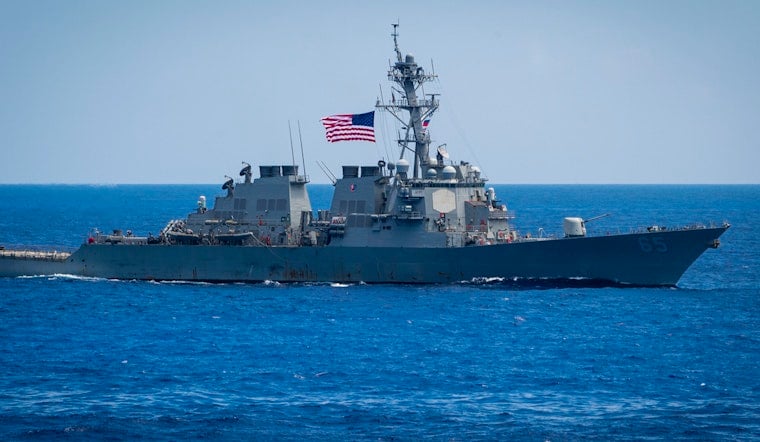
About 300 sailors aboard the USS Benfold spent four days without power, running water or working toilets after the Arleigh Burke-class destroyer suffered a major breakdown in the South China Sea in late July. The disabled warship needed help from the nearby USS George Washington carrier strike group before it could be towed to Subic Bay in the Philippines.
The engineering casualty struck the ship’s generators on July 24, 2026, cutting power across the destroyer, according to ClickOnDetroit, which cited reporting from Military.com correspondent Konstantin Toropin. USNI News first reported the incident publicly the following Friday, per the same account. With air conditioning and ventilation knocked out, the crew endured daytime temperatures that ranged between 89 and 98 degrees Fahrenheit in the South China Sea during that stretch, according to Task & Purpose, which noted that naval veterans believe crew members likely had to sleep on open decks or keep hatches open just to make conditions survivable below deck.
A Carrier Strike Group Steps In
With the Benfold dead in the water, the nearby USS George Washington carrier strike group was called on for assistance, and the USS Robert Smalls delivered meals to the stranded crew, the destroyer's report notes. No injuries were reported among the roughly 300 sailors aboard, but they went without meals, drinking water and functioning toilets for the duration of the outage. The loss of power also temporarily pulled a 90-cell Aegis combat platform out of frontline operations in contested waters, and nearby surface and air assets had to establish a protective escort so the ship would not be left vulnerable, according to CBS News.
Towed to the Philippines for Repairs
The Benfold arrived under tow at Subic Bay on July 28. Crew members were moved into contracted shore lodging the next day, ship power was re-established on July 30, and full system repairs wrapped up by August 7, according to a timeline reported by Sandhills Express/ABC Audio. The destroyer left port on August 8 with engineering, combat and crew support systems functioning normally. Japan-based Navy repair specialists met the ship at Subic Bay to carry out the electrical fixes, part of a broader shift toward relying on regional Asian shipyards for maintenance work that began after U.S. defense leadership expanded repair partnerships with South Korean and other Asian facilities in late 2025, as noted by The Diplomat.
Commissioned in March 1996, the Benfold is a 30-year-old Flight I Arleigh Burke-class destroyer built by Ingalls Shipbuilding, carrying gas turbine propulsion, 90 vertical launch missile cells and three electrical generators rated at 2.5 megawatts each, according to NavSource Naval History. Flight I ships are the oldest Arleigh Burke variants still forward-deployed in the Pacific with the 7th Fleet out of Yokosuka, Japan. In June 2022, the ship had been conducting routine underway operations in the Philippine Sea.
Not an Isolated Breakdown
The Benfold's outage came less than three months after another forward-deployed Arleigh Burke-class destroyer, the USS Higgins, suffered its own onboard electrical failure in the Indo-Pacific on April 28, briefly knocking out power and propulsion before the crew restored it, according to Military Times. Taken together, the two incidents point to a repeating pattern of electrical failures on Pacific surface warships rather than a one-off mechanical fluke.
The breakdown also arrived amid broader strain on the destroyer fleet's readiness. A December 2025 Congressional Budget Office analysis projected that Arleigh Burke-class destroyers will spend an average of nine years — more than a quarter of their planned service lives — out of the fleet undergoing maintenance, because overhauls regularly run 20% to 100% longer than scheduled. A January 2025 Government Accountability Office report found the Navy had failed to implement 46 recommendations issued between 2020 and 2024 aimed at improving surface ship maintenance tracking, crewing levels and material readiness. In April 2026 congressional testimony, GAO leadership told lawmakers that major U.S. surface shipbuilding and modernization programs are collectively billions of dollars over budget and years behind schedule, a gap oversight officials attributed to trade workforce shortages and design changes across Navy shipbuilding lines.
A Broader Push in the Pacific
The Benfold's ordeal unfolded as the Trump administration pursued an aggressive operational posture toward China, which it views as a force requiring deterrence to prevent it from dominating the U.S. or its allies, per the destroyer's report. The USS George Washington was expected to replace the USS Abraham Lincoln in the region, and George Washington strike group ships were headed toward the Middle East even as the Benfold sat disabled — raising the prospect that Pacific waters could see a period without a U.S. carrier presence. The Abraham Lincoln itself had spent 250 uninterrupted days at sea and reportedly experienced shortages of food and hygiene products, along with crew stress and poor mental health, prompting Democratic lawmakers to call for investigations into conditions aboard that carrier. Acting Navy Secretary Hung Cao said the Abraham Lincoln would be returning home soon, according to the same report.
Just five days before the Benfold's breakdown became public, President Trump issued a presidential memorandum on August 13 directing federal agencies to overhaul naval shipbuilding and repair infrastructure, citing severe order backlogs across six major Navy programs and a degraded commercial repair sector, according to a White House announcement. The directive encourages expanded competition and near-term foreign supplier contracts to relieve domestic shipyard repair backlogs — the same kind of outsourcing that ultimately got the Benfold back underway at Subic Bay.
The incident is the latest in a string of Hoodline reports on stalled destroyer overhauls and fleet strain, following coverage of sailors reuniting after long deployments and a Navy collision investigation in the Caribbean. Each points to the same underlying tension: an aging surface fleet stretched thin by maintenance backlogs even as operational demands across the Indo-Pacific and Middle East keep climbing.





_in_formation_during_Malabar_2018_180615-N-ZL062-0088.jpg)